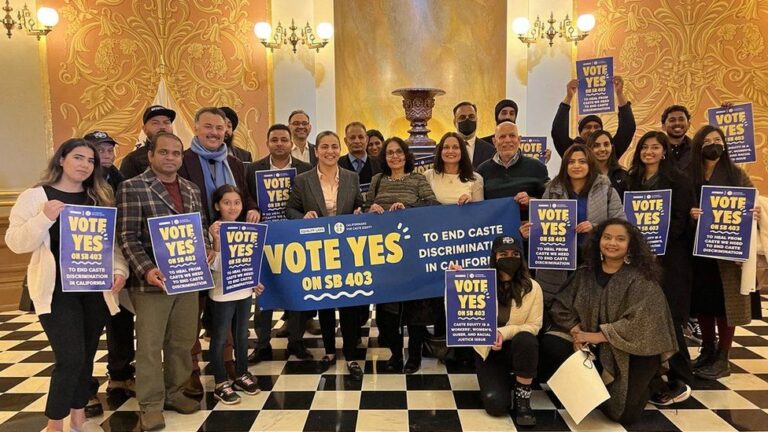
The California State Senate on Thursday cleared a bill to outlaw discrimination based on caste in the State. The bill passed with a 34-1 vote and will now go to the State Assembly for consideration.If it passes in the State Assembly and is enacted, California could become the first state in the the United States to outlaw caste discrimination by adding oppressed castes as a protected category in the state’s anti-discrimination laws.Earlier in February, the Seattle city council added caste to its anti-discrimination laws with a vote of 6-1, becoming the first US city and the first jurisdiction outside South Asia to ban caste discrimination. Several colleges and universities have also enacted similar policies barring caste discrimination on campuses, including University of California, Davis. Two weeks ago, striking students and workers in Rutgers University, New York, demanded that caste-based discrimination be banned on campus.
According to a report by Equality Labs from 2018, caste discrimination is rampant in the United States. 25% Dalits surveyed faced verbal or physical assault based on their caste, 60% Dalits faced derogatory caste-based jokes, 40% Dalits and 14% Shudras were made to feel unwelcome in places of worship, and 20% Dalits felt discriminated against at a place of business. Carnegie Endowment for International Peace found that 5% of Americans face caste-based discrimination, with high discrimination in areas with a large South Asian population.
State Senator Aisha Wahab, the first Muslim and Afghan American elected to the legislature, introduced the bill in March. On April 25, hundreds on both sides of the issue came to voice their opinions during a Senate Judiciary hearing on the matter. Proponents said that caste discrimination is a reality in California and that clarifying the state’s anti-discrimination laws will help protect caste-oppressed communities. Opponents maintained that the law will single out Hindus and people of Indian descent.Only Sen. Brian Jones voted against the legislation saying that he had heard concerns from numerous constituents and agrees with them that the legislation unfairly targets a specific group. He contended that caste bias is already covered under existing anti-discrimination laws.In April, the California Civil Rights Department voluntarily dismissed its case alleging caste discrimination against two Cisco engineers, Sundar Iyer and Ramana Kompella, while still keeping alive its litigation against the Silicon Valley tech giant. The case of caste discrimination goes back to 2016 when the complainant had reported Iyer to Human resources in November 2016 for outing him as a Dalit to colleagues. Iyer allegedly retaliated, but Cisco determined caste discrimination was not illegal and issues continued through 2018, the lawsuit states. Cisco reassigned and isolated the employee, rejected a raise and opportunities that would have led to one, and denied two promotions, according to the lawsuit.Thenmozhi Soundararajan, founder and executive director of Equality Labs, told Associated Press that the dismissal of the case against Iyer and Kompella does not change anything as the case “has given so many Dalits the courage to come forward with their stories about caste discrimination in education, the medical and tech industries”. She further added that “This is not a loss, but progress. The Dalit community owes [the engineer] and the Civil Rights Department gratitude for having the courage to bring such a historic case forward.”Read Also: California: Cisco sued over job discrimination based on caste of an Indian EmployeeSimilarly, Seattle Councilmember Kshama Sawant, in reference to the California bill, told the Indian Expressthat the fight does not end here. “We will be looking at going all the way to the US Congress for a similar Bill at the Federal level,” she stated.Source: Associated Press
Pakistan Tehreek-e-Insaf (PTI) Secretary General Asad Umar wasarrestedon Wednesday from Islamabad High Court premises by the Anti-Terrorist Squad of the Islamabad police. This came a day after PTI Chairman and former Prime Minister Imran Khan was arrested by Rangers outside the Islamabad High Court.
Umar was at the Bar Association Office with PTI leaders such as PTI Vice Chairman Shah Mahmood Qureshi, Senator Saifullah Sarwar Khan Nyazee and Ghulam Sarwar Khanalong to prepare to file a plea for a meeting with Khan.
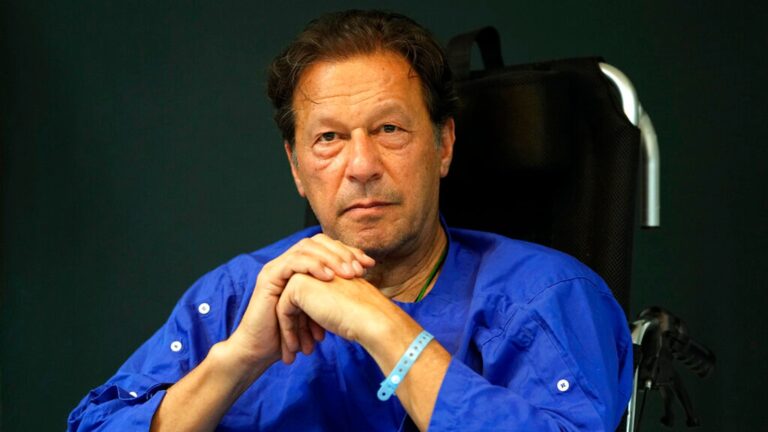
Khan was arrested in connection with the Al-Qadir Trust Case, in which the Al-Qadir Trust run by Khan and his wife Bushra Bibi received Rs. 5 billion and hundreds of kanals of land from real estate firm Bahria Town as a “donation”. It was allegedthat the money was sent in return for legalising a laundered amount of Rs. 50 billion and that the settlement between the two caused a loss of 190 million pounds to the national exchequer. Following Khan’s removal from power in last April, hundreds of cases have been filed against him, including charges of corruption and terrorism. Just hours before Khan’s arrest on Tuesday, an anti-terrorism court in Pakistan had approved his interim bail pleas in multiple cases.Noting, among other things, that Khan’s arrest warrants were issued by the National Accountability Bureau (NAB) and that the investigating officer from NAB was present during the arrest, the Islamabad High Court on Tuesday night declared Khan’s arrest as legal. The court also issued show-cause notices to the interior secretary and Islamabad IG, and directed the court registrar to get an FIR registered over the circumstances of Imran’s arrest. Khan is likely to remain in NAB custody for 4-5 days.During the court hearing for the same, Barrister Gohar Khan alleged that the former PM was “tortured” by the rangers and hit on the head and injured leg, and his wheelchair was tossed aside. Barrister Safdar added that the lawyers who came to assist him were also beaten up.
Following his arrest, PTI gave an immediate call for staging protests in the country. Largescale protests broke out in several cities such as Quetta, Karachi, Gilgit, Peshawar, Rawalpindi and Lahore. PTI workers stormed the Corps Commanders’ residence in Lahore and the Pakistan Army headquarters in Rawalpindi. The protestors smashed into both establishments by breaking the front gates, and destroyed property such as furniture. The Corps Commanders’ residence was later set on fire and a canon was taken.
People also took down army monuments and statues and many raised slogans against the army. This is the first time that Pakistan has seen a large-scale popular struggle against the military.
This is a mile away from my home, people in Sargodha contentment broke down the army honours they used to look up with pride for decades. Pure chaos. Pure pain. The damage you idiots have done is unparalleled. pic.twitter.com/25G83cV4IV
The Pakistani diaspora also held protests in New York, London, Toronto, Washington DC, Dallas, Chicago, Manchester, Wales, and other regions.
Imran Khan protest goes global – A large number of Pakistanis are protesting Imran Khan’s arrest in front of Nawaz Sharif’s house in London. pic.twitter.com/34V68Ak46G
The police imposed Section 144 in Islamabad, Peshawar and Punjab and other big cities. In Peshawar, Section 144 has been imposed for thirty days and authorities have warned strict action in case of violation. Police fired tear gas against protestors in Islamabad, Reuters reports. Authorities report that 43 protesters were arrested in Islamabad and 23 PTI workers were arrested in Karachi. One protester was killed and six were injured. Six police officers were also injured in Quetta. The PTI twitter handle accused the police of abducting Ali Haider Zaidi, PTI President of the Sindh chapter. Social media sites such as Twitter, Facebook and YouTube have been suspended in some parts of the country. Mobile internet services have also been suspended in major cities. All Pakistan Private Schools Federation announced that all private schools would remain closed on Wednesday.
Former Pakistan prime minister Imran Khan was arrested from outside the Islamabad High Court by Rangers on Tuesday, Pakistan media reported. Khan, the chairman of the Pakistan Tehreek-e-Insaf (PTI), was taken into custody from a court premises in Islamabad in a corruption case, the reports indicated.
“Imran Khan’s car has been surrounded,” Khan’s aide Fawad Chaudhry said without confirming his arrest. Information minister Marriyum Aurangzeb did not immediately respond to news agency Reuters request seeking confirmation of the report.
Another PTI leader Azhar Mashwani alleged that 70-year-old Khan had been “abducted” from inside the court by the Rangers. He said that the party had given an immediate call for staging protests in the country.
“They are torturing Imran Khan right now […] they are beating Khan sahib. They have done something with Khan sahib,” Cheema said in a video message posted on the party’s Twitter handle.
Khan’s arrest comes a day after the Pakistan Army slammed the former PM for “highly irresponsible and baseless” allegations by him against a serving ISI officer without any evidence as a fresh war of words broke out between the powerful military and the former prime minister.
In a strongly worded statement, the Inter-Services Public Relations (ISPR) – the media wing of the military- also said that Khan’s “fabricated and malicious allegations are extremely unfortunate, deplorable and unacceptable”.
“This has been a consistent pattern for last one year wherein military and intelligence agencies officials are targeted with insinuations and sensational propaganda for the furtherance of political objectives,” it said.
The statement came two days after the 70-year-old former cricketer-turned-politician at a rally on Saturday accused spy agency ISI Gen Faisal Naseer of orchestrating plans to murder him.
Earlier, Prime Minister Shehbaz Sharif took the PTI chief to task for “maligning and threatening” the army and intelligence agencies.
(With inputs from agencies)
It is an absolute tragedy that the Kukis and the Meeteis in Manipur have clashed and killed each other in the the early part of May 2023. This is now followed-up by what was a prelude to the crisis in terms of political articulations, free for all statements, allegations and what not. Whereas the usual understanding of such crises is in terms of explaining the process and the outcome of what has just happened, I feel strongly that such an approach would be very inappropriate to understand and explain the present crisis – we need to have an idea of the ethnicity building-ups at least during the previous few decades, the emergence of new shared feelings within each ethnicity, the qualitative as well as quantitative dynamics of demographic characteristics of each ethnicity, and the unfolding overall development dynamics of the economy and society.
I prefer to look from this larger and longer-term perspective to analyse what has just happened in Manipur instead of a common approach to bring in a recent order of the High Court of Manipur directing the provincial government to put recommendation for inclusion of the Meeteis in the Scheduled Tribes of India. While this directive and the demand for inclusion of the of the Meeteis have been there for some time, these would not be the ultimate flame for the recent clash.
So let us look at the potential causes. During the last two decades or so, a very healthy and positive social strength of the Kukis has become visible. Increasingly, we are witnessing robust youths – both boys and girls – among the Kukis becoming competent professionals ranging from plain academic to professional degrees. This has invariably enhanced the Social Aspirations of their community. This transformation must definitely have had a kind of behavioural implications for them. During the last thirty/forty years, the Kukis have been manifesting the preference to settle in a location in a rather permanent way and in a way different from their earlier social habits. In this, the fast decline in the coverage of the Protected Forest Areas of the governme nt must naturally have attracted their attention; while the geographic size remains the same, the trees (as huge as they are) in the Protected Forest areas have been the easy targets of the powers that be and the high-ranking officials. So when the Kukis express their preference for these areas for settlement, the moral ground for rejection is naturally weak.
This reality has been coupled by the establishment of military rule in the neighbouring country of Myanmar. There are signs that the Kukis on both sides of the country have been able to augment their interactions with potential encouragements from China. Since the borders are porous and significant political developments are happening across the border, it is imperative that India has a Myanmar Policy with the North East, particularly Manipur, in the background. But does India have a Myanmar Policy? NO.
With the different ethnic groupings constituting the society of Manipur, and with the inter- and intra-ethnic qualitative and quantitative dimensions undergoing changes, it is of utmost significance that there is a Demographic (Population) Policy keeping in mind the domestic as well as international political economic implications and also reflecting the socio-cultural dimensions. Does India (for that matter, Manipur) have one? NO.
Since there has been different property rights regimes in an otherwise small region like Manipur, it is imperative that a land policy is evolved to ultimately align the varied interests of the ethnicities. Does Manipur have a Land Policy? NO.
Because of history of association, the affiliation of the Kukis to the social sector structure of Manipur, both in terms of participation and alliance, is more robust than elsewhere.
In this more-ethnicity oriented social complex, there has recently emerged a more rigorous religious-oriented political arrangement.
These unfolding are happening in a context of Manipur where there has not emerged any long-term dynamics of development and for socio-political endeavors for shared development. This is a convenient atmosphere for various agents to maneuver for upmanship. During the last few months, groupings of the various ethnicities – the Kukis and the Meeteis – have been making fairly provocative statements reflecting rising intentions of engagements. This is the moment for the governance to come in and put in place the desired lines of action and compliance. While Government has been there, the Governance has not been visible.
Thus the twin absence of Policy and Governance have led to a crisis of inter-ethnic conflict in Manipur. But the inherited general strength of the population has been there for sharing and appreciation for ages across ethnicities, and it does possess elements for continuous sustainability.
Read also: Manipur Burns Over Question of ST Status For MeiteisProf. Amar Yumnam is a Fellow / Visiting Professor at the Centre for Economic and Social Studies (CESS). Views expressed here are personal.
Karnataka Elections are two days away and we can see already the level of discourse going down in the election speeches where instead of issues that affect daily lives of people the leaders are talking about Ram and Hanuman.
Even though BJP has not ruled the state for long, Karnataka has been battling the saffron onslaught for decades now. After BJP came to power again in 2018 by Operation Lotus, it has been vehemently and shamelessly pushing its communal agenda making the state a communal cauldron.
Over the last two years only, BJP government in Karnataka has managed to pass most anti people bills like anti cow slaughter bill and Anti conversion bill. These bills are used to harass the minority population and there have been several cases of Muslim and Christian places of worship being vandalised and prayer meets being disturbed across Karnataka.
Last one year the state was not in news for its IT sector but for Hijab politics. Throughout the year Muslim girls were harassed and made to remove hijab to attend classes and exams. Many girls quit studies altogether.
Economic boycott of Muslim traders and violence by sangh elements were very much visible throughout social media. All this while the state was reeling from post covid economic crisis like the rest of the country. It this was not enough the government was in news for one after another scam earning the nickname of 40% commission Sarkar.
Eddelu Karnataka
The events of last 4 years had shaken up the progressive sections of the society that has always believed in the secular syncretic traditions of Karnataka.
“Garden of peace for all races” as Karnataka was called by the many saints that have come from the states was being poisoned. Many could not believe what was happening in front of their eyes. MLAs who were bought and sold to form government. It is not chosen by the people.
What is Eddelu Karnataka?
Eddelu Karnataka or Wake up karnataka or Jaago Karnataka is a non-partisan civic campaign that was born with the bold decision to ensure that Karnataka does not fall prey to this evil plot once again.
Eddelu Karnataka is a joint platform of many individuals, organisations, civil society groups with a common aim to defeat BJP in this elections. The campaign is being led by many eminent intellectuals from the state like Purushottam Bilimale, Tara Rao, Du Sarawathi, Rahamat Tarikere, Devanur Mahadeva, G.N. Devy and AR Vasavi.
The idea of such a campaign came into being in January 2023 and by March 5th a consulting meeting was held in Bangalore which was attending by 150 organisations from 21 districts.
While intervening in the political arena as a civic forum, we have to be realistic as we, the common people, do not have many political options. Politics itself has sunk to an unprecedented low. From this, we have to find a solution based on reality. The main point is to prevent this extortionist government from regaining power. The party that gave the misrule should be defeated first. Then fight with the victors for the restoration of the people’s interests must continue – this is the only way to preserve democracy says Purushottam Bilimale.
Rejecting BJP is not enough. It is our responsibility to defeat them in such a way that they do not come to the market to buy MLAs again. Most of the people agree that this government which has brought untold suffering to the people should be removed. But who do we root for? People should vote for the candidate that can defeat BJP. If we are divided, only the party that splits us will benefit says Yogendra Yadav who has also backed the campaign.
The campaign has decided to not take financial aid from any political party and is not affiliated to any political party. We are also standing by the principles of not supporting any of the opposition parties per say but insisting that they agree to peoples major issues around and abide by them. This is a different experiment the fruits of which need to be properly assessed says Noor Sridhar.
Eddelu Karnataka has refined their demands to three principles of voting that everyone should follow:
No vote should be wasted. Everyone must vote without fail or excuse.
Vote should not be divided. Consultations and consensus should be built to iron out differences.
Vote only for the candidate who can defeat BJP. No point in voting for a candidate who is unlikely to win against BJP as such a vote will only help those whom we want to defeat.
Eddelu Karnataka’s sole aim is to deliver the message “Votes should not be wasted”, “Votes should not be divided”, “Vote for the candidate who can defeat the BJP”.
The campaign if successful would be a model for other states and for the participation of civil society to participate in voter awareness and demanding opposition candidates to do better and not only rely on anti incumbency wave.
As part of the campaign, the forum has been conducting a series of zonal, district and constituency level workshop for last one month conducting almost 110 workshops. The campaign also released a booklet exposing BJP’s misrule and 2 songs for the campaign.
As part of the campaign voter awareness, enrollment of voters was of prime importance. More than 1 lakh 58 thousand voters [1,10,000 Muslims and 48,000 Christians] were reenrolled, who were missing from the voters list.
Eddelu Karnataka also received support from Karnataka Rajya Raitha Sangha, State trade unions, Dalit Sangharsh Samiti, OBC federation, Muslim and Christian organisations and worked in coordination with the team.
Eddelu Karnataka (EK) campaign also managed to make some smaller parties and independent candidates who would act as vote splitters to sit out.
In response to Samyukt Kisan Morcha’s call for protests, farmers’ and workers’ organisations have joined the protesting wrestlers at Jantar Mantar or held separate protests in the border regions of the National Capital. Farmers from over three hundred Khap Panchayats and several farmers’ unions joined the wrestlers’ indefinite protests at Jantar Mantar over Sunday and Monday to demand the arrest of WFI chief and BJP MP Brij Bhushan Sharan Singh over several sexual harassment charges, including child sexual harassment charges. Farmers’ unions such as Bharatiya Kisan Union (BKU) and Samyukt Kisan Morcha (SKM) reached Jantar Mantar on Sunday and more unions such as BKU (Krantikari) joined the protest on Monday. They have come from across Punjab, Haryana, Rajasthan and Uttar Pradesh. It was announced that moving forward, Khap Panchayats will be joining the wrestlers’ at Jantar Mantar every day until the demands are met. The wrestlers have been protesting at Jantar Mantar for action to be taken against Singh since April 23. They have given the government till May 21 to arrest Singh and meet their demands.On Sunday, several farmers from BKU (Ekta Ugrahan), including the women’s contingent, were stopped by the police at Tikri border to prevent them from entering the National Capital and reaching the wrestlers’ protest. The Delhi Police deployed over 2000 personnel at Jantar Mantar and at the borders to prevent farmers from joining the protest. They did not allow any buses or tractor trolleys that held farmers to go through. Image Source: https://www.tribuneindia.com/news/haryana/tight-security-arrangements-at-tikri-border-505830Despite this, around 350 women farmers met with the protesting wrestlers to extend support. Farmers across organisations such as BKU and SKM reached Jantar Mantar in large numbers and filled up the area. The Delhi Police used heavy barricading to thin the crowd and subjected all the entering protestors to facial recognition technology and high surveillance through a mobile CCTV control room equipped with 13 HD cameras. Johinder Singh Ugraha, Rakesh Tikait, Darshan Pal, Baldev Singh Sirsa and other farmers’ leaders joined the wrestlers on the dais and spoke out against the BJP government’s complicity in the matter. They demanded that Singh be arrested immediately. Tikait told the crowd that this will be a long fight but they will not back down. He pointed out that once a case is registered under the The Protection of Children from Sexual Offences (POCSO) Act, 2012, the offender is to be arrested immediately. However, in the case of the wrestlers, no action has been taken yet. He further said that it is of great sadness that those who brought pride and international repute to the country are having to undergo such injustices. A roadmap is being prepared for the upcoming protests. Wrestling star Vinesh Phogat added that the committee investigation into this matter has made a joke out of very serious sexual harassment allegations. They also took out a candle march in the evening.
VIDEO | "The protest will continue till these kids (protesting wrestlers) get justice but how we take it forward, that will be decided by all of us today," says Chaudhary Surender Solanki, Khap president Palam, on mahapanchayat at Jantar Mantar today. pic.twitter.com/D4AurXXNP8
Other organisations showed support for the wrestlers by holding protests and rally’s in their respective localities. Jan Sangarsh Manch, Haryana, held a demonstration at the old bus stand Thanesar, Kurukshetra, to demand the immediate arrest of Singh. JSM leader Chandra Rekha addressed the crowd and stated that despite the case being registered under the POCSO Act, Singh has not even been removed from any positions of power, let alone arrested. Meanwhile, Singh has openly threatened and pressurised the seven women wrestlers who have registered complaints against him.
Student leader Kavita Vidrohi further pointed out that the Home Minister Amit Shah and Sports Minister Anurag Thakur have given complete political protection to Singh, who is a member of their party. She condemned the Delhi Police for cutting off electricity supply to the wrestlers sitting at the dharna, removing mobile toilets and preventing them from accessing beds in the rain, and demanded strict action against the police officers who harassed the wrestlers. The whole affair has exposed the Modi government does not actually care about women empowerment, despite the slogan – “Beti Bachao, Beti Padhao” (Save the Girl, Educate the Girl).
The protest was attended by many groups. Workers from MNREGA Mazdoor Union and Construction Work Mazdoor Mistry Union also participated in large numbers.Image Source: Jan Sangarsh Manch FacebookImage Source: Jan Sangarsh Manch FacebookRead also: SKM Announces Nationwide Agitation In Support Of Wrestlers’ Protest
On 30 April 2023, the results of the Paraguayan general elections were declared. Colorado party candidate Santiago Peña and his Vice Presidential candidate Pedro Alliana won the election beating Paraguayo Cubas and the Concertación candidate Efraín Alegre. Peña will take office later this year on 15 August 2023. He won with 43% of the vote. The conservative, right-wing Colorado party continues to rule Paraguay despite a stagnant economy and major allegations of corruption. The Colorado Party also won heavily in congressional and governor races, consolidating its power.
Who is Santiago Peña?
Santiago Peña is a Paraguayan economist. Peña was a member of the Board of Directors of the Central Bank of Paraguay. He started his career as a member of the opposition Authentic Radical Liberal Party from 1996 to 2016 before joining the Colorado Party. Peña has opposed the legalization of abortion and same-sex marriage and promised to create 500,000 jobs without raising any taxes.
Paraguay’s Situation
While the election results demonstrate the Colorado Party’s continued dominance, there has also been a strong shift towards outsider candidates in Latin America. Paraguayo Cubas, an outsider in the political arena, secured almost a quarter of the vote, coming in third place. This suggests that the people are frustrated with the mainstream parties.
The Colorado Party ruled Paraguay as the only legal party from 1947 to 1962. It has also controlled the presidency since 1948 almost exclusively, except for 2008 and 2013.
The opposition is the Authentic Radical Liberal Party (Partido Liberal Radical Auténtico, PLRA), a coalition of centre and left parties in Paraguay. Since 1989, the PLRA has been the primary opposition to the Colorado Party. However, the alliance fell apart after their only presidential candidate, Lugo, was impeached in 2012, and the PLRA has been in opposition since 2013. The Colorado Party and the PLRA are the two major establishment parties. The PLRA has been criticized for not having a clear political programme and is dominated by internal factionalism based on a network of locally powerful personalities.
Read Also:Brazil’s Lula De Silva Proposes BRICS Currency to Replace Dollar in Foreign Trade
The Last Time Paraguay Elected A Left Leader
The only time Paraguay had a left-wing President was from 2008-2012. Fernando Armindo Lugo Méndez was the only non-Colorado Party leader of Paraguay in the past 75 years. He was originally a Catholic bishop and served as President of Paraguay from 2008 to 2012. Before entering politics, Lugo was a Roman Catholic priest and bishop and served as Bishop of the Diocese of San Pedro from 1994 to 2005. His presidential election in 2008 ended 61 years of rule by the Colorado Party.
Lugo was known as “the bishop of the poor.” He entered the national political arena by supporting peasant claims for better land distribution. Despite his left-wing politics at home, he distanced himself from the other leftist leaders in Latin America. Lugo led a coalition of opposition parties and social movements in 2008 called the Patriotic Alliance for Change. As president, Lugo prioritized tackling corruption and encouraging land reform, implementing initiatives to improve the lives of Paraguay’s poor, such as low-income housing investments, free treatment in public hospitals, and cash transfers for impoverished citizens.
The legality of Lugo’s candidacy was questioned due to the Paraguayan Constitution’s prohibition of clerics holding elective office, and the then Pope Benedict XVI’s rejection of Lugo’s resignation from the priesthood. However, the Pope eventually removed Lugo from the clergy in July 2008.
Lugo was already impeached and removed from office by the Congress of Paraguay in June 2012. Lugo said that he was denied due process as he did not have enough time to prepare a defence. Several Latin American governments considered the impeachment as a coup d’état. Lugo himself formally accepted the impeachment but referred to it as a parliamentary coup.
The impeachment followed an incident on 15 June 2012 involving a police operation to evict landless farmers, which led to the death of six police officers and eleven farmers. Many countries criticized Lugo’s removal from office, comparing it to a coup d’état. Some countries, including Brazil, Argentina, Chile, Colombia, Peru, and Mexico, withdrew their ambassadors to Paraguay in response.
Following the impeachment of Lugo, the PLRA has had difficulty maintaining a clear and consistent platform. This is owing to the vast difference within the Paraguan Parliamentary left, which often can be centred around individuals.
A Tale Of Two Rights?
The Colorado Party secured victory in the recent election, but it was their weakest performance since 2003. This outcome reflects a growing trend of anti-establishment populism on the right in Paraguay, demonstrated by the strong showing of candidate Cubas. Paraguayans are increasingly frustrated with crime, corruption, and traditional politicians, creating opportunities for alternative political forces.
The left in Paraguay continues to struggle with establishing a cohesive platform to rally the people, contributing to its inability to capitalize on the current frustrations. As a result, Paraguay may lean towards the anti-establishment right in the coming years.
International media has framed the election around Paraguay’s stance on Taiwan and China, which will have significant implications for the nation’s trade future, economy, and international relations. President-elect Peña aims to maintain ties with Taiwan, while his opponent, Alegre, advocates for developing connections with China. The outcome of this election and the subsequent direction of Paraguay’s foreign policy will be instrumental in shaping the country’s future in a rapidly evolving global landscape.
If things continue like this, it is possible that Paraguay will go through a phase, where its political leadership will be stunt-driven reactionary right-wing politicians, as was seen in the USA, India, and Italy. There does not appear to be a strong cohesive left-wing presence in the country on the scale of Peru, Chile or Brazil. Most people see political leadership as corrupt but do not see any viable alternatives. In the one case, where they got a competent leftist leader, the political elite conspired to depose him making the traditional right-wing Colorado Party the best option for the time being.
Samyukt Kisan Morcha (SKM) on Saturday announced a nation-wide agitation program in support of the women wrestlers who are protesting against the BJP government’s inaction on the sexual harassment allegations against WFI President and BJP MP Brij Bhushan Saran Singh. The wrestlers have been on an indefinite protest at Delhi’s Jantar Mantar since 23rd April 2023. In light of the Supreme Court’s dismissal of their petition as well as harassment by the Delhi Police, the protesting wrestlers have formed two committees to decide further course of action.In their press release, Senior leaders of SKM from Punjab, Haryana, Delhi and Western Uttar Pradesh stated that hundreds of farmers will be visiting the protest site at Jantar Mantar on May 7 to extend support and solidarity to the wrestlers. Public meetings and protest marches will be held from May 11 to May 18 in all state capitals and in district and taluk headquarters. They plan to burn the effigy of Singh and his supporters during this agitation.Demanding the immediate arrest of Singh, SKM Leaders will also lead a deputation to important administrative and political persons such as the Commissioner of Police, Delhi, Union Sports Minister and Home Minister.The statement further condemned the Delhi Police’s inaction and insensitivity in dealing with the matter and ensuring in-camera proceedings. The Delhi Police has denied basic civil rights to the protesting sportspersons, such as cutting out access to water and electricity, denying access to bedding and subjecting them to harassment.Earlier last week on April 30, SKM held a National Meeting at Delhi where more than 200 farmers leaders of constituent organisations attended. During this meeting as well, SKM extended firm and unequivocal support to the protesting wrestlers and demanded that Singh be arrested immediately.Read also: SKM launches All Year Round Agitation Program of Farmers and Farmworkers
The State Bank Of India (SBI) sold electoral bonds worth Rs 970.50 crore between April 3 and April 12 in the 26th tranche of sales under the Electoral Bond Scheme, 2018. This is nearly nine times the value of electoral bonds sold ahead of the previous polls in 2018, reports Indian Express. The 2023 Karnataka Assembly Elections will be held on May 10. The information was received on Tuesday in response to an RTI filed by transparency campaigner Commodore Lokesh Batra (retd.). Electoral bonds are a financial instrument that can be bought by citizens and corporations to be donated to political parties. It was introduced by the government in 2018 in the name of keeping a tab on black money funding elections. These bonds can be purchased from designated branches of SBI in multiples of Rs. 1,000, Rs. 10,000, Rs. 1 lakh, Rs. 10 lakh, and Rs. 1 crore. The identity of the donor is kept anonymous, and the bonds can be redeemed by the political party within 15 days of the issuance. The parties must open dedicated bank accounts at designated SBI branches to receive electoral bonds, The RTI shows that 25 parties had opened such accounts as of the latest tranche of sales. Bonds were available in 13 SBI branches in April 2018 and SBI sold 256 electoral bonds worth Rs 114.90 crore in the second tranche of sales that took place right before the previous Assembly polls in Karnataka. Bonds are currently available in 29 branches. The Hyderabad branch has the most sales with electoral bonds worth Rs 335.30 crore being sold. This is 34% of the total bonds sold in the country. Following Hyderabad, Kolkata (Rs 197.40 crore), Mumbai (Rs 169.37 crore), Chennai (Rs 122 crore) and New Delhi (Rs 55.65 crore) had high sales. About 58% of the total bonds sold were encashed in the New Delhi branch of SBI (Rs 565.79 crore), where national parties are likely to have their bank accounts.
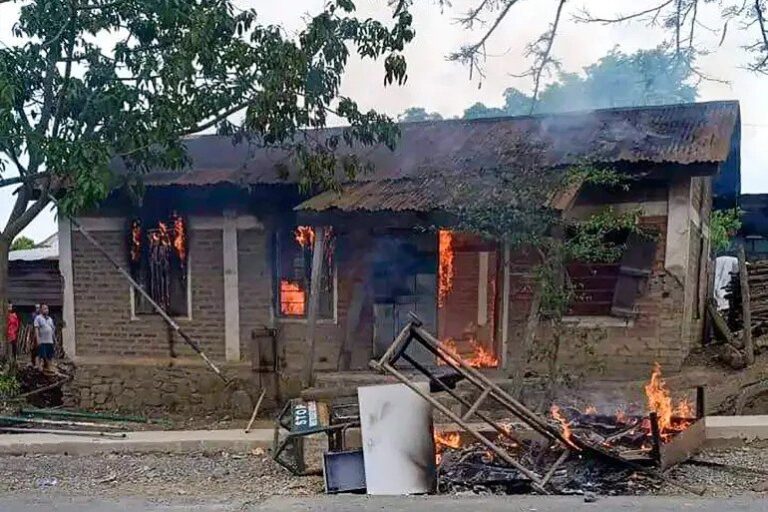
Latest Updates:A ‘shoot at sight’ order in Manipur on Thursday in light of the growing violence across the state since yesterday. Signed by Commissioner (Home) of Manipur T Ranjit Singh, the order was issued under provisions of the criminal procedure code, 1973, and allows all magistrates to issue the order when “ all forms of persuasion, warning [and] reasonable force” have been exhausted.The violence followed soon after a massive ‘Tribal Solidarity March’ held the day before by the All Tribal Students’ Union of Manipur Students’ Union of Manipur (ATSUM) against the inclusion of the Meitei community into the list of the state’s Scheduled Tribes (ST). Fifty five columns of the Army and Assam Rifles were deployed across the state and fourteen columns have been kept on standby. The Centre also dispatched the Rapid Action Force (RAF) in violence-hit areas. The Army and Assam Rifles carried out flag marches in the areas hit by the violence. On Wednesday, the government suspended mobile internet across the state for five days and Section 144 of the CrPC was imposed in eight districts: Bishnupur, Pherzawl, Jiribam, West Imphal, Thoubal, Tengnoupal, Kakching, and Kangpokpi. The carrying of stones, sticks, firearms and any objects that can be used as weapons has been prohibited. Currently over 9000 people have been displaced from their villages, some of whom were moved to shelters set up in open areas while others are moving to forested areas or neighbouring villages. The army is evacuating whole villages in violence-hit parts of Imphal district, Churachandpur, and other regions.As reported by East Mojo, eighty people were brought in to the Churachandpur District Hospital of whom thirty three are still admitted and three passed away. The deceased were all young men who suffered from bullet injuries to the abdomen, chest and arm. The available hospital staff may not be able to handle the situation if it continues to remain tense. East Mojo further reported that the violence has led to entire villages being burnt down with hundreds of people coming in from outside to attack the villagers. One can hear cylinders bursting in the background. Sources claim that local police stations have distributed guns to civilians in the name of protecting their villages. Other videos circulating online depict trucks full of men carrying guns, bodies littered across the highways, and sounds of bullets going off in the distance. Read also: Manipur: Violence Breaks Out in Churachandpur as Protests Against BJP Survey Continue
Understanding What Meitei ST Status Means To Different Groups In Manipur
Since 2012, the Scheduled Tribes Demand Committee of Manipur (STDCM) has been leading an organised campaign for the inclusion of the Meitei community into the state’s Scheduled Tribe list. They arguedthat they lost their tribal status when the Constitution (Scheduled Tribes) Order, 1950 was drafted and that ST status was needed to “preserve” the community, “and save the ancestral land, tradition, culture and language” of the Meiteis, who’s population percentage has declined from 59% in 1951 to 44% in 2011. ST recognition provides access to affirmative measures such as reservations in government offices and colleges, etc., and ST status within a tribal area would further grant reserved seats in a “tribal council”, special land and inheritance rights, etc. In light of the marginalisation that Northeastern states like Manipur face within India and with growing foreign investment under the ‘look east’ policy, there is a sense of insecurity among the people regardless of ethnicity. Given that ST status has become the most tangible way to access legal entitlements, it has become a sensitive demand for the Meiteis, especially for non-Hindu Meiteis who identify as tribal. On March 27, the Manipur High Court, while hearing a petition filed by members of the Meitei Tribe Union, directed the state government to consider the request within four weeks and send a recommendation to the Union government for its consideration. This directive was opposed by several hill tribal groups, such as the United Naga Council and the Kuki Inpi Manipur, as Meiteis are a dominant community that have control over the state apparatus, as 40 out of 60 constituencies are in the valley and the Meiteis are the largest population within the state. They also already have access to affirmative action through inclusion in the Other Backwards Classes and Scheduled Caste categories. The hill tribes fear that if Meiteis are given ST status, they will enter the hill region, further dispossessing the hill tribes and displacing them from their land.Image Source: https://www.eastmojo.com/manipur/2023/05/03/thousands-participate-in-tribal-solidarity-march-in-manipur/The timing of the directive coincides with a period already fraught with anxieties around land loss following the issuance of notices to 38 villages in the Churachandpur-Khoupum Protected Forest area by the Manipur government under the claim that they are “illegal settlements”. As the state pushes for a land and revenue survey to be carried out in the so-called Protected Area, people fear that more land will be snatched from them under the pretext of environmental protection. While the media has painted the hill tribes as being opposed to environmental protection measures, indigenous and tribal groups across India have spoken out against the extractive practices of the conservation nexus. The rhetoric of conservation is employed to grab indigenous land, however, the land is diverted towards tourism projects and other market-based programs for which forests are beautified and eco-engineered with no care for the environment. The same has been carriedout at Kaziranga National Park in the neighbouring state of Assam. Once declared forest land, it is increasingly common for land to be diverted towards mining operations. Given that Chief Minister N Biren is himself Meitei, both these moves together are seen as ways to dispossess the Zo communities of the hill regions. As a culmination of the above issues, thousands attended the Tribal Solidarity Rally on Wednesday. With tensions on the rise, violence broke out hours after.Read also: Network of indigenous communities on padyatra for rights in Nagarhole Tiger Reserve