Special Judge AR Patel had earlier found 49 of the 78 accused guilty of various offences including murder, sedition, and waging war against the State under the Indian Penal Code and provisions of UAPA.
This is the highest number of convicts to be sentenced to death in a single case in India’s legal history, The Indian Express reported citing the defence lawyers in the case.
A special court in Gujarat has sentenced to death 38 of the 49 convicts in the case relating to 2008 serial blasts in Ahmedabad, Times of India reported.
The remaining 11 convicts have been sentenced to life imprisonment.
The Court had earlier convicted the accused under various laws including murder, sedition, and waging war against the State under the Indian Penal Code and provisions of the Unlawful Activities Prevention Act and Arms Act and Explosive Substances Act.
Special Judge AR Patel had, on February 8, found 49 of the 78 accused guilty of various offences.
The Court pronounced the sentence today.
The court has also imposed a fine of Rs 2.85 lakh on each of the 48 convicts. Usman Agarbattiwala, the only one convicted under the Arms Act and among those sentenced to death, has been additionally awarded a year of imprisonment for conviction under the Arms Act.
Judge Patel also awarded compensation of ₹1 lakh to victims of the serial blasts, The Indian Expressreported.
The defence had cited mitigating circumstances in seeking a lesser quantum of sentence, while the prosecution had argued on the aggravating circumstances to make a case for death sentence to be handed down to the accused.
22 bombs went off in the city Ahmedabad on July 26, 2008 leaving 56 dead and hundreds injured. The sites of the serial blasts included the Civil and LG hospitals. Indian Mujahideen had claimed responsibility for the blasts.
After two phases of polling in assembly elections of Uttar Pradesh, it seems that the ruling Bharatiya Janta Party (BJP) has lost its sheen. Moreover, its gilt is getting eroded day by day due to the eyewash tactics that previously remained hidden from public view.
On February 10th when the state witnessed polling over 58 seats, PM Narendra Modi was addressing a rally in Saharanpur that saw 300 private buses carrying an audience from Haryana to fill the ground. This was not known until Hindi daily Dainik Bhaskar reported the grievance of bus operators who were demanding a sum of INR 31 Lakh due on diesel and toll charges. As per details, these buses were arranged to fetch a fake audience by the Haryana administration on oral orders of District Transport Officers of Jind, Ambala, and Panipat. Orders to DTO were direct from the Haryana CM office and the key persons involved in arranging this service were BJP Media in-charge Vipin Chaudhary and Saharanpur BJP head Devendra Sharma.
What is compelling the top leadership of BJP to resort to such filthy techniques? The answer lies in the poll trend of two phases that is likely to continue in later phases, maybe turning into a snowball effect.
Dent in BJP ‘s social coalition
Navnish, a senior journalist from Saharanpur gives a catchphrase to understand the scenario, “The crux of the matter lies in the fact that every caste community of Hindus has more or less come out to vote against BJP. Plus the Muslims have voted for SP-RLD alliance”.
In an interview with the Newsclick, Abhay Kumar Dube of the Center for Study of Developing Societies (CSDS) has articulated this phenomenon as dismantling of BJP’s “social coalition” that was responsible for its huge victories in 2014, 2017, and 2019. This social coalition consists of forward and backward Hindu votes. A chunk of votes from each section has now moved to the SP-RLD alliance due to its reasons and woes.
This phenomenon has played out differently on urban and rural seats. For example, in Ghaziabad and Noida that went for the polls in the first phase, the vote percentage remained less than 50 percent. Residents in high-rise societies and apartments did not come out to vote. These voters are predominantly upper-caste BJP supporters. A major chunk of workers of Rashtriya Swayamsevak Sangh (RSS) abstained from voting on the Sahibabad seat of Ghaziabad.
Sahibabad constituency is the largest in terms of voters (11 Lakh) and claims to hold the single largest number of RSS shakhas in Uttar Pradesh. The local in charge of Seva Bharti says that he did not go out to vote. Similarly, many functionaries of RSS and its affiliate abstained on the excuse that they have their names listed somewhere else.
This disillusionment in RSS ranks and urban BJP supporters has made this election tough for BJP candidates. On the rural seats that saw huge poll turnout in the first and second phase (more than 65 percent), anti-incumbency votes have played the role and spoilt the fortunes of BJP candidates. Here we could see an en masse voting by Muslims plus a chunk from every caste group going to the SP-RLD alliance.
Polling in the initial two phases has shown that the electorate has remained uninfluenced by BJP’s divisive tactics like the hijab row (Karnataka) that erupted just before the second phase polls. The polarisation of votes did happen but that was essentially pro-BJP and anti-BJP, as prophesized by veteran activist Ashok Chaudhary much before the state went to polls. (See The Peculiar Precursor-Part 1)
Out of 113 seats that have been polled in two phases, the SP-RLD alliance seems to be at the upper hand.
An insightful complaint
An interesting video went viral on February 17th in which Sarita Bhadauria, incumbent MLA from Etawah is seen complaining against voters. She says that the “voters have taken ration, salt, money, houses from us and now when we ask for votes they do not even greet us. This is sheer dishonesty….”
भाषा देखिए इटावा सदर की भाजपा विधायक सरिता भदौरिया की ..हार की बौखलाहट साफ़ झलक रही है..खुद ही कह रही हैं कि कोई इनसे नमस्ते भी नही कर रहा।एक सिटिंग विधायक की ऐसी स्थिति है तो उत्तर प्रदेश में क्या परिणाम आने वाले हैं स्पष्ट है @yadavakhilesh @samajwadiparty pic.twitter.com/wINpfaiLuF
MLA is referring to the ration and financial assistance that has been offered by the Center and state government during lockdown to the rural poor. BJP claims that an amount of 3.5 lakh crores has been disbursed to the needy people directly into their bank accounts. This is a first of its kind in Indian politics where citizens are first turned into beneficiaries and then they are expected to vote for the incumbent. This “beneficiary model”, as termed by Dube, has been witnessed since 2014 in the BJP regime.
This complaint gives insight into the confidence that resounds in BJP leaders’ repeated statements and claims of winning UP assembly elections. BJP had two clear-cut strategies beforehand: (a) polarising the electorate on religious lines; and (b) turning beneficiaries into voters. Polarization has failed after repeated attempts. BJP had a gut feeling that a major portion of rural voters will vote for it owing to some sort of obligation to the support and assistance provided by the state. Bhadauria’s video shows clearly that this plank is also failing.
Empty chairs, aggrieved leaders
As the poll progresses into the third phase on February 20th, fake audience manufacturing techniques of BJP are getting more exposed. The most recent case was a photoshopped image of Yogi Adityanath’s rally in Etawah. The UP CM himself tweeted this image and lauded the strong audience that was later caught fake.
On February 16th during a roadshow in Kanpur, Union Home Minister Amit Shah was heard saying, “Drop this roadshow… this is useless… stop this”. The video has gone viral.
Two days later, senior BJP leader and ex-minister Smriti Irani was seen leaving a roadshow abruptly that was organized in support of BJP’s candidate Raghunandan Singh Bhadauria.
The third phase consists of constituencies that have traditionally been SP strong-hold. BJP has just two phases left i.e. 4th and 5th, that it could claim to be winning handsomely. These are seats around the capital city Lucknow and in Bundelkhand. Since most of the media has neglected Bundelkhand and central UP hence there is no clear picture about voter sentiment in those areas.
If the crowd is to be believed then Akhilesh Yadav is ahead of his opponents. But still, nothing could be predicted on who will win the race.
The author is senior journalist and editor of junputh.com
Regretting that some people have misunderstood and misinterpreted the Karnataka High Court’s interim order on the Hijab row, NGO, Bahutva Karnataka has written an open letter to Chief Justice of Karnataka High Court, Rituraj Awasthi.
The letter has stated that by misinterpreting the order, the Constitutional rights of Muslim women are being violated.
Expressing concern over the deliberate and inhuman attacks taking place on Muslim girls following the interim order issued by the High Court of Karnataka, the NGO has written letter in the backdrop the incidents.
“ One of the basic tenets of the Constitution of India is to guarantee self respect for the individual, brotherhood and unity. But today, various entities of the government, a section of media are constantly trying to demean Muslim women and malign the image by misquoting the interim order. The sheer silence of Judiciary even when the constitutional rights are being violated openly, is appalling “, the letter says.
Adding further, the letter says that on February 4, several colleges and High Schools of the State denied entry to students and teachers into the classes for wearing Hijab. The students and faculty were forced to remove their Hijab outside the premises of the college in the presence of onlookers.
The district administration, government departments, Ministers and media organizations have misinterpreted the order, the result of which is that they are disrespecting and disregarding Muslim women.
The letter has quoted various incidents being reported in the media on the issue.
The interim order makes it amply clear that the order applies only to the colleges that have implemented the dress code or uniform in their colleges.
Despite this fact, the Hijab order is being implemented in every college of the State, giving a sense that the interim order applies to all.
It is also reported that the district administrations have given oral directions to all the government and aided schools and colleges to ban Hijab in their institutions.
The camera persons of various news channels have been literally forcing the colleges to implement the interim order. They are even barging into the schools and showing the faces of the Muslim girls wearing Hijab in the classes.
This is a clear violation of the interim order of the Karnataka HC. They have created a fear of psychosis in the society with their negative publicity.
Authorities of a few schools and colleges have seen directing the Burqa wearing students and teachers to remove it at the main gate of the institutions itself in front of passersby. Those who refused to obey, were not allowed to enter the premises. The students have returned home without attending exams.
Yesterday at PES college Inspector threatened students to book them. Students claimed to have come to get their hall tickets. "Edu minister announced no uniform for degree colleges, why discriminate? We r facing mental pressure, should we die?"
On February 15, in one of the schools of Shivamogga, the teachers disrespectfully sent a Hijab wearing student out. After the girl was sent away forcibly, a reporter of Etv Bharat news channel, chases the girl to capture her picture in his camera while the girl is running away in fear after being chased. It was one of the most tragic incidents to watch as a small girl is being treated like a criminal who is running away after committing some crime.
India: A minor student in Hijab being chased by a "reporter" outside a school in Karnataka. pic.twitter.com/lAW9VsUzeY
On February14 and 15, several Muslim students and teachers faced mental agony, harassment and disgrace they never faced in the past.
Because of the misinterpretation of the interim order, the fundamental right of Muslim women guaranteed under section 21 and 21 A of the Constitution to follow religion of their choice has been grossly violated.
Because of Covid pandemic, the educational institutions remained shut for a prolonged period. They have resumed the function only recently. On top of that, the final year exams are nearing and the students have to prepare for exams.
In such a crucial situation, Hijab controversy has only created fear among the students after it has taken a serious turn in the State.
At the time when the Covid pandemic had adversely affected the education of the students, it was the responsibility of the government to address the academic issues of the students caused by the pandemic.
But because of the government action with regard to Hijab row, more students would get deprived of education as they are not going to the schools and colleges.
The letter claims that on several occasions, attempts have already made to draw the attention of the High Court toward the injustice taking place against the Muslim girls, but for some reason, the Court has not considered it.
The Constitution gives authority to the Court to ensure that the rights of Muslim women are protected from violation of their rights by the Government or the Media.
The High Court should discharge their duties in this regard. The Court cannot remain as mute spectator when the constitutional rights of the people are grossly violated, the letter stated.
“ We are making yet another effort with this letter to draw the attention of the Court towards the incidents taking place in the State after issuing an interim order. The insult of the women and fellow citizens should not continue any more”, the letter said.
The letter mentions some of the points and appeals to the Court to take action.
The scope of the order should be clarified immediately.
Direction should be issued to conduct review of the misinterpretation of the order to the education department, deputy commissioner’s and elected representatives.
Relief should be given to the Muslims students and teachers whose rights of education have been denied.
Direction should be issued to the government to take action against those media channels that have violated the right to privacy of the people and constitutional aspirations, the letter added.
New Delhi: Poonam (43) and Poonam (45) are residents of Delhi’s Sonia Vihar area. Poonam (43) is known as Project 62 and Poonam (45) Project 57 to their peers. Both of them also came together in the strike going on for the capital city for thee last fifteen days under the leadership of Delhi State Workers and Helpers Union. The monthly income of Poonam (43), working as an Anganwadi helper, is only Rs 3900.
Since January 31, 2022, over 22,000 Anganwadi workers and helpers have been staging a sit-in near Chief Minister Arvind Kejriwal’s residence in the National Capital. They demand that the monthly income of the helpers be increased to 20,000, which at present is 3900- 4800 rupees. There are over 800 projects in New Delhi, each with a helper and a supervisor.
The two women don’t just share same name but also similar circumstances. Poonam (43) is the sole earner of her family. There are twelve members in her family and the responsibility of the household is on Poonam’s shoulders. The livelihood of this entire family comes from the “honorarium” received from the Anganwadi. “We have no choice but to fight for our rights”, says 43-year-old Poonam, explaining the importance of the strike. She leaves every day from January 31 at 7-8 in the morning after finishing her household chores, sometimes she comes by bus and sometimes travels on foot to reach Vidhan Sabha.
“With such a low income, we have to face inflation on one hand, and Corona on the other,” says 45-year-old Poonam Devi, who is on duty from 9 in the morning to 2 in the afternoon. But this time is only for the duty registers. Often they work till 5 in the evening, their tasks include providing awareness and education about vaccines, child-rearing, essential care during pregnancy. Poonam’s family consists of 7 members. She lives in Sonia Vihar with her husband, 3 children and her in-laws. Poonam’s husband has been looking for petty work for last two years, as he used to drive a school bus before the COVID’19, and now the shutdown of schools for two years has added to the financial problems for his family. Expressing her disappointment towards all governments, she says “Violence and injustice done by the government on us is not new, first we were sent out during COVID’19 without any safety gears and now they have called cops on us”.
PC:Sejal Patel
The January 11 “Khabardar Rally” organised by the workers and helpers, which was violently stopped by the Delhi Police. The common sentiment among the women was one of frustration with the political masters who only want their votes.
“Every leader comes to us asking for votes, but in this odd situation, they send the police to do beat us.” The protesters are furious due to the violent handling by the police.
“The Kejriwal government has money to give to police to attack us but no money to increase the income of the workers”, says Sunita, woman sitting next to Poonam. Some of Poonam’s associates were arrested by the police on January 11 from the rally itself. Police also confiscated stage draperies, mike and other paraphernalia.
Sitting in the scorching sun, Poonam (43) also says that she was earlier told by the Delhi Police that no one has been arrested. But then after a loud protest at the Civil Lines police station, the police officers released their accomplices.
During the strike, the union’s president Shivani Kaul said that the echo of this strike of the Anganwadi workers had reached the Rajya Sabha. This Anganwadi strike was discussed in the Rajya Sabha last Sunday. It is the effect of the indefinite strike of thousands of Anganwadi workers in Delhi, due to which the voices of our fight are being heard even by this deaf government.
45-year-old Poonam Devi says that she does not have any insurance like Asha workers, so health insurance is also included in her demands. She explains the working conditions and tells that when a child becomes ill, she is questioned, not the parents of the children, and if many times money has been deducted from salary even though it is not their fault or negligence. It is very difficult for them to take a day off.
Sitting in a pink shawl fighting in winter chill, Poonam asks, “Everything is so costly! How much a person can save from 3900Rs. Our health also suffers. It is becoming extremely difficult to run a household due to financial constraints. No one in the family has a smartphone to use the Poshan Tracker app launched to help Anganwadi workers and it is not feasible to ask neighbors for phone calls every day.”
The 43-year-old protester, like the rest of her colleagues, is afraid that her salary will be deducted due to the strike. But they do not see any other way out of this crisis. “We take care of nurturing all the children but don’t our children have the right to lead a good life? I want my daughter to become a doctor.” But she is also aware of the rising inflation and extremely high fees in the medical colleges. She also said that sometimes her income is stopped for a couple of months. In such a situation, she takes out the expenses by taking out a loan and pays little by little when she gets the salary. She expresses her disappointment and emphasised the need for the strike and their demands to be met.
Shivani further informed that through the meeting notice issued by the Department of Women and Child Development on February 11, 2022, the department has proposed a dialogue with the Delhi State Anganwadi Workers and Helpers Union. It has been written in this notice that the Minister of Women and Child Development Department of Delhi Government is going to be present in the talks to be held on February 21, 2022.
Adorned with red-pink colors, in this strike, along with fearlessness, struggle and hope, the colors of art were also visible. Children who came together in the struggle with their mothers are found doing painting to singing songs of rebellion.
PC: Sejal Patel
Both Poonam return to her house after the dharna and take care of the household chores. She laughs and says that “In anganwadi supervisor gets harsh, and in homes- it’s our husbands, we work all day and earn in pennies!” According to them, this strike is not only for their rights but also for their dignity. And they are hopeful to achieve victory in this.
The organising union have proposed two pre-conditions to negotiate with the department and the government: First, that no union other than the Delhi State Anganwadi Workers and Helpers Union, the only union representing the Anganwadi workers of Delhi, will be invited to the talks. And second that the right to elect their delegation will be completely with the union. The department and the government union will not interfere in the election of the delegation.
Sejal Patel is pursuing her post graduation in Convergent Journalism from Jamia Millia Islamia.
Belgavi, Karnataka: In view of two serious incidents of members from the Adivasi community of Madhya Pradesh being held as bonded labourers in Nippani and Ramdurg taluks of Belagavi district, a team consisting of Shashank SR (People’s Union for Civil Liberties – Karnataka), Avani Chokshi (All India Lawyers’ Association for Justice), Syed Junaid (All India Students’ Association) and Sachi (All India Students’ Association) representing different human rights and progressive organisations came together to initiate a fact-finding into the issue. The team visited Belagavi on the 28th and 29th of January, 2022 to meet the workers. The team also spoke to the Deputy Commissioner of Belagavi district, Deputy Labour Commissioner of Belagavi district, the Child Welfare Committee and the District Legal Services Authority.
On speaking to the workers, it was found that the labourers belong to the Adivasi community of Madhya Pradesh. They were brought to Belagavi by contractors on payment of advance of Rs. 20,000/- per labourer. In respect to the group this team spoke to, the said advance was paid to 20 workers, of whom nine are minors.The workers stated that prior to being brought to Belagavi, the labourers were not informed of the rate of wages to be paid to them, details of repayment or information of interest accruing to the advance given to them. Upon their arrival at Belagavi, the labourers were made to live in tarpaulin shacks around the fields they harvested. The labourers worked daily for almost 15 hours a day, harvesting sugarcane and loading the daily harvest onto the tractors, and were not paid at all by the contractor, but were paid small sums of Rs. 25-30 per person by the farmers on whose lands they worked, as tips. After working for 2 1⁄2 months without pay, they enquired with their contractor about their wages, but were informed that they were still under the debt of Rs. 2 lakhs and that they could leave only after clearing this debt. This is clearly a ‘bonded debt’ as defined under the Bonded Labour Systems (Abolition) Act, 1976.
Shockingly, the Tehsildar of each taluk undertook spot enquiries with members of the labour and police departments and panchayat officials and gave reports that there was no bonded labour or child labour, on the grounds that the labourers were not physically restrained. On the basis of this, the Deputy Commissioner has issued a letter to the team stating that there was no forced labour or child labour. The denial, time and again by various state authorities and the district administration including the DC and the Magistrates of any occurance of the violation of the rights of adivasi migrant workers and children and their denial to initiate proceedings against the accused according to the provisions of the law, coupled with the indifference and insensitivity that various officials displayed towards the grave violations of the rights of one of the most marginalised communities makes it evident the the district administration was attempting to sweep the issue under the carpet. Finally, on 05.02.2022, an FIR bearing No. 18/2022 was lodged by the Sadalaga Police station under Sections 16 and 17 of the Bonded Labour Systems (Abolition) Act, 1976. The Deputy Labour Commissioner (Belagavi) has also treated the complaint of the workers in respect of non-payment of due amounts as a complaint under the Minimum Wages Act, 1948, and the case is currently pending.
Findings of the Report on Bonded Labour
● The team found numerous constitutional and statutory violations by the administration, including violations of Article 23 of the Constitution of India which prohibits begar and other forms of forced labour.
● The team came to the conclusion that the workers were Bonded labourers as defined in the Bonded Labour System (Prohibition) Act, 1976, and were required to be provided relief and rehabilitation in accordance with the said Act. It was found that the workers were entitled under the Central Sector Scheme for Rehabilitation of Bonded Labour 2016, to a rehabilitation package of Rs. 1 lakh per adult male bonded labourer and Rs. 2 lakh per woman or child bonded labourers.
● It was found that the DC has failed in his duty to enquire whether any bonded labour is being enforced within his jurisdiction and take necessary action to eradicate this enforcement. Moreover, his action in finding that no forced labour was in practice without speaking to the workers is in violation of the Standard Operating Procedure for the Identification and Rescue of Bonded Labourers and Prosecution of Offender, 2017. His actions are also in contravention of the NHRC Advisories dated 31/05/2021 and 08/12/2021 to Identify, Release and Rehabilitate Bonded Labourers
● The team also found that child labour had taken place, prohibited under the Child and Adolescent Labour (Prohibition and Regulation) Act, 1986, on the basis of the statements of the workers. In fact, the admission of the contractor that 20 people had been paid advances makes it evident that apart from the 11 adults, all 9 children were also employed, in violation of the 1986 Act. In fact, even the Child Welfare Committee affirmed that the statements of the children made out a violation of the Act.
● The team found that the provisions of the Minimum Wages Act, 1948 and the Inter-State Migrant Workmen (Regulation of Employment and Conditions of Service) Act, 1979 had been flouted, and calculated that the statutory dues of each worker under
these laws.
● Scheduled Castes and Scheduled Tribes (Prevention of Atrocities) Act, 1989, which makes the forced labour of a member of a Scheduled Tribe punishable with imprisonment extending up to five years.
The team found violation of the Karnataka Grama Swaraj and Panchayat Raj Act, 1993, which makes it obligatory on the part of a Grama Panchayat to report any case of enforcement of the Bonded Labour System.
● The institutional apathy and lack of awareness amongst officials in respect of workers hailing from the most vulnerable and marginalised sections of society is shocking and itself contributes to the violation of the workers to their fundamental right to dignified lives under Article 21 of the Constitution of India.
The incident cannot be seen in isolation. The workers in their interactions with the fact- finding team revealed that they knew of many such groups which migrated from their homes to different districts in Karnataka including Belagavi and Bagalkot. The migration of workers to various districts in Karnataka is an annual occurrence. The hierarchical power structures in this nexus of players involved in the cycle of migration, enables systemic patterns of exploitation and oppression which negates the rights of the workers hailing mostly from the vulnerable communities.
The Bonded Labour Systems (Abolition) Act must be understood in letter and spirit by all district authorities and holistically implemented, with activation of Vigilance committees, regular surveys and enforcement of rehabilitation mandates.
Similarly, the District Magistrate and the Labour Department must work hand in hand to ensure abolition of child labour and regulation of adolescent labour in accordance with law, with regular surveys and monitoring, and activation of the District Task Force Against Child and Adolescent Labour is to be constituted and activated. Moreover, the system of periodical monitoring and inspection is required to be put into effect as per Rule 4E.
The Labour Department must conduct regular inspections in respect of compliance of the Inter-State Migrant Workmen (Regulation of Employment and Conditions of Service) Act, 1979 and the Minimum Wages Act, 1948, and ensure immediate prosecution of violators.
The State of Karnataka must issue a circular to all for treating the workers employed in the oppressive, exploitative and bonded conditions of labour in a humane and dignified manner and must ensure that those officials who summarily dismiss allegations of violation of law face immediate disciplinary action.
The State of Karnataka must consider the constitution of a welfare board to provide financial security and improve the standard of living of sugarcane workers who are engaged in sugarcane cutting, harvesting and transportation.
The State government must conduct awareness campaigns on bonded labour for all authorities etc. to ensure the eradication of bonded labour and the protection of fundamental rights of workers.
The Rural Development and Panchayat Raj Department, Government of Karnataka must issue a circular to all Gram Panchayats to strictly adhere to the obligation to report bonded labour under Section 58A of the Karnataka Grama Swaraj and Panchayat Raj Act, 1993.
The District administration of Belagavi must make a concerted effort to survey interstate and intrastate migrant workers involved in sugarcane harvesting and loading each season, and ensure compliance of the various laws detailed above.
The Director General and Inspector General of Police, Karnataka must issue a circular reiterating the directions of the Hon’ble Supreme Court in the case of Lalita Kumari v. State of U.P., (2014). 2 SCC 1, which mandates registration of FIR where information discloses commission of a cognizable offence and states that no preliminary inquiry is permissible in such a situation. The further direction of the Hon’ble Court that “The police officer cannot avoid his duty of registering an offence if cognizable offence is disclosed. Action must be taken against erring officers who do not register the FIR if information received by him discloses a cognizable offence.” must also be strictly adhered to.
The report is carried out by People’s Union for Civil Liberties – Karnataka (PUCL-K) All India Lawyers’ Association for Justice (AILAJ) All India Students’ Association (AISA).
Part 1 of the Namma Metro article can be read here
A worker from Assam in a labour camp said that he owns around 6 acres of land, of which a large part is used for tea cultivation. But now they don’t earn much from it and also since his family has grown bigger that he has to take care. He said – “My mother used to say that Farming is Supreme, Business is in the Middle, while Slavery (wage slavery) is the Worst work to do. But now conditions are different, Slavery has become Supreme while Farming is being sidelined. Farming is the noblest occupation, farmers feed everyone, but now one can’t buy anything from the earnings through farming.”
We spoke to a migrant security guard from West Bengal who is posted in Dairy Circle and Lakkasandra (Metro line and station construction site). He recently came to Bangalore from Haryana. He said they are given Rs 15,500 salary for 12hrs daily shift for 30 days. There is no weekly off and no OT is paid. They sometimes work for 36 hours long (3 continuous shifts) to earn some extra money to meet their need. He said the farming in his village (Gopiballabpur, Paschim Medinipur district) has become so unprofitable that he has spent 11 months in cities to run his family. He said, “We (security guards) still get ESI and PF but the labours working do not get it.” A huge number of them are not registered under any welfare board like BOCW. He himself said that if he filed a complaint his job will be lost if they all do it together there can be some effect.
We met a worker Ajay who is from Bihar outside the labor camp. He said that he did not get salary for the last two months, so did not go for work that day. He demanded his pending salary from the contractor and had declared that he’ll not go to work if not paid. He was working under the contractor for more than 2 years and was working in RV collage metro site for the last 5-6months. Rs 400/day is the wage. No question of ESI or PF. He said that their family owns very small piece of land in the village (he said 1 katha) and also he is not getting farm work in the village so had to migrate to Bangalore. He memorized my number and later gave a call from his phone which was inside the camp.
We met two other workers on a site who were from West Bengal. They came to Bangalore 3 months back and said they have only 1-2 bigha of land. The situation is such that after they send money home from the city, only then seeds can be sown in their fields. Wages were the same. I could not talk further as they were busy in work. They wrote my number on a block of concrete with a broken piece of brick as they did not have a phone.
We noted that most of the workers cannot afford to bring their families in Bangalore. However, in one labor camp some workers from Bengal stayed with their wives, these ladies are employed in low-paid work like cleaning the sites after work. Some workers like security guards and other skilled ones like driver, electrician etc, are enrolled in ESI. However, they said they do not have cards to avail the facilities. Other workers (with Rs 400 – 550 per day wage) are not enrolled in any scheme. They said, if something happens the thekedars take care.
Workers are extremely dependent on these thekedars regarding a lot of matters like payments, getting new jobs when one is over, medical assistance in case of accident and illness, travel etc. Thekedars are most of the time from the same village or from a nearby village of the respective workers. So, in this alien city, without any official agreement of work, without any guarantee of pay, without any safety or security of work, the workers only have their thekedars to depend upon. They cannot, most of time, express their grudges to them in the fear of losing the relationship, and thus, losing the contact to work in the city. They also cannot express their grudges to the company (the contractor under BMRCL) directly, as this would result in further worsening of their relationship with the thekedars, without whose support neither they can get work nor their payments. So, in this precarious and vulnerable situation the workers are forced into a semi-bonded feudalistic relationship with their thekedars. This relationship is used by the big corporates like L&T, Simplex, ITD etc, who a government entity BMRCL has hired. In line with the neoliberal design, this relationship is used specifically to keep their salary lesser than half they deserve by law, keep them in inhumane living conditions and refrain them from bargaining their rights specified in law by getting unionized.
Another aspect of this neoliberal design is to keep the unorganised workers undocumented. By making them anonymous, it becomes easy for the state to dodge their responsibility and not to adhere to the laws and guidelines formulated by them to wear the mask of a “Welfare State”. Under this mask, it keeps on facilitating super profits for the domestic and foreign corporates through super exploitation. There are some social welfare schemes like BOCW and e-Shram which has some benefits like compensation in case of accidental death and injury, ensuring occupational safety and health etc. The onus of registering in these schemes is on workers and no responsibility is imposed upon the employers. Due to lack of information, lack of access to internet and lack of proficiency to use digital means the metro construction workers have to depend on funded NGOs or middlemen for their registration. As mentioned earlier, most of these workers are not registered and thus, do not even get these meagre benefits. Because the employers reap the superprofits from the labour of these workers, they should thus be held accountable to labour laws. However, these social welfare schemes help the corporates to refrain from such a responsibility and make it an affair solely between the state and workers. Moreover, by only offering social welfare schemes, the state makes the individual’s identity as a worker secondary and that of beneficiary in a social welfare scheme primary. Thus, pushing the question of labour rights into the background.
The Non-Inclusive “Namma”
It should be clear by now that Namma Metro’s “namma” is not inclusive of the workers who are building it. However, will the great majority of the people of Bengaluru be benefited by this project built upon illegal theft of labour of these migrant workers? Will this project bring the BMRCL’s vision of “Garden City’s travel partner to all sections of commuters in Bengaluru” into reality? The answer is a clear NO. Research by Gitam Tiwari of IIT Delhi, published in EPW, shows with overwhelming evidence that capital-intensive metro rail systems serve only a small proportion of the total trips in cities in developing countries such as India. Other forms of public transport (like buses and suburban railways) are fairly inexpensive and thus covers most of the trips. The increasing amount of private and foreign capital being invested in these projects have made these metro services unaffordable for the majority. Further, metro generally enjoys numerous tax benefits in India which are not offered to the bus system, which carries at least five times more trips. Thus, BMRCL’s “Namma” is not even inclusive of the majority of Begulurians. Working class and lower middle class section of the city will not be able to afford this service, rather, a section of middle class and upper middle class would be its market. To capture this market, Namma Metro, which is built upon the sweat and blood of migrant workers, is a venture to make massive profits for the foreign investments.
Moreover, according to the EIA Report (August 2017), a total of 838 households will be affected by Namma Metro project. Based on the average household size of city it is estimated that about 3890 persons will be affected by the Project. The loss of livelihood estimated under the project is 1045. A study published in EPW shows that out of 223 households of Basaveshwara Nagar and Jai Bheema Nagar slums, who were displaced by this project in 2007-08, 151 households got the “rehabilitation package”. For the displaced households, the access to multiple employment opportunities they had in the city were lost due to forced relocation. The paper states that: “access to facilities such as education, healthcare, and markets became difficult due to relocation, forcing women to spend more to avail these, thereby impoverishing them further. Hence, one can state that spatial relocation only reinforces the economic and social marginalisation of poor urban women by curtailing their economic mobility. Moreover, any changes in the location caused by developmental activities, such as the metro project (infrastructure), perpetuates spatial inequality.”
To sum-up, this non-inclusive “Namma” metro project on one hand excludes the majority of the people staying in Bengaluru and on the other hand creates a playground for super-exploitation of the migrant workers constructing it. Because of a conscious effort by the neoliberal regime to break the backbone of agriculture, farmers are forced to migrate to cities in order to sustain themselves. Rural unemployed farmers are transformed into “reserve army” of cheap labour in the cities to be conveniently super-exploited by the foreign and domestic capital. Hopping from cities to cities in search of work, they are left with a precarious and unstable environment which restricts them from getting organized under trade unions. Being strongly attached with farming and their villages possibly gives them some sense of security in their majorly uncertain occupation of construction work.
However, they spend most of their time in cities getting exploited by the corporates and thekedars. Therefore, there is a good possibility of organizing them in the cities. The demands of better living conditions, minimum wage, benefits like PF and ESI, safety measures from work related hazards, would constitute the core issues. In a long term, demand of providing the social welfare benefits under BOCW as a right and putting its onus on the employer should also be taken up. Movement has to be directed against the companies (contractor) and BMRCL. Thekedars are another entity who act as the agents of exploitation for the corporates. These middle men eat up a section of earnings of the workers without putting in any labour. Movements in the demand of reducing their commission should also be thought of in long term. However, with all of this said, we will face two main challenges while organizing this section of construction workers, especially, workers working in such megaprojects. Firstly, the duration of stay in one location of these workers are extremely low. They tend to stay for 6-8 months in one labour camp and then mostly go back to their villages. While they come back to the cities, there is a high possibility of the change in the location of work and stay. The project he’s working on might change, or the site of work might change, or, a lot of time they shift to a different city altogether. Thus, coordination with organizations in different cities and villages, to keep in touch with the workers might be helpful. Secondly, the workers are so much bonded with the thekedars, as described previously, that even though they are discontent, it becomes difficult for them to act on it at this stage. However, we have to think of ways to overcome these challenges and devise tactics to organize them. Also, with the impact of working class movements intensifying in other sectors, objective conditions of this section getting organized will become more favourable.
Author is a based in Bangalore and works with migrant workers. The article was first published in Workers Resistance.
Bengaluru Metro Rail Corporation Limited (BMRCL), a joint venture of Government of India and the State Government of Karnataka, is the agency for building, operating and expanding the “Namma Metro” (“Our Metro” in Kannada) network. The BMRCL started constructing Bangalore Metro Rail in April 2015 and after completion of first phase it had planned for the second phase, there are 6 routes that are being constructed with huge investments from foreign banks. Although there is no source which gives aggregated information regarding the total percentage of foreign bank investments in Bengaluru metro, some instances regarding this is as follows.
A 2013 figure says Japan International Cooperation Agency (JICA) was funding 45% of the budget. To implement the almost 23 km long Gottigere to Nagavara reach (Line – 6), BMRCL got a loan from European Investment Bank (EIB) which approved a multi tranche loan of Euro 500 million and Asian Infrastructure Investment Bank (AIIB) approved a loan of USD 335 million. That is 52% from foreign banks out of the total budget of USD 1,785.00 million for this line. In 2021, BMRCL secured a $318 million loan from JICA, and a $500 million loan from the Asian Development Bank (ADB) to fund construction of the Outer Ring Road-Airport metro. The State and Union governments will contribute US$530 million, and the Karnataka Government will pay an additional US$370 million for land acquisition. That is, 47% of the budget is coming from foreign banks for this line.
With an objective to understand the conditions of the workers constructing this heavily foreign funded project, AICCTU started visiting the worker camps and interacting with them in the construction sites. We will point out some important insights and conversations that came out of these visits.
No contract, No overtime payment and no minimum wage
By neoliberal design, the lowest ranks of the workers, who constitute the majority, are mostly inter-state migrant workers from West Bengal, Bihar, Jharkhand, Rajasthan, MP, Uttarakhand etc. There exists a hierarchy of contractors. For example, companies like Starworth, Texmaco or L&T being at the top and sub-contractors (thekedars) with local connections with teams of migrant workers hailing from a given village, being at the bottom. None of the workers have been signed up with a formal contract.
Most workers work for 12 hrs for 6 days. But there is no paid weekly off-day. So, some workers also work for 7days a week. Overtime wage for work exceeding 8 hrs a day is not paid. Idea of PF and ESI is alien to most of the workers. Majority of the workers do not have registration under BOCW or inter-state migrant workers or any other governmental scheme.
Depending on the skillset of the workers the salary varies. The lowest rank of the workers are paid from Rs 9,000 to Rs 15,000 per month. That is at best around Rs 500-550 per day for 12 hours of work (Considering Rs 12,000 as the monthly salary, some workers have also reported Rs 400 per day figure). However, the minimum wage guideline says that even for an unskilled worker, Rs 639 has to be paid for 8 hours work in a day. Considering the rule that double payment has to be made for the extra 4 hours work that they do, the payment according to the law has to be Rs 1278 per day. That is, most of the workers are not even paid half the salary they should have been paid by law. Here, we are not even considering the allowances that they are supposed to get if they work at a height or in a tunnel, as most of them do.
For some jobs requiring special skills, there is a stark division of labour, according to where they come from. Workers from West Bengal are mostly involved in laying tracks, workers from Bihar are mostly involved in painting, workers from Rajasthan are mostly involved with marble works etc.
On how cost of labour-power is determined, Karl Marx observed in Wage Labor and Capital – “It is the cost required for the maintenance of the labourer as a labourer, and for his education and training as a labourer. Therefore, shorter the time required for training up to a particular sort of work, the smaller is the cost of production of the worker, the lower is the price of his labour-power, his wages. In those branches of industry in which hardly any period of apprenticeship is necessary and the mere bodily existence of the worker is sufficient, the cost of his production is limited almost exclusively to the commodities necessary for keeping him in working condition.”
Thus, this divison of labour according to where they come from, helps the corporates to keep the wages low by avoiding the cost to train the workers separately in these special skills, as the workers are already trained due to the skill being part of their family occupation.
Delayed wage payment is common and the wages are usually paid in cash, although there we found some mentions of bank transfers. The wage is paid by the sub-contractor (thekedar, who is the lowest layer of contractor most of the time having no official licence), however, the guideline says that the payment has to be made directly by the company who is having official contract.
Non-payment of wages is very common. For instance, in the Reach 6 site of the project, after some dispute between Simplex (the contractor) and BMRCL, more than 30 thekedars and 500 workers had not been paid for five months (September 2020 to January 2021). The workers stayed in the city for a few months waiting for their wages; however, because they are forced to live from hand to mouth, they had to go back to their villages. After number of representations to the Central Labour Department with details of workers from AICCTU and protests by the thekedars, the workers, as of now, have only got a month of the pending pay.
Conditions in the Workers Camps
Usually 8-12 workers share single temporary rooms made of tin walls and sheds. Many times no ceiling fan or proper ventilation exists in these rooms. Numbers of toilets are low in comparison with number of workers resident in the camps. For example, in the Kenchenahalli camp, there are about 14 toilets for 450 workers of which the majority lie defunct. There are open common bathing spaces that get filled by tankers. The bathing water was extremely dirty in all places and was seen to have floating chunk of dirt and algae in it. The workers in a lot of camps complained that there is lack of water supply, also there is no water supply in the lavatories and there is no provision of cleaning them periodically. Lots of garbage dumps could be seen around in all the camps and the surrounding is extremely unhygienic. Many workers complained of bed bugs filling their rooms. The workers have formed groups and each group runs a small mess, the expenses for which are managed by the workers themselves.
A committee to monitor the conditions of the workers in these camps were formed after an order given by the Karnataka High Court in Samuel Sathyasheelan vs Union Of India case represented by Clifton D’ Rozario (National Secretary of AICCTU). Although the order was passed in 2014, the committee was inactive. It was reinitiated during the COVID times after repeated representations from AICCTU but we were not allowed inside the worker camps and the site most of the time. The reason might have been that our reports from these camp visits used to make the committee really uncomfortable.
To the workers we have spoken, many from their families migrate to different cities including Bangalore for some work in unorganized sector time to time. Almost all the workers are from peasant family, and most of them go back during crop season. On asking why they left their villages, unanimously they said because farming has become unprofitable for them, livelihood is difficult in villages. However, most of them said, if those are from rural area are given a chance with profitable farming they would surely like to move back to their native place.
Part-2 can be read here.“Author is a based in Bangalore and works with migrant workers. The article was first published in Workers Resistance. “
The ongoing struggle of farmers is not for political power. It is a struggle to transform Indian agriculture and the livelihoods of the farming majority which are in ruins in most parts of the country. The compulsion of our time is to give a new direction to a peaceful peoples’ movement to generate momentum in small peasant agriculture, which in turn could give real content to our democracy. Setting aside false promises of doubling the farmers’ income by the Government or pretending that market-friendly reforms will do the trick, we propose a different way of designing a minimum support price (MSP).
A background
The massive solidarity (despite deeply divisive social faultlines) seen in the recent farmers’ movement has already shaken the Himalayan arrogance of the Government. Maintaining that solidarity is essential, which means MSP must look especially into the requirements of farmers and the landless. MSP could serve, in principle, three purposes — price stabilisation in the food grains market, income support to farmers, and also as a mechanism for coping with the indebtedness of farmers.
The price stabilisation policy for food grains in India evolved over time, first with the Essential Commodities Act in 1955 to counter price rise due to speculative private trading and then MSP in the 1960s. A buffer stock policy with the public storage of food grains for market intervention was developed over time to involve different kinds of mechanisms such as: setting cost-based minimum procurement price; paying the difference between procurement price and market price; storing the procured surplus for sale through the Public Distribution System (PDS) at issue price, and market intervention to stabilise price when deemed necessary. These induced farmers to shift to a high-yielding varieties cropping pattern during the Green Revolution, while ensuring food security for citizens. This task required interlinking procurement, storage and distribution with more centralised investment and control of each of these tasks.
Partial coverage of MSP
The procurement and PDS from the Green Revolution period provided assured price incentives for rice, wheat and sugar (the flagships of the Green Revolution), but left out some 20 crops now under discussion for MSP including millets, coarse cereals, pulses and oilseeds. As a result, this partial MSP coverage skewed the cropping pattern against several coarse grains and millets particularly in rain-fed areas. The area under cultivation of rice and wheat from the time of the Green Revolution till recently increased from 30 million hectares to 44 million hectares and nine million hectares to 31 million hectares, respectively, while that of coarse cereals plunged from 37 million hectares to 25 million hectares. Although part of the diet of many people across the country, these left-out crops (grown mostly in rain-fed conditions) were not made available in ration shops. Almost 68% of Indian agriculture is rain fed and the crops grown in these regions are usually more drought resistant, nutritious and staple in the diet of the poorer subsistence farmers. This has been a particularly vulnerable point of our food security system; greater coverage of all 23 crops under MSP is a way of improving both food security and income support to the poorest farmers in rain-fed regions.
The centralised mechanism for ensuring distribution of the procured stock of rice and wheat at MSP entails bringing the procured grains to centralised Food Corporation warehouses. Here they are milled, made ready for consumption and sent back to each district/province, and from there to villages/slums/wards for distribution through fair price (ration) shops at an issue price fixed by the government which is below the market price to make it affordable for poor households.
The total economic cost involving subsidy for selling below market price along with procurement costs, distribution costs of freight, handling, storage, interest and administrative charges along with costs borne due to transit and storage losses would be around ₹3 lakh crore. Sugarcane comes under a separate category because all this is organised through private sugar mills and is often plagued by delays.
If price is charged in a range according to harvest conditions, the total economic cost will vary within a price “band”.
As a band
MSP has to be conceived as a list of some 23 crops with a more flexible arrangement. Each crop within a band of maximum and a minimum price depending on harvest conditions (i.e. higher price in a bad and lower price in a good harvest year in general) will have its price set in the band. The price of some selected coarse grains can be fixed at the upper end of its band to encourage their production in rain fed areas. In this way, the objectives of income support to farmers, price stabilisation and food security and inducing more climate-friendly cropping patterns can be combined to an extent. Wide coverage of MSP through income support to farmers would generate massive positive economic externalities through raising industrial demand especially for the unorganised sector. This will help in extending solidarity among farmers and non-farmers while creating a chain reaction of demand expansion through multipliers for the whole economy.
For estimating the additional cost of a wider MSP; of the total grains produced some 45%-50% is for farmers’ self-consumption and the rest is marketed surplus. This marketed surplus sets the upper bound of total procurement cost from which must be deducted the net revenue recovered through the PDS (if all these crops are sold through ration shops). Our preliminary estimate puts it in the range of ₹5 lakh crore, far less than the ₹17 lakh crore estimated by the government. It is of the same order of magnitude as DA to public sector employees (less than 5% of the population, and the total tax break and income foregone announced in the Budget for a handful of industrial houses (₹3 lakh crore), not to speak of a wilful default of bank loans by a handful of borrowers (well over ₹10 lakh crore). This expenditure will benefit more than half the population directly and another 20%-25% of the population indirectly in the unorganised sector — over 70% of India’s citizens.
Tackling debt
A real breakthrough in the recurring problem of agricultural debt can be made by the linking of selling of grains under MSP to provision of bank credit particularly for small farmers. The farmer can get a certificate selling grains at MSP which would be credit points proportional to the amount sold; this will entitle them to a bank loan as their right, and calibrate the fluctuations between good and bad harvest years by storing the certificates for later use. This mechanism would go a long way not only in addressing the indebtedness in the farming community but also has the virtue of great administrative simplicity in disbursing bank loans.
Photos from 2017 TN farmers protest in Delhi
It needs emphasising that how effectively such an MSP scheme could be implemented would depend largely on decentralising the implementing agencies under the constitutionally mandated supervision of panchayats. The near miracle we have witnessed in organising and unifying the farmers’ movement across caste, class and gender through the panchayat and maha-panchayat system in Punjab, Haryana and West Uttar Pradesh raises hope that they will turn their attention to decentralising the MSP implementation mechanism. The movement enabled massive and effective mobilisation through these decentralised bodies. Therefore, they are capable of doing it again.
Amit Bhaduri has taught economics across various universities. Kaustav Banerjee teaches at Dr. B.R. Ambedkar University Delhi. Views are personal
Data collected and analysed by Citizens for Justice and Peace, a human rights organisation, and independent experts shows deaths in the Purvanchal region of eastern Uttar Pradesh, home to Prime Minister Narendra Modi’s constituency of Varanasi, surged in shocking fashion as the COVID-19 epidemic raged in the state.
From January 2020 to August 2021, the areas surveyed saw around 60% more recorded deaths than expected from 2019 records as well as from government data on the death rate in the state before the pandemic.
If the rise in mortality in these areas was repeated across all of Uttar Pradesh, the state as a whole could have had around 14 lakh (1.4 million) excess deaths during the pandemic – roughly 60-times Uttar Pradesh’s official COVID-19 death toll of 23,000.
This would make Uttar Pradesh one of the hardest-hit states in the country during the pandemic – and also one where death recording has been the weakest.
Polling for the state’s assembly elections began on February 10.
Details of COVID surgery
Across India, the COVID-19 epidemic has taken a heavy toll. Official figures, however, reflect only part of the suffering. We know now from many independent reports and studies that COVID-19 deaths in India have been grossly under-reported. Academic studies using civil registration statistics and data from various surveys have revealed that India has likely seen over 3 million excess pandemic deaths.
However, mortality data from Uttar Pradesh, India’s largest state, has been very limited. Official COVID-19 deaths in Uttar Pradesh number around 23,000. A report from IIT Kanpur claimed that thanks to the state government’s effective response to the outbreak, COVID-19 has had limited impact on the state.
On the other hand, especially during the second wave, around May 2021, the media was awash with stories of death sweeping through the state, of bodies swelling the Ganga and of patients dying avoidable deaths without oxygen.
Official claims and ground reports appear to tell entirely different stories. Where does the truth lie?
We decided to dig deeper, hoping to use data available in the public domain to understand the scale of COVID-19 deaths in Uttar Pradesh.
During November-December 2021, the Uttar Pradesh team of Citizens for Justice and Peace (CJP) undertook a mammoth exercise to collect records of deaths from 2017 to August 2021, as maintained by local offices in villages and urban areas in the Purvanchal region of eastern Uttar Pradesh. We succeeded in obtaining complete records from 129 areas, largely in Varanasi and Ghazipur districts.
A basic analysis of this data reveals a big spike in recorded deaths in 2020-2021 compared to previous years as well as to expectations based on government data on Uttar Pradesh’s death rate.
While not all deaths can be conclusively attributed to COVID-19, it is reasonable to conclude that the pandemic played a key role in the huge increase in mortality.
Let us dive in.
Data collection
Our teams faced many challenges when collecting death records in the regions we visited. Although we attempted to obtain data from many areas in four districts – Varanasi, Ghazipur, Jaunpur and Chandauli – the majority of data we were eventually able to collect came from Varanasi and Ghazipur districts.
Over the course of gathering the data, our team approached Nagar Nigam offices, gram panchayat offices and crematoria and burial grounds, and sought the help of village heads and secretaries, as well as ASHA workers. In many areas, we were unable to access any data – either because death records were not maintained or because they were not shared.
In the end, we were able to obtain partial or complete death records from 2017 up to August 2021, from 147 rural and urban areas. Village officials and ASHA workers were key to our success in obtaining this data, especially in the Varanasi district.
To assess trends in the data, we used only numbers from areas with complete records going back to 2017. We removed from the analysis 17 areas that did not have records for every year, and one area for which we could not find population data. Of the remaining 129 areas whose data we analysed, 79 were rural and 50 were urban. Of these, 104 areas were in Varanasi, 23 were in Ghazipur, and one each was in Jaunpur and Chandauli districts.
The 129 areas we used in our analysis had an estimated total population of around 2.8 lakh in 2021. Of them, around 43,000 people resided in urban mohallas and the remainder were in rural areas. That is, the surveyed population was roughly 85% rural. This is an approximate reflection of Uttar Pradesh as a whole: according to government projections, around 76% of the population resides in rural areas.
The results of COVID -19 death survey
The number of deaths recorded in the 129 areas from 2017 to August 2021 is set out in the following table.
We observe first that there were significant increases in the number of deaths recorded year-on-year in these areas prior to the pandemic. In fact, recorded deaths increased by 9% between 2017 and 2018, and a further 23% between 2018 and 2019. It is likely that much of this increase is a consequence of improved record-keeping.
Indeed, some local officials told our team that they do not maintain a record of all deaths in the village. They only register the deaths of those people who approach them to get a death certificate. And it is usually for reasons connected to pension benefits, life insurance claims, property settlements and bank accounts that families wish to get a death certificate or a deceased relative’s name recorded in the death register.
It is likely that, over time, more and more families chose to report deaths to local officials.
During the pandemic period, we see further sharp rises in recorded deaths. Could further improvements in record-keeping, with more families needing death certificates, explain the rise in deaths between 2019 and 2020, and again between 2020 and August 2021? A closer look reveals that this is highly implausible. Let us see why.
From our data, we can calculate an annualised crude death rate (CDR) for each time period – namely, the number of recorded deaths occurring per 1,000 population per year in the surveyed population. This gives us the numbers in the following table.
We see that the CDR, according to death records, was indeed rising prior to the pandemic in 2017-2019 – no doubt reflecting increasing levels of death registration, and probably not increasing mortality.
According to government estimates in the 2019 Sample Registration System (SRS) bulletin, the actual CDR for Uttar Pradesh as a whole is 6.5 (6.9 in rural areas and 5.3 in urban areas). Based on the rural-urban make-up of the surveyed population, we would expect the CDR in the surveyed areas to be around 6.7. We see that by 2019, the recorded CDR of 6.4 in this population was in fact close to state-level expectations. There was not much room for further improvement in reporting to push the numbers up.
It is important that, in these areas, the CDR in 2020 is already around 15-20% higher than expected either from 2019 data or from the state-wide CDR estimates from the annual SRS. And the death rate during January-August 2021 was, shockingly, more than double the expectation.
Even if we assume that the SRS significantly underestimated pre-pandemic yearly deaths in Uttar Pradesh, and further assume that record-keeping improved to perfection during the pandemic period (highly unlikely, especially given major disruption to death registration during the lockdown), we still find deaths during the pandemic period to be greatly above expectations.
It is inconceivable that such a big surge in recorded deaths reflects anything other than many more people dying.
We can try to gain more insight into the scale of the mortality surge by looking separately at rural and urban areas. Analysing rural and urban data, we find the following annualised CDR values.
We see that in the surveyed areas, the rise in CDR during 2020 was largely driven by a sharp rise in urban deaths. But in case it is claimed that 2020 had no increase in rural deaths – we note that there is in fact a more modest, but nevertheless clear, rise in rural deaths reported from 2019 to 2020.
The dramatic increase in deaths during January-August 2021 came from both rural and urban areas. Indeed, deaths in rural areas during the first eight months of 2021 were double that expected from the 2019 data – and around 80% higher than that expected based on the SRS-estimated rural CDR.
The surge is consistent with reports during the second wave of large numbers of COVID-19 deaths among the state’s teachers and reports in the Hindi press of the death and destruction wreaked by the virus in Uttar Pradesh’s villages.
Estimating excess pandemic deaths across UP
We cannot be sure if the situation in the parts of Purvanchal that we visited was reflected across the state. But we can nevertheless ask: if the mortality surge seen in the surveyed areas was repeated across the state, what would this imply about the scale of pandemic deaths in Uttar Pradesh?
The surveyed areas had 55-60% more deaths during the 20 months from January 2020 to August 2021 than expected in this period. Across Uttar Pradesh, a 55-60% surge over 20 months would amount to around 14 lakh (1.4 million) excess deaths in this period.
To understand this figure, note that, based on SRS and civil registration data, Uttar Pradesh expects to have around 15 lakh deaths in a normal year. The pandemic excess death toll would then amount to almost a full year’s extra deaths in the state.
Another perspective on these stunning numbers is that 14 lakh people amounts to around 0.6% of Uttar Pradesh’s estimated 2021 population, of around 23 crore. This means 0.6% of the state’s population possibly lost their lives prematurely as a result of the pandemic.
How does this compare to the pandemic toll in other parts of India?
It is on the very high end. Andhra Pradesh has good civil registration data available, and which has reported the highest pandemic excess mortality in India. In fact, estimated excess deaths in Andhra Pradesh amount to a little over 0.5% of the state’s population. Our survey thus suggests that when it comes to pandemic mortality, Uttar Pradesh could be worse-hit than Andhra Pradesh – and possibly the hardest-hit state in all India.
Understanding the results
As it emerged, the data confirmed our worst fears: COVID-19 had indeed left a gory trail of death in every town and village in Purvanchal.
The story in the data was confirmed by multiple testimonies. Muniza Khan, a social science researcher who compiled the data, said, “We were shocked by the sheer number of deaths in these four districts. ASHA workers and Panchayat heads said they did not know a single house where a person had not died due to COVID-19.”
Khan recalled how anguished families would throng Adikeshav ghat, where bodies of people who had died with COVID-19 were sent for their last rites. The place was packed with families waiting their turn to bid their loved ones goodbye, while funeral services workers struggled to find firewood for cremations. “They finally ran out of firewood. The bodies that didn’t burn properly were simply thrown into the Ganga,” she said. “Still the long lines continued.”
Not just hospitals and crematoria – there were long lines at burial grounds for Muslims and other minorities as well. Employees were working overtime, digging graves even as space ran out and people waited outside. One worker at Ramnagar, near the city area, told the CJP team, “I have been digging all day long but the lines outside the burial ground won’t shorten.”
It is also noteworthy that many burial grounds across India for Muslims, Christians and other minorities, who bury their dead, were found to be saturated with bodies to the point that older graves had to be ‘recycled’ to accommodate the growing number of the dead.
The tragedy was compounded by the weak or absent health and welfare infrastructure. Already during relief work, the CJP team observed how healthcare centres in rural areas were often shut. Families approached the CJP headquarters to ask for medicines and oximeters. Both in towns and in villages, education and three-meals-a-day had become everyday challenges. One elderly individual told Dr Khan, “The last two years have been the most traumatic years of my life. I don’t even want to remember this time.”
Conclusions
Our investigation found a staggering increase in the number of deaths during the pandemic in Varanasi and nearby areas. This discovery is very different from the official story of a well-managed epidemic with limited impact. In fact, local people in some areas told us that every household had lost a family member to the virus and poor healthcare.
While the bulk of the rise in deaths occurred during 2021, presumably during the second wave of the outbreak, there was also significant excess mortality during 2020. And although additional deaths during 2020 seemed to be concentrated in urban areas, even the rural areas we surveyed saw around 20% more deaths during 2020 than during 2019.
There is little convincing evidence that this reflects improved record-keeping. On the contrary, data from many parts of the country shows death registration plunging during the first part of 2020 as several offices shut during the national lockdown.
Across our sample, deaths from January to August 2021 were more than twice as many as we could expect from the 2019 data, and SRS estimates. In a period of eight months, in this population, we would expect to have around 1,200 recorded deaths based on 2019 records or the state’s death rate as estimated in the SRS. Instead, we found 2,570 deaths.
While the population we surveyed was concentrated mainly around the Varanasi district, our data suggests that Uttar Pradesh as a whole was hit very hard, especially during the second wave. It is clearly crucial to survey more parts of the state – to assess the true impact of the COVID-19 epidemic as well as to bring the lives lost in the state out from behind its government’s veil of propaganda.
This report was first published in the Citizens for Justice and Peace (CJP) website and The Wire and may be read here.
The chief accused in the Lakhimpur Kheri murder case, Ashish Mishra Teni alias Monu has been granted bail yesterday. Samyukt Kisan Morcha(SKM) that has been demanding justice for the murder of farmers in Lakhimpur Kheri has has expressed their anger and shock at the bail order that too just on the first day of UP elections.
The brutal case of four farmers and a journalist being crushed to death in broad daylight by the son of a Union Minister was a trial for the rule of law across the country. In such a case, despite clear evidence, the murder accused getting bail so soon, and that too on the first day of elections in Uttar Pradesh, is a matter of surprise.
SKM has pointed out loopholes in the reasons given by the High Court in the bail order. SKM stated that without any proof, high court has speculated that the driver must have driven the vehicle over the crowd in panic. The comments made by the Court on the agitation without any context are unwarranted. The court granting bail to Ashish Mishra without considering the firm possibility of a politically powerful accused influencing the witnesses is extremely disappointing.
Hope of Fair Investigation in the murder of Farmers Bleak: SKM
Since the Lakhimpur Kheri massacre, the police and administration are constantly trying to protect Ajay Mishra Teni and his son Ashish Mishra. From the very beginning, the Uttar Pradesh Police has been negligent in investigating this case and apprehending the accused, and has tried to dilute the case. The complicity of the police and the government is evident from the fact that section 302 of IPC has not been imposed on accused Ashish Mishra Monu, whereas in the second case, section 302 has been imposed on the accused farmers. It is clear from the order of the High Court that the interest of the prosecution was in getting bail to the minister’s son in this case. This order blurs the hope of fair investigation and justice in this heinous murder case.
Samyukta Kisan Morcha demands that the government should immediately file an appeal against this decision of the High Court. Samyukta Kisan Morcha will cooperate fully with the families of the victims in filing an appeal after taking the opinion of the country’s leading lawyers in this regard. The Morcha appeals to the court of the people of Uttar Pradesh, to punish the Bharatiya Janata Party which is bent on saving the real culprits of this massacre by casting vote against it.




 What is compelling the top leadership of BJP to resort to such filthy techniques? The answer lies in the poll trend of two phases that is likely to continue in later phases, maybe turning into a snowball effect.


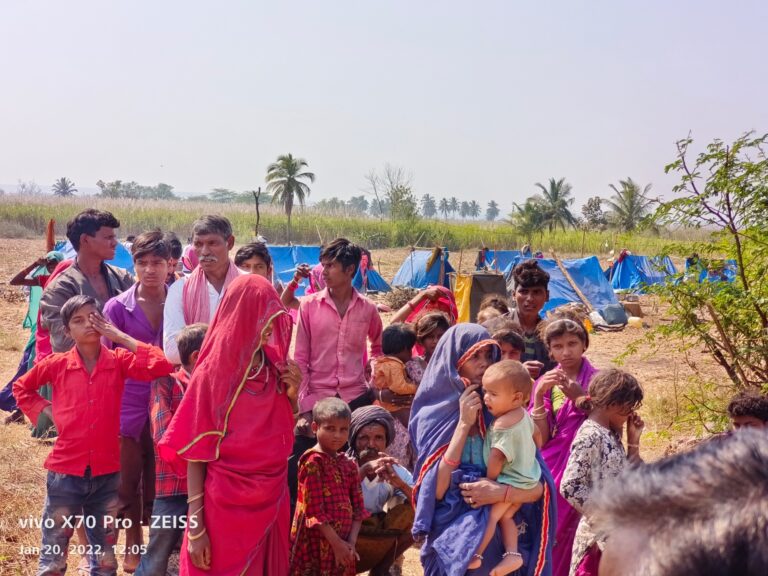
 Shockingly, the Tehsildar of each taluk undertook spot enquiries with members of the labour and police departments and panchayat officials and gave reports that there was no bonded labour or child labour, on the grounds that the labourers were not physically restrained. On the basis of this, the Deputy Commissioner has issued a letter to the team stating that there was no forced labour or child labour. The denial, time and again by various state authorities and the district administration including the DC and the Magistrates of any occurance of the violation of the rights of adivasi migrant workers and children and their denial to initiate proceedings against the accused according to the provisions of the law, coupled with the indifference and insensitivity that various officials displayed towards the grave violations of the rights of one of the most marginalised communities makes it evident the the district administration was attempting to sweep the issue under the carpet. Finally, on 05.02.2022, an FIR bearing No. 18/2022 was lodged by the Sadalaga Police station under Sections 16 and 17 of the Bonded Labour Systems (Abolition) Act, 1976. The Deputy Labour Commissioner (Belagavi) has also treated the complaint of the workers in respect of non-payment of due amounts as a complaint under the Minimum Wages Act, 1948, and the case is currently pending.

 Another aspect of this neoliberal design is to keep the unorganised workers undocumented. By making them anonymous, it becomes easy for the state to dodge their responsibility and not to adhere to the laws and guidelines formulated by them to wear the mask of a “Welfare State”. Under this mask, it keeps on facilitating super profits for the domestic and foreign corporates through super exploitation. There are some social welfare schemes like BOCW and e-Shram which has some benefits like compensation in case of accidental death and injury, ensuring occupational safety and health etc. The onus of registering in these schemes is on workers and no responsibility is imposed upon the employers. Due to lack of information, lack of access to internet and lack of proficiency to use digital means the metro construction workers have to depend on funded NGOs or middlemen for their registration. As mentioned earlier, most of these workers are not registered and thus, do not even get these meagre benefits. Because the employers reap the superprofits from the labour of these workers, they should thus be held accountable to labour laws. However, these social welfare schemes help the corporates to refrain from such a responsibility and make it an affair solely between the state and workers. Moreover, by only offering social welfare schemes, the state makes the individual’s identity as a worker secondary and that of beneficiary in a social welfare scheme primary. Thus, pushing the question of labour rights into the background.
 To sum-up, this non-inclusive “Namma” metro project on one hand excludes the majority of the people staying in Bengaluru and on the other hand creates a playground for super-exploitation of the migrant workers constructing it. Because of a conscious effort by the neoliberal regime to break the backbone of agriculture, farmers are forced to migrate to cities in order to sustain themselves. Rural unemployed farmers are transformed into “reserve army” of cheap labour in the cities to be conveniently super-exploited by the foreign and domestic capital. Hopping from cities to cities in search of work, they are left with a precarious and unstable environment which restricts them from getting organized under trade unions. Being strongly attached with farming and their villages possibly gives them some sense of security in their majorly uncertain occupation of construction work.
However, they spend most of their time in cities getting exploited by the corporates and thekedars. Therefore, there is a good possibility of organizing them in the cities. The demands of better living conditions, minimum wage, benefits like PF and ESI, safety measures from work related hazards, would constitute the core issues. In a long term, demand of providing the social welfare benefits under BOCW as a right and putting its onus on the employer should also be taken up. Movement has to be directed against the companies (contractor) and BMRCL. Thekedars are another entity who act as the agents of exploitation for the corporates. These middle men eat up a section of earnings of the workers without putting in any labour. Movements in the demand of reducing their commission should also be thought of in long term. However, with all of this said, we will face two main challenges while organizing this section of construction workers, especially, workers working in such megaprojects. Firstly, the duration of stay in one location of these workers are extremely low. They tend to stay for 6-8 months in one labour camp and then mostly go back to their villages. While they come back to the cities, there is a high possibility of the change in the location of work and stay. The project he’s working on might change, or the site of work might change, or, a lot of time they shift to a different city altogether. Thus, coordination with organizations in different cities and villages, to keep in touch with the workers might be helpful. Secondly, the workers are so much bonded with the thekedars, as described previously, that even though they are discontent, it becomes difficult for them to act on it at this stage. However, we have to think of ways to overcome these challenges and devise tactics to organize them. Also, with the impact of working class movements intensifying in other sectors, objective conditions of this section getting organized will become more favourable.
Author is a based in Bangalore and works with migrant workers. The article was first published in Workers Resistance.
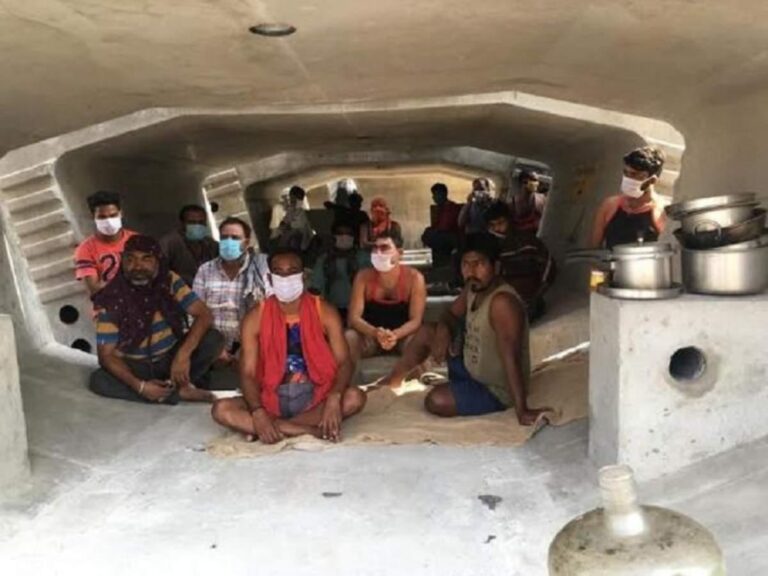
 Depending on the skillset of the workers the salary varies. The lowest rank of the workers are paid from Rs 9,000 to Rs 15,000 per month. That is at best around Rs 500-550 per day for 12 hours of work (Considering Rs 12,000 as the monthly salary, some workers have also reported Rs 400 per day figure). However, the minimum wage guideline says that even for an unskilled worker, Rs 639 has to be paid for 8 hours work in a day. Considering the rule that double payment has to be made for the extra 4 hours work that they do, the payment according to the law has to be Rs 1278 per day. That is, most of the workers are not even paid half the salary they should have been paid by law. Here, we are not even considering the allowances that they are supposed to get if they work at a height or in a tunnel, as most of them do.


 If price is charged in a range according to harvest conditions, the total economic cost will vary within a price “band”.


 We observe first that there were significant increases in the number of deaths recorded year-on-year in these areas prior to the pandemic. In fact, recorded deaths increased by 9% between 2017 and 2018, and a further 23% between 2018 and 2019. It is likely that much of this increase is a consequence of improved record-keeping.
Indeed, some local officials told our team that they do not maintain a record of all deaths in the village. They only register the deaths of those people who approach them to get a death certificate. And it is usually for reasons connected to pension benefits, life insurance claims, property settlements and bank accounts that families wish to get a death certificate or a deceased relative’s name recorded in the death register.
It is likely that, over time, more and more families chose to report deaths to local officials.
 We see that the CDR, according to death records, was indeed rising prior to the pandemic in 2017-2019 – no doubt reflecting increasing levels of death registration, and probably not increasing mortality.
According to government estimates in the 2019 Sample Registration System (SRS) bulletin, the actual CDR for Uttar Pradesh as a whole is 6.5 (6.9 in rural areas and 5.3 in urban areas). Based on the rural-urban make-up of the surveyed population, we would expect the CDR in the surveyed areas to be around 6.7. We see that by 2019, the recorded CDR of 6.4 in this population was in fact close to state-level expectations. There was not much room for further improvement in reporting to push the numbers up.
It is important that, in these areas, the CDR in 2020 is already around 15-20% higher than expected either from 2019 data or from the state-wide CDR estimates from the annual SRS. And the death rate during January-August 2021 was, shockingly, more than double the expectation.
Even if we assume that the SRS significantly underestimated pre-pandemic yearly deaths in Uttar Pradesh, and further assume that record-keeping improved to perfection during the pandemic period (highly unlikely, especially given major disruption to death registration during the lockdown), we still find deaths during the pandemic period to be greatly above expectations.
It is inconceivable that such a big surge in recorded deaths reflects anything other than many more people dying.
We can try to gain more insight into the scale of the mortality surge by looking separately at rural and urban areas. Analysing rural and urban data, we find the following annualised CDR values.
 We see that in the surveyed areas, the rise in CDR during 2020 was largely driven by a sharp rise in urban deaths. But in case it is claimed that 2020 had no increase in rural deaths – we note that there is in fact a more modest, but nevertheless clear, rise in rural deaths reported from 2019 to 2020.
The dramatic increase in deaths during January-August 2021 came from both rural and urban areas. Indeed, deaths in rural areas during the first eight months of 2021 were double that expected from the 2019 data – and around 80% higher than that expected based on the SRS-estimated rural CDR.
The surge is consistent with reports during the second wave of large numbers of COVID-19 deaths among the state’s teachers and reports in the Hindi press of the death and destruction wreaked by the virus in Uttar Pradesh’s villages.
 The tragedy was compounded by the weak or absent health and welfare infrastructure. Already during relief work, the CJP team observed how healthcare centres in rural areas were often shut. Families approached the CJP headquarters to ask for medicines and oximeters. Both in towns and in villages, education and three-meals-a-day had become everyday challenges. One elderly individual told Dr Khan, “The last two years have been the most traumatic years of my life. I don’t even want to remember this time.”