
Babasaheb Ambedkar: Champion of Women´s Rights

Babasaheb Ambedkar is one of the first feminist leaders and women’s rights advocates in the country. “I measure the progress of a community by the degree of progress which women have achieved” Babasaheb had said. Despite this, his feminist contributions are often ignored and denied. Even Indian Feminists often limit his work to the betterment of Dalit women’s lives. This invisibalization of Ambedkar and his life’s work is symptomatic of upper caste feminist movements. Ambedkar is only called upon when upper-caste women speak to and of Dalit women, beyond that Babasaheb’s work in pushed to the margins. 

Ambedkar´s contribution is not an outlier to feminist struggles but has been instrumental in shaping women’s rights in the country.

In his essay Castes in India Babasaheb outlines how endogamy was the essence of the caste system. He details how the focus on maintaining caste exclusivity leads to the rise of Sati and child marriage. He articulates through this piece the linkages between caste and the subordination of women. Ambedkar has always maintained that women were the gateways of the caste system and the caste system lay down a structure for the subordination of women and it had to be uprooted. He saw castes’ exclusionary violence and subjugation of women inherent to the very process that lead to caste formation. Ambedkar in his other works details the gendered violence that women face withing Hindu Smritis and Vedic texts. In the Manusmriti for example, Manu set the ideal for women to worship her husband despite all his flaws. He says “Manu can hardly be said to be more tender to women than he was to the Shudra.” 
“I measure the progress of a community by the degree of progress which women have achieved”-B R Ambedkar
Ambedkar did not only right for women’s rights, he continuously worked with women to realize the ambition of equality amongst genders.  He advocated for the rights of sex workers and spoke out against the casteist nature that was the foundation of sex-work. He worked to ensure that women were also protected under labour laws. He was instrumental in reducing the number of working hours and improving the working conditions. In 1928, as a member of the Legislative Council of Bombay, he supported a Bill granting paid maternity leave for women working in factories. He was of the view that if the employer was getting benefits off of women’s labour, they should also be supporting women, partly, when they are on their maternity leave. The other half he believed should be paid by the government as it was in the interest of the nation. Ambedkar also believed that women have the right over their own body. He said that conception was a choice that women should make. He argued for reproductive rights for women, recommended that birth control facilities be made available to them, and was a strong advocate of women’s reproductive freedom.

Ambedkar Jayanti, Anand Teltumbde arrest and the casteist face of power

He also drafted the Mines Maternity Benefit Act which asked for equal wages and equal representation of women on the welfare fund for the coal mine workers, and emphasised equal citizenship and women’s right to economic development as crucial for women’s rights in India. Between 1942 and 1946 he passed several progressive legislations for women that dealt with equal wages for equal work, casual and privilege leave, compensation in cases of injury, and pension.

Hindu Code Bill: Ambedkar´s antidote to  Brahminical Patriarchy

One of the biggest testaments to Ambedkar’s feminism was the Hindu Code Bill. Ambedkar was entrusted with drafting the Hindu Code Bill. This Bill was to codify property practices for men and women, design law of maintanence, marriage, divorce, adoption amongst other issues. Ambedkar used this as an opportunity to ensure women had full access to rights within the system. He included the issue of abolition of birth-right to property, property by survivorship, half share for daughters, conversion of women’s limited estate into an absolute estate, abolition of caste in matters of marriage and adoption, and the principle of monogamy and divorce. Ambedkar stood by these issues in face of strong opposition from conservative Hindu men in the parliament.
Image courtesy: Nehru Memorial Library
The focus of the bill was to give women absolute right over property, absence of endogamy, the access to divorce, and to relieve women of the threat of polygamy.

The aim was to oppose the practices of Brahminical patriarchy and thus stop its reproduction. 

The Bill kept getting tabled in the parliament with promises to address it “at a later point in time” but this never happened. The house was well aware of the power of disruption that the bill possessed. It could shake the foundations of patriarchal control over production and reproduction. In despair, Ambedkar resigned. In his resignation speech Ambedkar said: “The Hindu Code was the greatest social reform measure ever undertaken by the legislature in this country. No law passed by the Indian legislature in the past or likely to be passed in the future can be compared to it in point of its significance. To leave inequality between class and class, between sex and sex, which is the soul of Hindu society, untouched and to go on passing legislation relating to economic problems is to make a farce of our Constitution and to build a palace on a dung heap. This is the significance I attached to the Hindu Code. It is for its sake that I stayed on, notwithstanding my differences.” Movements headed by Ambedkar always had women walking side-by-side with the men. During the Mahad Satyagraha 10,000 men and women walked together to break the law on not allowing the Mahars to drink water. This was in contrast to Gandhi’s Salt Satyagrah, during which there were no women who were allowed to participate. In the Kalaram temple-entry movement Ambedkar inspired women to come out of their social arenas and speak with courage. In 1930, 15000 people came out to be part of this movement. Radhabai Vadale, who was one of the women who was moved by Babasaheb’s call, said, “”It is better to die a hundred times than to live a life of humiliation.” This was a testament to the fact that Ambedkar had inspired confidence in women to fight for their rights.  In an address to the All-India Depressed Classes Women’s Conference he told women: “Give education to your children. Instill ambition in them… Don’t be in a hurry to marry; marriage is a liability. You should not impose it upon children unless financially they are able to meet the liabilities arising from them. Above all let each girl who marries stand up to her husband, claim to be her husband’s friend ad equal, and refuse to be his slave. “ This was telling of Ambedkar’s feminism and his push to ensure women were not enslaved to the patriarchal ideas as mapped in the Hindu religion. Ambedkar rallied for the rights to equal partnership in marriage well before Savarna feminists, who appropriated his call.  Dr. Ambedkar started a newspaper called ‘Mooknayak’ in January 1920. He started a biweekly called ‘Bahishkrut Bharat’ in 1927, and both these newspapers regularly covered issues related to women and their rights. In a time where women were constantly pushed to the margins, Ambedkar worked to fight against this marginalization.  While speaking to a gathering of Dalit women, Ambedkar has asked, “ What is the difference between children born to Kayasatha and other savarna women sitting in this meeting and us?You must think and realise that you have as much character and purity as a Brahman woman. In fact, the courage and will to act that you possess, even the Brahman woman lacks. Then why must children born to you, be insulted? You’ve not given this a thought, or else you would have organized a Satyagrah…” Ambedkar´s ideas have helped feminists in India to understand that their struggle is incomplete without Dalit women. This introspection also made led women´s movement more inclusive to the transgender people.

SC Slams Karnataka Govt Scrapping of 4 percent Muslim Reservation as “Shaky and Flawed”

0
The Supreme Court on Thursday raised concerns at the Karnataka government’s decision to increase quotas for Vokkaligas and Lingayats in government jobs and educational institutions by two per cent each, while scrapping the four per cent reservation for OBC Muslims. A Bench of Justices KM Joseph and BV Nagarathna orally observed that the government had relied on an interim report rather than a final report to come to its decision. The apex court said the decision prima facie appeared to be on “highly shaky ground” and “flawed”. A bench of Justices KM Joseph and BV Nagarathna said from the records tabled before the court it seems that the Karnataka government’s decision is based on an “absolutely fallacious assumption”. Senior advocates Kapil Sibal, Dushyant Dave, and Gopal Sankarnarayanan, appearing for members of the Muslim community from Karnataka highlighted the lack of data and research-based evidence with the government to support the decision. They said that no study was conducted and there was no empirical data available with the government to scrap the quota for Muslims. Senior Advocate Kapil Sibal, appearing for a petitioner in a tagged matter, argued that scrapping of the quota was violative of Article 14 of the Constitution. Senior Advocate Prof Ravivarma Kumar said that the Muslim community was singled out because of their religion. He added that the urgency to scrap the reservation comes at a time when institutes in the State were taking admissions. Appearing for Karnataka, Solicitor General Tushar Mehta, sought some time to file replies to the petitions and assured the bench that no appointments and admissions will be made in the meantime based on the March 24 government order which has been challenged by the petitioners. Senior advocate Mukul Rohatgi, appearing for members of the Vokkaliga and Lingayat communities, said no interim order should be passed without allowing them to place their response to the petitions. The matter was posted for further hearing on April 18. The bench asked Mehta and Rohatgi to file their responses by then. The state’s Basavaraj Bommai led BJP-government decided to scrap the four per cent reservation for Muslims in government jobs and educational institutions weeks ahead of the state assembly polls on May 10. The state government also announced two new categories for reservation and divided the four per cent Muslim quota between the Vokkaligas and Lingayats, two numerically dominant and politically influential communities in the state. Muslims eligible for quotas were categorized under the economically weaker sections. The state government’s decision has pushed the reservation limit to around 57 per cent now.

ED Files case against BBC in Foreign Exchange Violations

0
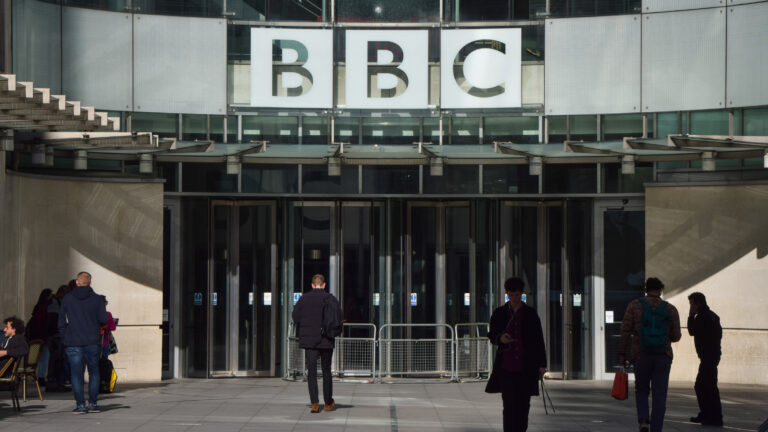
The Enforcement Directorate Wednesday registered a case against the British Broadcasting Company (BBC) India under the Foreign Exchange Management Act (FEMA) for alleged foreign exchange violation, news agency PTI reported. Earlier in February, the Income-Tax Department had carried out surveys at the premises of the BBC in New Delhi, Mumbai on what it alleged was “non-compliance” with transfer pricing rules and diversion of profits. The I-T department alleged BBC has been non-compliant under transfer pricing rules; persistent and deliberately violative of transfer pricing norms. It deliberately diverted a significant amount of profits, and did not follow the arm’s length arrangement in the case of allocation of profit, the department claimed. The tax department’s action came weeks after the British broadcaster had on January 17 released a documentary on the 2002 Gujarat riots titled “India: The Modi Question”. On January 20, the Central government ordered YouTube and Twitter to take down links sharing the documentary, with officials saying it was found to be “undermining the sovereignty and integrity of India” and had “the potential to adversely impact” the country’s “friendly relations with foreign states” and “public order within the country”. The probe is essentially looking at purported foreign direct investment (FDI) violations by the company, they said. The moves comes in the backdrop of the Income-Tax department surveying BBC office premises in Delhi in February. The Central Board of Direct Taxes (CBDT), the administrative body for the I-T department, had then said the income and profits shown by various BBC group entities were “not commensurate” with the scale of their operations in India and tax has not been paid on certain remittances by its foreign entities.

“All is not Well” as Eshwarappa Quits Active politics and Shettar Rebels 

Election fever has gripped Karnataka and things are getting heated in political fray. While the news of veteran BJP leader KS Eshwarappa quitting active politics hasn’t settled, Another senior leader Jagdish Shettar has blown the bugle of rebellion less than a month away from voting day in assembly elections. Former Chief Minister Jagadish Shettar announced he is upset after the party asked him to make way for others and indicated he won’t be given a ticket. Mr Shettar, the MLA from Hubballi, has won six elections in the past. He won by over 21,000 votes in the last assembly election in 2018, defeating his Congress rival Mahesh Nalwad. He comes from Lingayat community. “Last elections I got elected with a margin of more than 21,000 votes. What are my minus points?” Mr Shettar, looking visibly upset, told reporters. “I ask only one question – I won six times, have no blot in my career and have no allegations against me. So why am I being excluded? I want to tell the party to allow me to contest, otherwise it won’t be good for the party,” said the BJP MLA who was Chief Minister in 2012. “I will ask the party to define seniority so that there is no confusion about how they decide who gets to contest. I have a clean image and won Hubballi with good numbers,” Mr Shettar said.

Karnataka: “No Land No Vote” Movement Gears Up Before Elections

Eshwarappa Quits Active Politics

This afternoon, Eshwarappa’s farewell from active politics came as a shocker. He was also asked to make room for others in this election. Sources say that BJP wants to put younger fresh untainted faces in the election and many more will be likely to quit or rebel. In a letter to BJP chief JP Nadda, Mr Eshwarappa said he is retiring from electoral politics he wrote that he wishes to retire from electoral politics and requested it to not consider fielding him from any constituency in the Assembly polls next month. The decision of the former state unit president, who played a key role along with B S Yediyurappa in building the party in the state over the last four decades, came in the midst of the BJP finalising its list of candidates for the elections. “I wish to voluntarily retire from electoral politics. Hence, it is my request not to consider my name for any constituency for the Assembly elections this time,” the former Leader of Opposition in the Legislative Council said in a letter to BJP President J P Nadda.
Eshwarappa, who resigned as minister last year over a corruption charge, expressed his gratitude to the seniors in the party who gave him honourable positions in his 40-year political career right from booth level to the deputy Chief Minister. The 74-year-old Kuruba leader, also known for his controversial statements, is a five-time MLA from Shivamogga, and has served as minister holding various portfolios. Kurubas come under the OBC category in the state. Eshwarappa quit as the Rural Development and Panchayat Raj Minister after a contractor Santosh Patil killed himself a year ago in a hotel room in Udupi accusing him in his suicide note of demanding 40 per cent commission for awarding civil works in Belagavi.

Yediyurappa Sudden Return to Bangalore

On Monday when former CM BS Yediyurappa made a premature departure from Delhi to Bangalore rumors circulated that he is unhappy not having his way with candidate choices. The party leaders have been discussing the candidate list since Saturday evening in Delhi, with one of the reasons for the delay cited back home being Yediyurappa’s insistence on tickets for as many as 30 of his candidates, with the promise to ensure victories of each. There are reports that close to 22 senior party leaders were asked to retire from active politics. With no known Chief minister face in upcoming elections what will be BJP’s election strategy? Will the election be fought on Modi’s name or will BJP expert election strategizing work this time too inspite of party infighting. It remains to be seen!

Bellsonica Workers Protest In One Of The Largest Autoplants In Manesar, Haryana

0

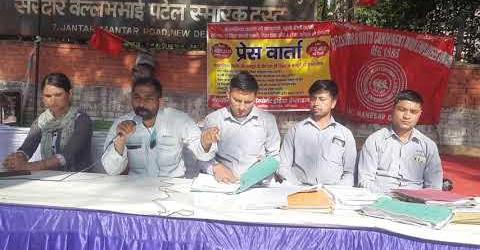
Bellsonica Employees’ Union held a protest followed by a press conference at Delhi’s Jantar Mantar on Saturday. They were protesting against the factory management’s targeted efforts to disband the union and cut down on permanent staff.

Bellsonica Auto Components Private Limited is a Gurgaon-based subsidiary to Bellsonica Corporation, a Japanese multinational company. It is a first-tier vendor for major companies like Maruti Suzuki in the auto sector and employs approximately 700 permanent workers and 1,600 contractual staff. 

The management has been steadily cutting down permanent staff and weakening the union since 2021. Over the past month alone, the management has issued four chargesheets, suspended thirteen permanent workers overall, three of whom are leaders in the union, and sacked three contractual workers who were seeking to unionise. The company also deployed a large number of police forces and bouncers within the factory to intimidate workers.

Chargesheets against Workers over “fake documents”

In July 2021, the management filed chargesheets against 22 workers accusing them of using forged documents to secure permanent jobs. The Bellsonica union responded with legal action and protests, submitting dozens of memos to the DC and management. In a press conference held on Saturday at Jantar Mantar, Union Secretary Ajit Singh claimed that they repeatedly asked the management to provide advertisements, official documents or verifications stating that an applicant must have certain qualifications for the job. The management themselves admitted that the company does not have any official policy criteria for education level, and during the recruitment process, they accept self-declarations from the applicants.

The 22 workers had served the company for over 10 years and produced lakhs of cars. Similar patterns can be seen in Maruti and Bajaj factories. Company management’s across Gurgaon have begun a uniform campaign of fabricating chargesheets against permanent workers as an excuse to retrench them. Singh claimed that the Japanese MD, who sits in the Bellsonica factory, himself stated that he had no other option but to cut down the permanent workforce. Since then, the pattern of issuing chargesheets to permanent workers has continued.

On March 1, 2023, the Union held a six-hour tools-down protest demanding that chargesheets be revoked.

Union Membership to Contractual Worker

Singh highlighted that contractual staff who supported the union or spoke on labour issues were coerced into voluntary retirement (VRS) in August 2021 when the union gave membership to a contractual worker who worked at the factory. They cited Article 19 of the constitution, as well as the Trade Union Act, 1926, which does not specify anywhere that contractual workers cannot unionise. However, the company management as well as the Trade Union Registrar of Haryana deemed this illegal and threatened the union with de-registration.

While the Registrar took issue with the fact that a contractual worker was given membership to a union of permanent staff, they did not take issue with the fact that contractual workers were being made to do work of a permanent nature. The union submitted an unfair labour practices complaint with the Labour Court pointing to this contradiction but no action was taken.

Due to this, the union had to temporarily cancel the membership of the contractual worker, who along with two other contractual workers, went to the High Court of Haryana to resolve the membership issue. The case is still pending in the court and the next hearing is 17 July 2023. However, the management sacked all three workers on April 7, 2023.

Press Conference
Image Source: https://www.facebook.com/b.union1983/

Deployment Of Bouncers

Despite a letter from the Labour Department requesting both parties to maintain peace, the management suspended three union leaders — General Secretary Ajit Singh himself, President Mohinder Kapoor and Organising Secretary Sunil Kumar — on March 17. There has also been high police deployment at the union office, and bouncers carrying guns and lathis have been walking around on the shop floor and intimidating workers. The union complained about this to the Police Commissioner but no action was taken.

‘While workers dont even get proper food and water at the factory but the bouncers are given milk and other condiments every morning. This is the state of the factory that has a union, so one can only imagine the state of factories that don’t.’- Ajit Singh added.

In an effort to undermine the union and push for its de-registration, the management also referred to the union leaders as “Marxists” who extend support to other unions and Jawaharlal Nehru University students.

Push For Informalisation

Attempts to revoke the union’s registration, retrenchments and intimidation of workers should be seen within the larger context of global efforts to informalise organised sector workers.

The proposed Labour Codes, which seek to introduce fixed-term contracts and apprenticeships, and take away the provision to unionise also reflect this trend. The Haryana Government was quick to term the union’s actions “illegal” when it gave membership to a contractual worker, but they have taken no such action against the management for illegally deploying armed bouncers within the factory premises and suppressing worker dissent.  

As of today, there are 150 bouncers stationed at the factory in what can only be seen as an effort to escalate matters further. In his address at the press conference, Saroj Giri expressed fear that the management will use the bouncers to provoke conflict, similar to the Maruti workers’ struggle in 2012. He urged the crowd to take the struggle forward in a comprehensive manner while also connecting it to larger global struggles against capitalist forces.

TMC, CPI loss is AAP’s Gain, What does the National Party Status Mean?

0
In a significant development, the Election Commission of India (ECI) has stripped the Communist Party of India (CPI), Trinamool Congress (TMC), and Nationalist Congress Party (NCP) of their ‘national party’ status. They will be treated henceforth as regional parties. On the other hand, the EC named AAP as a national party based on its electoral performance in four states — Delhi, Goa, Punjab and Gujarat. The Arvind Kejriwal-led party is in power in Delhi and Punjab. The BJP, Congress, CP), Bahujan Samaj Party (BSP), National People’s Party (NPP) and the AAP are now national parties. The Election Commission, meanwhile, derecognised NCP, CPI and TMC as national parties.

Reason For Derecognition

The ECI’s latest order comes in response to the show-cause notices issued to TMC, CPI, and NCP in July 2019, which had specifically sought an explanation on why their national party status should not be revoked, after their performance in the 2019 Lok Sabha elections, according to Indian Express. In their response, these parties requested the poll panel to allow them to retain the national status till 2024. The EC subsequently deferred its decision to review the national status of the parties. In its order, the Commission also revoked the state party status granted to RLD in Uttar Pradesh, BRS in Andhra Pradesh, PDA in Manipur, PMK in Puducherry, RSP in West Bengal and MPC in Mizoram. The Commission said that NCP and Trinamool Congress will be recognised as state parties in Nagaland and Meghalaya respectively based on their performance in the recently concluded assembly elections. TIPRA Motha recognised as a ‘state party’ in Tripura while KCR’s BRS, earlier known as TRS, lost its ‘state party’ status in Andhra but retained it in Telangana. The national and state party statuses are reviewed every 10 years, after the EC amended the rules in 2016, before which the revision was to happen every five years.

What Makes a Party ‘National Party’?

According to paragraph 6B of the Election Symbols (Reservation and Allotment) Order, a political party needs to satisfy any one of three conditions to be recognised as a “national party”. First, it needs to secure at least six per cent vote share in at least four states during the last Lok Sabha polls or assembly elections. In addition, no less than four Lok Sabha MPs should be elected “at the last general election” from any state or states. Second, a party satisfies the recognition criteria if it gets at least two per cent of the total seats in the last Lok Sabha election and the elected members come from at least three different states. Third, as in the case of AAP, the party is recognised as a ‘state party’ in at least four states. Fourth, if the party has “one member to the House of the People for every 25 members or any fraction thereof allowed to that state”. The last criteria to be recognised by the EC is, for a party’s candidates to secure at least eight per cent vote share in the state assembly elections or in the last Lok Sabha polls from the state. The newly assigned status of national party for AAP will definitely be a boost to the party workers and in 2024 elections and as a challenge for both BJP and Congress. Likewise, downgrading the status of parties like TMC, NCP, and CPI is not good news for democracy overall as it makes the number of MPs less representative and lead to more centralisation. When a national party status is achieved, a party posses number of advantages such as common party symbol across states, free airtime during elections on public broadcasters, space for a party office in New Delhi, etc. A recognised national party can contest on all Lok Sabha and assembly seats on its symbol. It also gets to field more star campaigners for electioneering. After losing the national party status, TMC is exploring legal options to challenge the decision of the Election Commission, a party source said. The Nationalist Congress Party on Monday said it would react to the Election Commission stripping the Sharad Pawar-led outfit of its ‘national party’ status after receiving the order in written form.

JD(S) Asks Ban on Kiccha Sudeep Films till Elections

0
Karnataka polls: As actor Kiccha Sudeep says he’ll campaign for BJP, JD(S) asks EC to block his ads till May 10 Kannada superstar Sudeep announced on April 5 that he would campaign for CM Basavaraj Bommai and BJP candidates for the May 10 elections.

The Janata Dal (Secular) party in Karnataka has written to the chief electoral officer of the Election Commission in Karnataka seeking to block the display and screening of advertisements featuring Kannada film star Kiccha Sudeep in the wake of the actor announcing his intent to play the role of a star campaigner for the BJP in the 2023 polls. The party claimed that this might influence the voters during the upcoming May 10 Karnataka assembly elections.

“The well-known film star Kiccha Sudeep has become a star campaigner for the BJP, and advertisements, posters, and promotional events featuring the actor must not be shown on television and print media until the conclusion of the Karnataka polls. Posters of the star must be removed from public places,” advocate and secretary of the JDS legal wing Pradeep Kumar has stated in a letter dated April 6 to the Election Commission. The Kannada superstar announced on April 5 that he would campaign for Chief Minister Basavaraj Bommai and BJP candidates identified by him for the May 10 elections. The actor, director, and producer Sudeep, hails from the Shivamogga district and commands a sizable fan-following by virtue of his status as one of the top five stars of the Kannada film industry. He hails from the Valmiki Nayaka community, a Scheduled Tribe group.

Karnataka: “No Land No Vote” Movement Gears Up Before Elections

0

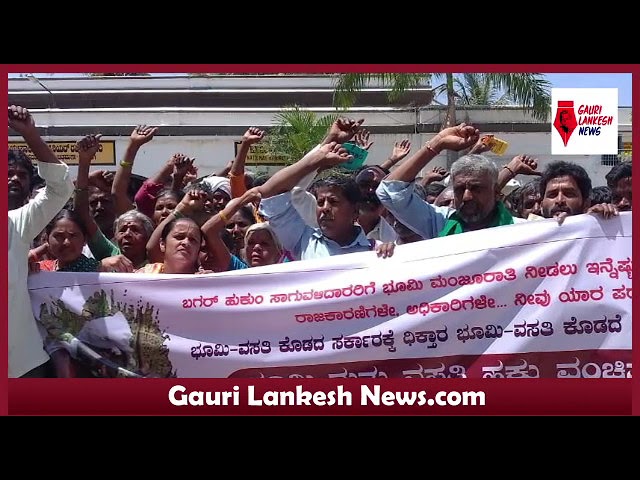
Mandya: Around 200 people came together March 28 to March 30 in New Tamil Colony, Mandya district of karnataka to demand land deeds for their homes. They are protesting for 165 families to get title deeds, for housing projects to be undertaken, and for basic amenities such as water, electricity and roads to be provided. They have also asked that the 1.2 acres of land that had been announced be transferred to the city’s Slum Development Board. The protest was called off after local officials conceded to the demands. 

The protest in Tamil colony began after a rally and meeting on March 26 organised by Karnataka Janashakti and Mahila Munnade over the demands of slum-dwellers in Mandya. Located near Mandya Institute of Medical Sciences, Tamil Colony exists in the city centre and has seen a history of eviction notices and land struggles as the government increases its attempts to profit off the land. Most recently, plans to build an apartment complex had commenced operations. As the Karnataka Assembly Elections get closer, residents of Tamil Colony raised banners saying – “No land, no vote” across the locality. The MLA for Mandya Constituency, M Srinivas, along with other local officials agreed to issue land deeds.

Shramikanagaras or slums across Mandya, such as Hakki Pikki Shramika, Nanda Shramika, Gurumatte Shramika and Indira Badavane have protested and raised banners demanding their rights. Without recognition of land rights, the residents cannot build pakka houses and do not have claims to functional drainage systems or other basic amenities. Less than a month ago, residents of Kalappa Badawane also won deeds to the land they resided upon.

The struggles in Mandya are not alone as similar protests have gained traction across several districts in Karnataka over various land and shelter related causes. These struggles are part of a larger movement spearheaded by Bhoomi Matthu Vasati Hakku Vanchitara Horata Samita or the Land And Shelter Struggles Action Committee. Over the past week, Kodagu has been witnessing indefinite protests against the construction of a cricket stadium on a two-acre patch of land that had been allocated as burial grounds. In Raichur, a three-day land struggle was held from March 27 to 29. A sixteen-day protest was held in Anekal from March 13 to 29. Chitradurga, Koppala and Ballari have also seen night-long protests in front of local taluk offices. 

These protests represent a history of a deeper struggle carried out by Dalit and Adivasi groups over land redistribution and ownership even before the Land And Shelter Struggles Action Committee was set up. They have been fighting to issue title deeds to ‘Bagair Hukum’ cultivators and those cultivating forest land, and to stop forceful land acquisition by large corporations. 

Bagair Hukum cultivators are those who are dependent on small plots of government land for their livelihood but do not have any formal ownership rights to the government land they occupy. Not only has the government denied them legal titles to the land they occupy, it has also evicted many and rendered them shelterless in the interest of private players.

Bagair Hukum Committees that process applications for regularisation of land titles have not been functional for decades and the government keeps extending the period within which applications are to be dealt with. On the other hand, efforts to remove Baigar Hukum farmers from their land have only intensified through concocting charges of land grabbing against Bagair Hukum farmers. There has also been a slow reversal of the old land reform provisions as more and more amendments are being made to relax ceilings on agricultural holdings and allow purchase of agricultural land by  non-agriculturalists.

Read also: Karnataka: Violence Against Farmers In Gubbi And Yelahanka

Lakhs and lakhs of Bagair Hukum farmers and labourers in Karnataka have for generations run around, filling forms and submitting applications to no avail. While the grandchildren of politicians who made empty promises have entered the government, the policies and the empty promises are still the same as their grandfathers. The MLAs are not interested in actually redistributing land since most of them are themselves landlords and are only interested in acquiring more land. In light of the forthcoming elections, people across Karnataka have declared that they will not vote in the elections unless their demands are met.

Centre to Set up Fact-checking Body to Remove ‘Fake News”

0
The Central government has decided to set up a “fact-check body” that will flag false information posted online about the Union government, PTI reported. The Union Ministry of Electronics and IT (MeITy), on Thursday, April 7, notified amendments to the 2021 IT Rules that allow an entity formed by the Union government to decide whether information shared on social media platforms are ‘fake’ or not. This will include news articles or videos published by any media organisation online. The new rule makes it obligatory for social media platforms, considered to be intermediaries, to “not share or host fake, false or misleading information in respect of any business of the Union government.” This basically means that once the fact checking entity of the government brands an article, video etc as false, fake or misleading, it can then ask social media platforms to remove it. Social media platforms such as Twitter and Facebook and other intermediaries will have to take down any information marked as “fake or misleading” by the body if they want to retain the “safe harbour” protections, which provide legal immunity to them against content uploaded by their users. One of the primary amendments made to the rules, which has become controversial, is the appointment of a Fact-checking Unit to identify fake news. “These amendments have been drafted after holding widespread consultations with multiple stakeholders including parents, school teachers, academics, students, gamers and gaming industry associations, child rights bodies, etc,” MeITy said in a statement. Union minister of state for Electronics and IT Rajeev Chandrasekhar told PTI that the government has decided to notify an entity through Meity which would be the fact-checker for all aspects of content online and content related to the government. The Editors Guild of India, however, said it is “deeply disturbed” by the amendments and urged the IT ministry to withdraw the notification. “In effect, the government has given itself absolute power to determine what is fake or not, in respect of its own work, and order take down,” the association said in a statement. The Guild said the amendments will have “deeply adverse implications” for press freedom in the country. Digital rights body Internet Freedom Foundation also raised concerns, saying that assigning any unit of the government such “arbitrary [and] overbroad powers” to determine what is correct “bypasses the principles of natural justice”. The amendments allow the government to bypass Section 69A process for blocking content, the body added in a statement. “The notification of these amended rules cement the chilling effect on the fundamental right to speech and expression, particularly on news publishers, journalists, activists, etc,” the statement said.

Karnataka: Violence Against Farmers In Gubbi And Yelahanka

Last week, a protest in Gubbi town, Tumkur District of Karnataka was met with violence from the forest department forces. Nearly a 100 people in Gangaiahanapalya, Gubbi had come together in a peaceful protest against the acquisition of their land by the forest department. They have been cultivating the land for the past three to four decades and have been taxed for it as well. Sources claim that the forest department is acquiring this land as compensatory afforestation for relieving forest land elsewhere. 

Karnataka Rajya Raitha Sangha (KRRS) and Hasiru Sena State President HR Basavaraj informed us that the forest department forces began to build trenches in Gangaiahanapalya, and when locals protested, they began to beat up protestors. Three people were even admitted to the hospital. They then filed an FIR against the protestors claiming that violence broke out because the locals did not allow them to dig the trenches. KRRS has filed a police complaint in return. The matter is being looked into and the trenches have momentarily been closed. 

In the same week in Yelahanka, the Bangalore Development Authority (BDA) bulldozed five acres of farmland, destroying full-grown sapota, areca palm and coconut crops. Using the upcoming Karnataka Assembly Elections as an excuse, BDA officials allegedly told the farmers that they cannot protest in this period. 

The BDA began its latest round of demolitions for the Dr Shivaram Karanth Layout plan on 24 February, when it bulldozed through farmlands across seventeen villages, including Yelahanka. As reported by Deccan Herald, nine farmers who protested in Yelahanka were taken to the Yelahanka New Town Police Station and booked under Section 353 for “obstructing officials”. They have demanded that the government provide compensation two times the market value in urban areas and four times in rural areas, as per the Right to Fair Compensation and Transparency in Land Acquisition, Rehabilitation and Resettlement Act, 2013. However, the BDA is only offering a pittance of the market value.

The farmers’ struggle against the BDA acquisition of their land has been ongoing since the plan to acquire 3,546 acres for Shivaram Karanth Layout was announced in 2008. More than 15,000 landowners across 17 villages objected to this acquisition at the time and the Karnataka High Court ruled against the acquisition in 2015. The BDA challenged this in the Supreme Court while simultaneously issuing No Objection Certificates (NOCs) to build residences on over 1,200 acres of agricultural land. NOCs were primarily given to gated communities and private layouts. In 2018, the SC reversed the Karnataka HC’s ruling and directed the BDA to issue a final notification and go ahead with the formation of the layout in 3 months. The authority then issued the final notification for 3,546 acres. A plea was filed in the SC highlighting that the land of the rich and powerful were being excluded from acquisition but the SC rejected this plea in August, 2018. By September 2022, the SC regularised some residences and even reprimanded BDA Commissioner Rajesh Gowda for illegally allotting alternate sites within the Layout. BDA forces have invoked the SC order to relentlessly subject the locals of the 17 villages to various degrees of violence. 

Gautam Navlakha Bail Plea Denied by NIA Court

A special National Investigation Agency court on Thursday rejected the bail petition of activist Gautam Navlakha in the Bhima Koregaon case, reported Bar&Bench. Navlakha, a former secretary of the People’s Union for Democratic Rights, had moved the High Court after the special National Investigation Agency court rejected his bail plea on September 5. The National Investigation Agency had opposed Navlakha’s bail plea alleging that he is a member of the banned Communist Party of India (Maoist) and that he possessed incriminating documents related to the group. Navlakha had challenged the special court’s order in the Bombay High Court. Last month, the High Court had directed the special court to conduct a fresh hearing. The High Court had noted that the special court’s order was cryptic and did not consider an analysis of evidence carried out by the prosecution, reported The Indian Express. On November 10, the Supreme Court had allowed Navlakha to be placed under house arrest in Navi Mumbai for a month. The house arrest was extended by a month on December 14 on account of his medical condition. The Bhima Koregaon case, in which Navlakha has been named as an accused person, pertains to caste violence in a village near Pune in 2018. A total of 16 persons were arrested in the case. The 73-year-old was arrested in April 2020.

Elgaar Parishad and Bhima Koregaon Arrests Today

Elgar Parishad Event ‘Had No Role’ in Bhima Koregaon Violence

On 22nd January 2022, a senior police official investigating caste violence on members of the Dalit community at Bhima Koregaon on January 1, 2018, has, on oath, admitted that the Elgar Parishad event, organised 30-kilometres away in Pune city, had no role in the violence. This significant revelation by Sub-Divisional Police Officer Ganesh More, made before the two-member judicial commission to investigate the violence, rips to pieces the Pune police and subsequently the National Investigation Agency’s claims against the 16 human rights defenders arrested in a separate case.  

Pakistan’s Parliament Rejected the SC verdict about holding elections

Pakistan’s parliament on Thursday rejected a Supreme Court order to conduct provincial snap polls, in the latest move in a power struggle between the government and the top court amid political and economic instability. The top court had on Tuesday ruled illegal the government’s move to delay the snap polls in two provinces where former prime minister Imran Khan had dissolved his local governments earlier this year. The speaker, in a live broadcast, said a motion was adopted by a majority of lawmakers to reject the court decision by a three member panel headed by the chief justice and to demand a full court panel consisting of all judges hear the case. Pakistan court strikes down colonial-era ‘sedition’ law The court’s Tuesday order said that the elections in two provinces should go ahead despite government reluctance to hold the votes now as it struggles with an economic crisis and a political challenge from the opposition. It gave a date of May 14 for voting in Pakistan’s largest and most prosperous Punjab province, and a pending date for voting in the northwestern Khyber Pakkhtunkhawa province due to some technical issues. The government and judiciary have been at odds over cases related to political-wrangling, and parliament last week introduced a draft law to clip the chief justice’s powers. Prime Minister Shehbaz Sharif’s government has been saying the country’s poor economic condition didn’t allow spending on the snap polls and then on a general elections due later this year. Khan’s Pakistan Tehreek-e-Insaf (PTI) party and its allies had dissolved the provincial governments, hoping that it would force Sharif’s government to hold snap polls across the country, his longstanding demand since he was ousted a year ago. Separately, Law Minister Azam Tarar said that a full court bench should be set up to look at the issue of elections and give a single date for the general elections in the country. The resolution has laid bare the political fault lines and threat of further instability in the country as the tussle between the judiciary and executive has also drawn the parliament in it.

Students Organisations Demand Restoration of OBC Muslims Reservations

0
On  24th March 2023, the cabinet of ministers of Karnataka state arbitrarily and in absolute haste scrapped the reservations that were provided for the Muslim community under the head 2B of the Other Backward Classes (OBC) category. Instead, they have been moved to the Economically Weaker Sections (EWS) quota. The 4% share in reservations that were released by the scrapping of the 2B Category of Other Backward Classes has been shared equally amongst the two dominant communities of the state – the Lingayat and Vokkaligas – each of them allotted an additional 2% share in reservations. The order goes to make two major claims as the reasons for the scrapping of the reservations under the 2B category. Evoking the judgement in the case of T. Muralidhar and Others v. State of Andhra Pradesh, it states that the 7 judges’ bench in its order dated 8.02.2010 ruled that the reservations provided in Andhra Pradesh Reservation was unsustainable and in violation of Articles 14, 15(1) and 16(2) and that an appeal against the said order was pending before the Hon’ble Supreme Court of India. Union Home Minister who has been making frequent visits to the poll-bound state of Karnataka was speaking at the India Rising Summit where he said, “I agree, we got a bit late doing it (scrapping reservation for Muslims). Reservation on the basis of religion is illegal and it is not in the constitution. There cannot be any reservation based on religion. Congress did it for polarisation and we corrected it” thereby spreading misinformation amongst citizenry that the reservations provided to Muslims was based on religion. However, it must be noted that in the case of Andhra Pradesh the reservations provided to Muslim community was struck down by the judiciary on the grounds of procedural impropriety, improper information and the possibility of increased conversions. The  case of Karnataka has been very different. Reservations provided to the Muslim community in Karnataka is on the basis of their socio-economic and educational backwardness. The order goes further to note that “Whereas at the time 2B category was created and the members of Muslim Community were included/classified as Backward Classes for the purpose of reservation, there was neither any recommendation by any body, nor was there any empirical data nor any materials for granting them the said status. Whereas the members of the Minority community have adequate protection under the Constitution for establishment and administration of Minority Institution/Students. Whereas the Government has taken into consideration the above amongst other factors”. However, the order’s claim that the Muslim community was provided reservations under the 2B category without being recommended by anybody or in the absence of empirical data is a blatant lie that has found a place not just in the rhetorical narratives of the Sangh Parivar and the Bharatiya Janata Party leaders as was the case of CM Basavaraja Bommai’s statement on the issue but also in a Government Order! On one end, the order clearly overlooks Para 6 of the GO it cites as a reference!  The said paragraph reads as “Now the Karnataka State Commission for Backward Classes have submitted special report and 71 advices vide their letter dated 04-12-2000 read at Sl. No. 4 above. Pending consideration of the entire report, the Government have examined in detail the Creamy Layer Policy contained in the Special Report and 71 Advices, relating to inclusions, deletions, correction of spellings etc. and have made the following orders” there by clearly establishing that the reservation were provided on the basis of recommendations made by the Karnataka State Commission for Backward Classes. On the other end it also disregards the over-a-century long history of affirmative actions in Karnataka. The reservations provided to the Muslim community dates back to the pre-independent times wherein the then Maharaja of Mysore, Krishna Raja Wadiyar IV fondly known as Nalwadi Krishna Raja Wodeyar amongst the people of Karnataka implemented it based on the recommendations made by the Justice Miller Committee in 1918 which continued to be in place until Independence. In the post-independence era, all the Karnataka’s Backward Classes Commissions with only the LG Havanur Commission being the exception have, after considering various parameters recommended that a majority of the Muslim community be provided reservations on grounds of socio-economic and educational backwardness. This was later also affirmed by the Sachar committee report. In fact, the order in question violates the principles laid out by the Supreme Court in the Indira Swahney case which stated that any changes to be made to the categories that have the rights of reservation must be based on empirical data-based study. The government order that the Muslim community can avail reservations under the EWS quota is nothing but a mockery of social justice! The socio-economically and educationally backward Muslim communities in Karnataka are now expected to compete with the more better off communities under the EWS quota thereby killing the very idea of social justice where the other dominant communities placed alongside the Muslims are expected to corner the provisions of reservations. It must also be noted that Karnataka is the first state in India to implement the National Education Policy 2020. The NEP is a nexus of neoliberal model of privatisation and Hindutva as is very evident from its promotion of public-philanthropic-partnership model and ‘Sanskrit knowledge systems’ coupled with Bramhinical ideals like ‘dharma’, ‘karma’, ‘swachchhata’ that form the ideological basis of the caste system. The document has nowhere used the word ‘reservation’, implying that the New India under Modi doesn’t care about social justice policies in education sector as well. In this backdrop, the move comes forth as a very toxic mix of casteism and communalism. However, it is clear that the BJP government, fearing that they will be voted out of power in the only South Indian state they have gained some ground at, has used reservations as a tool at their disposal to be able to please and garner votes from certain sections of the electorate. This is evident when we understand that all the changes with respect to reservations – be it the case of SC/ST reservations, Internal reservations and OBC reservations have been introduced in the last three months (since December 2022) in the run-up to Karnataka Assembly Elections 2023 after sitting on people’s demands over the last 3 years. As students’ organisations, we understand this as yet another attack by the ruling BJP regime on the rights of minorities, more so the educational rights of Muslims. After closing the gates of education to Muslim women students in the garb of Hijab and the scrapping of Maulana Azad National Fellowships and the Minority Scholarships of the PhD Scholars, by scrapping the reservations, the ruling regime is determined to deny educational opportunity to the Muslim community. It is in this regard, that all pro-people students’ organisations demand the BJP Government to take back its order. Else, the changes brought in by the BJP government with scant regard to social justice and history of Karnataka shall mark the beginning of end of BJP in the only Southern state it has a footing! As students’ organisations that uphold Preambular values of Socio-Economic and Political Justice and the constitutional values of Liberty, Equality and Fraternity; we understand that the ploy employed by the BJP government in this case to incite communal conflicts in the garb of reservations in the run-up to elections. However, people of Karnataka and students in particular shall rise above such petty communal ploy. Students’ organizations hereby resolve to work with all communities in our quest to uphold the Right to affirmative action and thereby ensure that social justice is served to not just the Muslim community but to every person of Karnataka! Participant organisations: AISA, ASA, Bangalore University Students’ Union, Collective, DVP, GIO, KVS, PARIVARTHANA & SIO

Karnataka Elections 2023: Congress Announces Second List Of 42 Candidates

The Congress has named 42 candidates in its second list for Karnataka Assembly elections scheduled on May 10. Out of the 42 seats, the party has marked Melukote constituency for Sarvodaya Karnataka Party. The party had announced 124 names in its first candidate list that it released last month. In the first list, Congress announced that state party president DK Shivakumar will be contesting from the Kanakapura constituency. Priyank Kharge will be contesting from Chitapur (SC) constituency. Amid expectations that former chief minister and leader of the oppositionSiddaramaiah will contest from Varuna, the leader was allotted the same constituency by the Congress’s high command. Amid speculations of joining BJP ahead of the state assembly elections scheduled on May 10, Kannada actor Kichcha Sudeep confirmed that he will not contest elections, but will support BJP leader and Chief Minister Basavaraj Bommai. Sharing a stage with CM Bommai, he said, “He (Bommai) is like a father figure. If he requires my help, I will help him. I am here to support my uncle.” Meanwhile, expelled JD(S) leader and former Mandya MP LR Shivarame Gowda joined the BJP in presence of party’s state chief Nalinkumar Kateel in Bengaluru on Wednesday.  

Supreme Court Dismisses Plea by 14 political parties alleging misuse of CBI, ED against Political Rivals

0
The Supreme Court Wednesday refused to entertain a plea by fourteen political parties alleging that the Central government led by Bharatiya Janata Party was misusing central agencies like Central Bureau of Investigation (CBI) and Enforcement Directorate (ED) against leaders of opposition parties. A bench of Chief Justice of India DY Chandrachud and Justices PS Narasimha and JB Pardiwala said that political leaders do not enjoy an immunity higher than common citizens as reported by Bar &Bench.   “You are trying to extrapolate the statistics into solid legal guidelines. So now these statistics only relates to the politicians,” CJI Chandrachud said. “How can we start laying down guidelines in abstract context. Laying down general guidelines de hors the facts of the case cannot be done. If an individual comes to us, then the law can be laid down as highest court of the country.. it is in context facts of the case and also a general law. (But) we need to have facts in a case or group of cases,” the Court said. Sorry we cannot entertain this, the bench added. The petition was filed by Indian National Congress (INC), Dravida Munnetra Kazhagam (DMK), Rashtriya Janata Dal (RJD), Bharat Rasthra Samithi (BRS), All Indian Trinamool Congress (TMC), Aam Aadmi Party (AAP), Nationalist Congress Party (NCP), Shiv Sena (UBT), JMM, JD(U), Communist Party of India (Marxist), CPI, Samajwadi Party, J&K National Conference. The petitioners contended that has been an alarming rise in the use of coercive criminal processes against opposition political leaders and other citizens exercising their fundamental right to dissent and disagree with the union government. Madras HC Calls CBI ‘caged parrot’, Asks Union Govt to Make it Autonomous Investigating agencies such as the CBI and ED are being increasingly deployed in a selective and targeted manner with a view to completely crush political dissent and upend the fundamental premises of a representative democracy, it was submitted. The petitioner also shed light on the following statistics to buttress their claims. – The action rate on raids in terms of complaints filed following raids reduced from 93 per cent in 2005-2014, to 29 per cent in 2014-2022; – Only 23 convictions have been secured as of now under the Prevention of Money Laundering Act (PMLA) despite a rise in the number of cases registered by the ED from 209 in 2013-14 to 981 in 2020-21, and 1180 in 2021-22; – Between 2004 and 14, of the 72 political leaders investigated by the CBI, 43 (under 60 percent) were from the opposition of the time. Now, this figure is over 95 percent. In ED investigations, proportion of opposition leaders from total number of politicians investigated rose from 54 percent before 2014 to 95 percent after 2014. The petitioners, therefore, sought guidelines to fulfil and realise the guarantee of personal liberty under Article 21 of the Constitution for all citizens including those targeted for exercising their right to political dissent and for performing their duties as the political opposition. – For arrest and remand The petitioners prayed for the triple test to be used by police officers, ED officials and courts alike for the arrest of persons in any cognisable offences except those involving serious bodily violence. Where these conditions are not satisfied, alternatives like interrogation at fixed hours or at the most house arrest be used to meet the demands of investigation. – For bail The petitioner prayed the principle of ‘bail as rule, jail as exception’ be followed by all courts especially in cases of non-violent offences. They also prayed that bail be denied only where the triple-test is not met. In cases where special laws such as PMLA with stringent bail conditions are concerned, the petitioners sought directions to harmonise such bail with Article 21 of the Constitution. Where it appears that trial is unlikely to complete within 6 months, the accused be released on bail even under special laws unless the conditions under the triple-test are not fulfilled. During today’s hearing, Senior Advocate AM Singhvi appearing for the petitioners, stated that there was clearly a skewed used of the CBI in jurisdictions of opposition ruled States which led to a skewed democratic playing field. “Thus opposition is only fighting these cases… democracy has been held as a basic structure of the constitution”, he argued. It was further contended that the petitioner-parties represent 42 per cent of the electorate and if they are affected, the people are affected. “These are parties all across the spectrum.. thus, level playing field has to be maintained.” The senior counsel asked, “What is democracy when the leaders are just fighting these cases?” Further, he underscored that the process itself was the punishment the triple test could not be satisfied in almost 95 per cent cases. Thus, he argued that when there is a conscious weaponisation of an entire branch of law, then focusing on individual cases was not the answer. However, the Court declined to allow the plea.

Puneeth Kerehalli Arrested in Idrees Pasha Lynching and Murder Case

0
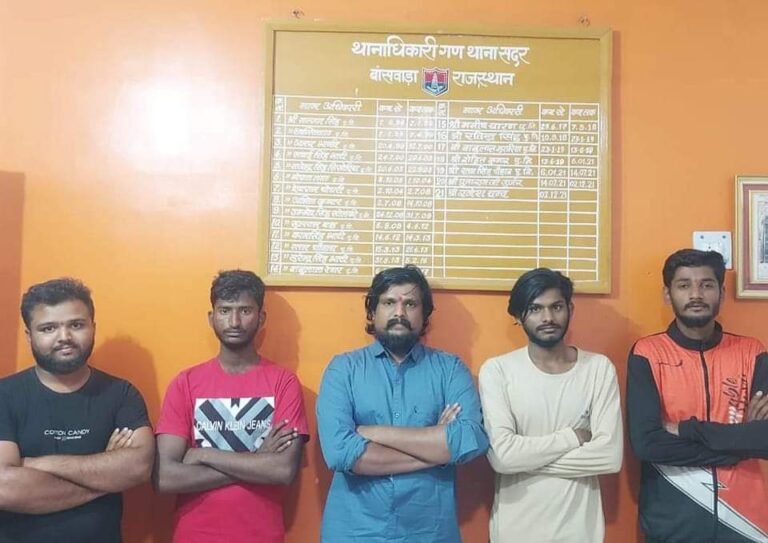
Karnataka police on Wednesday arrested right – wing activist Puneeth Kerehalli, who is accused in the alleged murder of a cattle trader in Ramanagara district. Puneeth along with four others were caught in Rajasthan and they were arrested by the police. According to police, Kerehalli runs ‘Rashtra Rakshana Pade’ a right-wing organization. He had also organized campaigns against halal meat and sought a ban on Muslim traders at Hindu temple fairs in the past. His arrest comes four days after he went absconding. Puneeth is accused of killing Pasha and assaulting his two associates — Syed Zaheer and Irfan — for transporting cattle. Pasha was chased, assaulted and killed by a gang of Hindutva extremists led by Puneeth on March 31. Through videos posted on social media, Puneeth has been known for using a stun gun to inflict pain during his ‘cow vigilante’ outings, and Pasha’s body also had burn marks on it. Puneeth has been photographed with top Bharatiya Janata Party (BJP) leaders in Karnataka. He and four others were booked by the police under Sections 302 (Murder), 341 (wrongful restraint), and 504 (Intentional insult with intent to provoke breach of the peace) of the IPC, based on a complaint lodged by Pasha’s family members. The FIR stated that although Pasha had documents to prove that the cattle he was ferrying was from the local market, Puneeth and his gang continued to threaten him. They even demanded a fee of Rs 2 lakh to release him and threatened to kill him if the amount wasn’t paid.

Critical Views Against Government Policies cannot be termed as Anti-establishment: SC

0
In a significant judgment, the Supreme Court on Wednesday ruled against the telecast ban imposed by the Union Government on Malayalam news channel MediaOne. The Supreme Court on Wednesday quashed the Centre’s denial of security clearance to Malayalam news channel MediaOne, and pulled up the Ministry of Home Affairs for raising national security claims in “thin air” without facts. A bench headed by Chief Justice DY Chandrachud set aside the Kerala High Court order which had upheld the Centre’s decision to ban the channel’s telecast on security grounds. The top court said critical views of the channel against government policies cannot be termed as anti-establishment as an independent press is necessary for robust democracy. “National security claims cannot be made out of thin air, there must be material facts backing it,” the bench said. The Court passed the judgment in a special leave petition filed by Madhyamam Broadcasting Ltd (MBL) – the company running the channel- assailing the Kerala High Court’s judgment of upholding the decision of the Ministry of Information and Broadcasting to not renew the broadcast license of the channel for want of security clearance from the Ministry of Home Affairs. The channel’s editor Pramod Raman and the Kerala Union of Working Journalists had also filed separate petitions challenging the High Court’s judgment. The top court was hearing the plea of the news channel against the Kerala High Court’s order which had upheld the Centre’s decision to ban its telecast on security grounds. On January 31, 2022, the Centre barred the telecast of the Malayalam channel and revoked its licence on grounds of national security. The government’s directive was challenged by the channel in the Kerala High Court which upheld the telecast ban order. Last year in June, the Centre told the Supreme Court that the denial of security clearance to MediaOne is based on intelligence inputs, which are “sensitive” and “secret in nature”. It said that as a matter of policy and in the interest of security of the State and its establishments, the MHA does not disclose the reasons for denial. The Supreme Court heavily criticised the High Court’s approaching in upholding the Centre’s decision solely on the basis of the sealed cover documents submitted by the Ministry of Home Affairs.

Protests In Kenya: Odinga’s opposition

On 2 April 2023, opposition leader, Raila Odinga called off the mass demonstrations that he was leading in Kenya since late March 2023, where thousands came out on the streets. This came in response to an appeal by President William Ruto to engage in talks. While protests have been suspended, Odinga has been clear that they could restart within a few days. The protests were led by Odinga when he blamed the Kenyan President for a failing economy and also claimed that Ruto’s victory in the 2022 election was fixed, despite a ruling from the Supreme Court upholding the validity of the results. During the protest, Odinga demanded that the government allow access to the 2022 election results from the electoral commission’s main computers. Police have been violent at the protests using force to disperse protesters, resulting in four deaths since the protests started. Many Human rights groups, including the Kenya Human Rights Commission, have expressed concern over the abuse by the police during the protests and urged restraint. The Media Council of Kenya reported that journalists have been attacked during the demonstrations. The current protests are the aftermath of controversy in the 2022 elections though they have a long history. The then Deputy President William Ruto was declared the winner of the 9 August 2022 poll, beating Odinga by a very narrow margin. The voting process was relatively peaceful. However, almost immediately, the announcement resulted in protests where supporters of Odinga took to the streets in protest, setting fire to tires and clashing with police. Despite previous pledges by both candidates to handle any disputes in court rather than on the streets, protests erupted in many of Odinga’s strongholds. This was partially expected, as every presidential election outcome has been contested in Kenya since 2002. Kenya had been grappling with severe drought leading to high prices, and widespread corruption.

Also Read: Largest strike in decades brings Germany to a standstill

Brief History

Kenya has undergone significant political changes in the past few decades, marked by several key events, beginning with the 2002 general election. In the 2002 general election, 62% of voters rejected Kenya Africa National Union’s (KANU) presidential candidate, Uhuru Kenyatta, voting in the National Rainbow Coalition (NARC) into power. The Incumbent Daniel arap Moi could not run for a third term due to the two-term limit in the Constitution of Kenya. This was the first time in Kenya since independence in 1964 when KANU was not in power. Kenya had a de facto one-party rule in 1969. The general election saw the end of the dominance of the KANU, which had governed the country since independence, including 23 years as the only legal party. KANU had been a pro-market conservative party and ruled Kenya without contestation until the 1992 election when other parties were allowed to contest. Mwai Kibaki became the President of Kenya, and Daniel Arap Moi, the longest-serving president in Kenya’s history, stepped down from power. In 2003, Crispin Mbai, the head of a key and contentious committee in Kenya’s constitutional reforms that led to the elections, was murdered. Many perceived this as a political murder, sparking outrage and protests, leading to the current cycle of protests following the elections. In 2005 a constitutional referendum was held. This was perceived by the people as a move against President Mwai Kibaki. 57% of voters rejected the draft constitution. In 2007, the general elections were held, and the campaign and election period were heavily polarised along ethnic lines. The results were contested by the Orange Democratic Movement, led by Odinga, and the Party of National Unity led by Mwai Kibaki. Mwai Kibaki was declared victorious. The post-election crisis of 2007–2008 began shortly after the election, with at least 1,133 people killed and more than 600,000 displaced. Ruto was one of the people indicted to stand trial at the International Criminal Court for their involvement in Kenya’s 2007/2008 political violence, but these charges were later dismissed. In 2010, Kenya held a constitutional referendum, with two-thirds of voters approving a new constitution. In 2013, Uhuru Kenyatta was voted in as the fourth President of Kenya, with Ruto as his deputy president, following the 2013 Kenyan General Elections. In 2016, the International Criminal Court dropped its case against the deputy president of Kenya, Ruto. In 2017, the Kenyan General Elections were held, with Chris Msando, the head of IT at the Independent Electoral and Boundaries Commission found murdered. The election was highly contested with allegations of rigging, leading to protests in Nairobi, Western Kenya, and the Coastal region. The police response was lethal, leading to the deaths of at least 12 people and over a hundred injured. The Supreme Court annulled the election results, and fresh elections were called for within 60 days. In the second Presidential election held on 26th October 2017, Odinga refused to participate, citing uncorrected issues within the Independent Electoral and Boundaries Commission, leading to Kenyatta being declared the winner with 98% of the vote. In 2018, amidst a media blackout, Raila Odinga was sworn in as the “People’s President” in an effort to persuade Uhuru Kenyatta to come to the negotiation table. Kenyan lawyer Miguna Miguna officiated the ceremony but was deported in February following treason-related charges. The same year, an investigative report revealed that Cambridge Analytica, a data analytics firm, played a critical role in the elections. Faith in Kenyan elections are at a low owing to the long history of corruption by the political elite in Kenya. Mass Protests after the election had become common since the country moved away from the draconian rule of KANU. Since then, every election, the results have been challenged by the great mass of disenchanted Kenyan voters. As elections are always suspect, protests are one place where the people find their voice.

Kerala Court convicts 14 for lynching tribal Youth Madhu in Attappadi

0
Palakkad: A court in Kerala on Tuesday convicted fourteen persons for lynching and murder of a tribal man Madhu in 2018. The verdict, that comes 5 years after a murder  that created much outrage across communities, was delivered by SC/ST Special Court Judge Ratheesh Kumar. According to Mathrubhumi, the order was passed by a special court constituted for trying cases under the Scheduled Castes and Scheduled Tribes (Prevention of Atrocities) Act (SC/ST Act) The prosecution case was that Madhu, a mentally challenged tribal youth, was tied up and brutally beaten to death by the accused in Palakkad’s Attappadi. The accused had allegedly caught Madhu from a nearby forest and assaulted him after accusing him of stealing rice from a grocery shop. The accused who were found guilty today by the Special Court were accused of committing offenses punishable under Sections 143, 147, 148, 323, 324, 326, 294(b), 342, 352, 364, 367, 368, and 302 r/w 149 of the Indian Penal Code (IPC) and Sections 3(1) (d), (r) (s) and 3(2) (v) of the Scheduled Caste and SC/ST(PoA) Act. The High Court had granted bail to them earlier subject to several conditions. However, the Special Court later cancelled the bail after noting that several witnesses had turned hostile at the behest of accused. The High Court subsequently upheld the cancellation of bail in 2022.’

 The Incident

On 23 May, 2018 a gang of men from Mananthvadi village ganged up against Madhu,  a mentally unstable tribal youth. The assailants  bound his hands  and beat him up for what they said was stealing grocery from shop.  Madhu spent most of  his time in the forest and ventured to the village only on lookout for some food. The brutal lynching of a marginalised tribal over picking  a pack of rice and some basic grocery, created shock and outrage across communities. The prosecution case was that Madhu, a mentally challenged tribal youth, was tied up and brutally beaten to death by the convicts who accused him of stealing rice from a grocery shop.

The Tip of the Iceberg: Sedition and the (Mis)use of the Criminal Law

On 30th March, 2023, the Lahore High Court declared Section 124-A of the Pakistan Penal Code unconstitutional for violating several of the rights guaranteed in the Pakistan Constitution, such as the freedom of speech and expression. This follows on the heels of the Indian Supreme Court putting the Indian equivalent of the same provision in abeyance while a process of review takes place on its efficacy and need. The Indian Supreme Court order, similar to the Lahore High Court judgment, takes note of the argument that the law of sedition, as Section 124-A is known, is used as a tool for the prosecution and targeting of views and activities that are critical of the Government or of powerful interests. The vague provision has been amenable to misuse even after several requirements were read into it by the Supreme Court most notably in 1962, such as an incitement to violence and the unlawful use of force. The question of the constitutionality of the sedition provision has been recurrent both politically as well as legally. It has been pointed out that the provision was suited to the desires of a colonial government, and is fundamentally incompatible with a democratic and rights based legal system, where criticism of the Government should be considered an important right which cannot be suppressed by the threat of criminal law. The Lahore High Court, in its ruling, accepts this argument which leads to the conclusion of the provision’s unconstitutionality. There are obvious similarities in the rights based schema of the Indian Constitution, where the question of freedom of expression and the right to life have undergone extensive development through decades, and the question that remains to be seen is whether the Indian Supreme Court will eventually come to similar conclusions. From a legal standpoint, it is necessary to clarify a certain argument in order to take this discussion forward. In constitutional law, it is often argued that mere misuse of a particular provision is not grounds to declare that the same is unconstitutional. This has been argued by those keen to defend these laws, that the provision by itself is perfectly valid and necessary, but has been misused. This was also the trend followed in 1962, where the Supreme Court upheld the constitutionality of the provision but attempted to thwart its misuse by adding conditions to when the law could be used. It is possible that the same argument may be made today, and was recently made to defend the constitutionality of another notorious provision, which was Section 377 of the Indian Penal Code (the provision criminalising sexual intercourse between people of the same sex). Read also: Same Sex Marriage is Not a Fundamental Right: Central Government to the Delhi High Court The Lahore High Court judgment has proceeded to hold that misuse of the sedition law in Pakistan had attained such intensity and recurrence, that the law had to be held unconstitutional. Similarly, the Indian Supreme Court has held on several past occasions that the effect of a law has to be taken into consideration while deciding its constitutionality. A law can be designed and written in such a manner that on the face of it, it does not have a discriminatory nature. However, if the effect of implementation of that law is discriminatory and unconstitutional, then it should be struck down as being so. Further, if a law by its design is itself prone to misuse, it can be held unconstitutional. To an extent, this answers the use versus misuse argument if one can show that the law of sedition is so prone to misuse by its own design, that it must be held incompatible with the Constitution.
Image Source: https://www.trtworld.com/asia/tens-of-thousands-hit-pakistani-streets-to-protest-imran-khan-s-ouster-56244
It must also be kept in mind that where criminal law is involved, the question of misuse of the law attains a completely different stature than in any other case. Criminal accusations by themselves invoke a very onerous and cumbersome procedure for the accused. The filing of an FIR entails reputational loss, the prospect of arrest, being subjected to searches and seizures, and a host of indirect consequences. These arise much prior to any question of actual guilt or innocence and even use or misuse of the law. Therefore, the use of criminal law must proceed with special caution and care, and where laws are designed to be abused, constitutional safeguards have to be applied to ensure that this cannot be the result. Finally, it must be said that the judgment of the Lahore High Court puts into perspective the question of afterlife of colonial rule in the legal systems of both India and Pakistan. The entire nature and design of the law of sedition, which was used in the colonial period to maintain control over subjects, must be re-evaluated when it comes to the question of infringing the rights of citizens who hold a legitimate participatory role in the governance of the country and are entitled to be treated with dignity and respect for their rights. There are many forms of government power that are called into question here. The almost unlimited and indefinite detention of persons in custody without trial, the use of extra-legal mechanisms such as demolition of property instead of law, and similar abuses of government power are all called into question if we evaluate the question of sedition in its right context. The judgment on sedition opens the door to question all the ways in which a thin veneer of legality is often used to deprive citizens of some of the most cherished rights in the Constitution. Often, the arguments of public safety and order that are used to justify these laws are substitutes for the uncontrolled authority of persons in power against any form of dissent. Kunal Ambasta, Assistant Professor, NLSIU Bangalore. Views are personal.