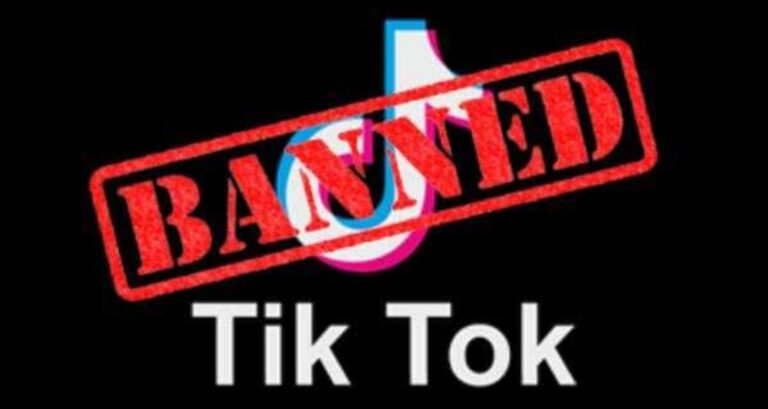
The Indian government has announced a ban on 59 such Chinese apps, including Tik Tok. The government has decided to disallow the usage of these apps both in mobile and non-mobile Internet-enabled devices.
The press release from the IT ministry states that the Central government has decided to ban Chinese apps diverting data and those with privacy issues.
The IT ministry has banned 59 Chinese-owned applications, including TikTok, ShareIt, UC Browser, Likee, WeChat, and Bigo Live. The Ministry stated they were “prejudicial to sovereignty and integrity of India, defense of India, the security of the state and public order.”
The Minsitry used Section 69A of the Information Technology Act.
In a press release from the Ministry of Electronics and IT, the ministry has raised concerns about the data security and privacy of 130 crore Indians.
The release states-
“It has been noted recently that such concerns also pose a threat to the sovereignty and security of our country. The Ministry of Information Technology has received many complaints from various sources including several reports about the misuse of some mobile apps available on Android and iOS platforms for stealing and surreptitiously transmitting users’ data in an unauthorized manner to servers that have locations outside India. The compilation of these data, its mining and profiling by elements hostile to national security and defence of India, which ultimately impinges upon the sovereignty and integrity of India, is a matter of very deep and immediate concern which requires emergency measures.”
The Indian Cyber Crime Coordinate Centre under the Ministry of Home Affairs sent an exhaustive recommendation for blocking these “malicious apps,” the IT ministry. “This Ministry has also received many representations raising concerns from citizens regarding security of data and risk to privacy relating to operation of certain apps.”
In addition, the CERT-IN also has received representations from citizens regarding security of data. Parliamentarians have also flagged the issue, the release said.
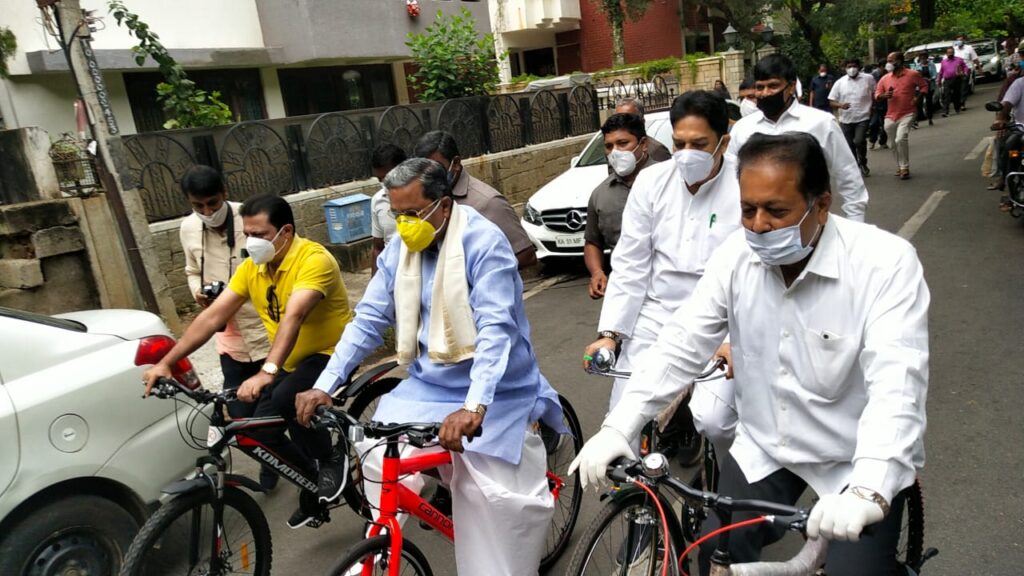
Former Karnataka Chief Minister and senior Congress leader Siddaramaiah along with Congress leaders on Monday rode a bicycle from his residence to Minsk Square in Bengaluru to protest against the hike in fuel prices.
KPCC President DK Shivakumar was also seen riding a bicycle along with other members of the Congress party to Minsk Square where the party staged the protest.
Siddaramaiah on Monday slammed Prime Minister Narendra Modi over a drastic hike in fuel prices.
Siddaramiah has also written to PM Modi on 17th June raising concerns about the fuel price hike in the country amidst the Covid-19 pandemic. He has alleged that the BJP government is extracting flesh out of the common people when the country is undergoing a crisis.
“Continuous hike in fuel prices since the last 22 days has exposed the opportunistic and inhumane character of PMO India, Narendra Modi. Poor and middle-class people are worst affected and this comes at a time when the world is facing health crisis and job loss,” Siddaramaiah tweeted.
Continuous hike in fuel prices since last 22 days has exposed the opportunistic & inhumane character of @PMOIndia@narendramodi.
Poor and middle class people are worst affected and this comes at a time when the world is facing health crisis & job loss.#SpeakUpAgainstFuelHike
“BJP leaders jumped to criticise Dr. Manmohan Singh for increasing fuel prices marginally when crude oil price touched USD 120. Now with crude prices at just USD 30, the Narendra Modi government has increased fuel prices drastically. Why are BJP leaders silent now?
#SpeakUpAgainstFuelHike,” he added.
.@BJP4India leaders jumped to criticize Dr. Manmohan Singh for increasing fuel prices marginally when CrudeOil price touched $120.
Now with Crude price at just $30, @narendramodi govt has increased fuel prices drastically.
During the protest, Mr Siddaramaiah and Mr Shivakumar along with party leaders carried a bike on their shoulders.
“We are carrying out our duty today. At the time of the UPA government’s rule, when there was any hike in fuel prices, several BJP leaders had made bold statements. It is ironic that today, at the time of this COVID-19 pandemic, even despite the price of barrels falling, they have increased fuel prices,” said Mr Shivakumar.
“In Delhi, diesel prices have exceeded petrol prices. We must protest against this. The DCP can file whatever case he wants to. Despite several cases against us, we have never been shaken up. They are inconveniencing people and causing the people to burn in hell. These people must be protected,” he added.
With the hike in fuel prices, the petrol prices stand at Rs 83.04/litre (increase by Rs 0.05), and the diesel prices stand at Rs 76.58/litre (increase by Rs 0.13) in Bengaluru, according to a price notification of state oil marketing companies.
The Congress has termed the increase in the prices of petrol and diesel as “unjust” and “thoughtless”, and urged the Central government to roll back the increase with immediate effect and pass on the benefit of low oil prices directly to the people.
Governments across the developedworld have responded to the COVID-19 crisis by making welfare states vastly more generous. Historical parallels suggest that this munificence may endure even as the pandemic recedes.
Welfare states will only, however, become permanently more generous if voters believe this pandemic poses an enduring risk to their incomes and if they make common cause with the people who have been worst affected.
The most pertinent historical parallel to the current situation is the second world war. After the conflict, governments dramatically increased both the number of people covered by the welfare state and the value of the payments they received. At that time, people were demanding greater social insurance in the face of universal risks and pervasive uncertainty.
Social Spending includes the following: health, old age, incapacity-related benefits, family, active labour market programmes, unemployment, and housing.Our World in Data (2020), CC BY
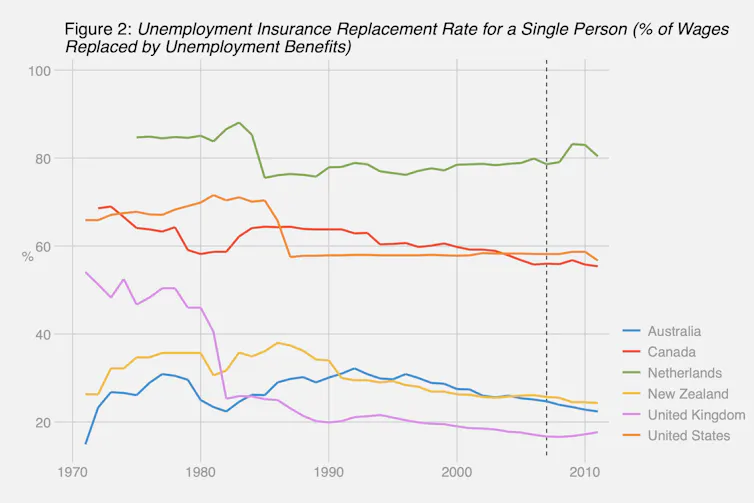
The late 1970s marked the end of this golden era. Technological advances, demographic change and globalisation led to increased fiscal pressures and cuts to the generosity of modern welfare states.
Alongside these structural pressures, automation and trade were also destroying mid-skill manufacturing occupations. Labour markets became segregated into high- and low-skilled jobs. And while high-skilled workers didn’t feel the need for an expanded welfare state, those working in low-skilled professions were too small a constituency to make a difference at the ballot box.
In short, structural pressures were making the welfare state more expensive and governments faced little electoral incentive to be generous.
Dotted line indicates the start of the Great Recession in 2007.Comparative Welfare Entitlements Dataset
Later, the impact of the recession that followed the 2007-8 financial crash was concentrated among low-skilled workers. Governments did not increase the generosity of the welfare state in response. The total amount spent on social security payments did temporarily increase as unemployment rose, but the individual payment amounts did not.
What makes COVID different?
The impact of the current economic crisis is much wider. Both the pandemic and the corresponding public health measures – the forced closures of businesses and schools – have taken their toll on people’s ability to work across the income distribution. The figure below shows that the increases in unemployment claims literally go off the old charts.
Australian Bureau of Statistics, Statistics Canada, Bureau of Labor Statistics (US), Office for National Statistics (UK)
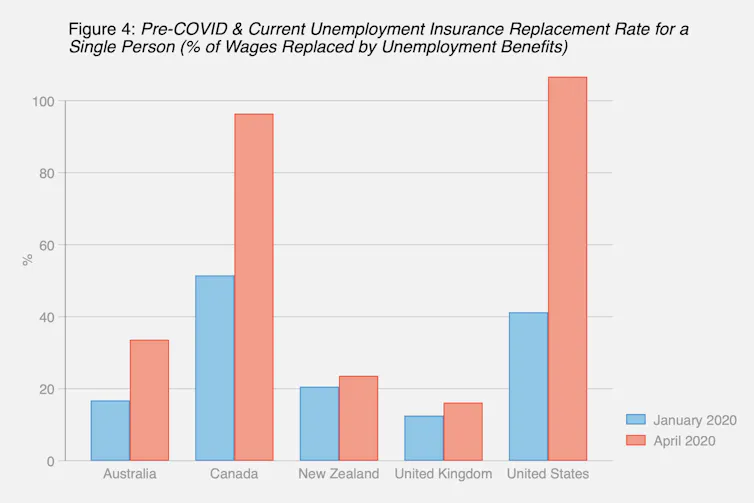
Just as with the second world war, the universal impact of this crisis and the subsequently greater risks it poses has led to a correspondingly large increase in the generosity of the welfare state.
The particular hazards this pandemic poses has also led to changes to specific social insurance payments. The risks to people’s health have increased demand for sick pay among workers. Everyone who could potentially be infected is advised to stay away from work for between one and two weeks, and governments have been stepping up and cover that cost. Even the US, which had no nationally mandated sick leave prior to this crisis, finally introduced some sick pay in response to the pandemic.
Canada figure includes both Employment Insurance and Canada Emergency Response Benefit. US figure takes average UI payment across states plus national Pandemic Unemployment Compensation Payment of $600. Average Wage in 2019 used for calculations across all countries.Australian Government, Government of Canada, Center for Budget and Policy Priorities (US) & Department for Work and Pensions (UK).
A new consensus on welfare
This pandemic will only, however, lead to a permanently more generous welfare state if electorates believe it poses an enduring risk to the livelihoods of themselves or those they care about and subsequently vote for governments who will protect their incomes. If enough voters now feel that this pandemic or a future crisis could suddenly and dramatically hit their incomes, then they will demand significantly higher social insurance payments as protection. Political parties will then feel pressure to deliver on these demands in order to win elections.
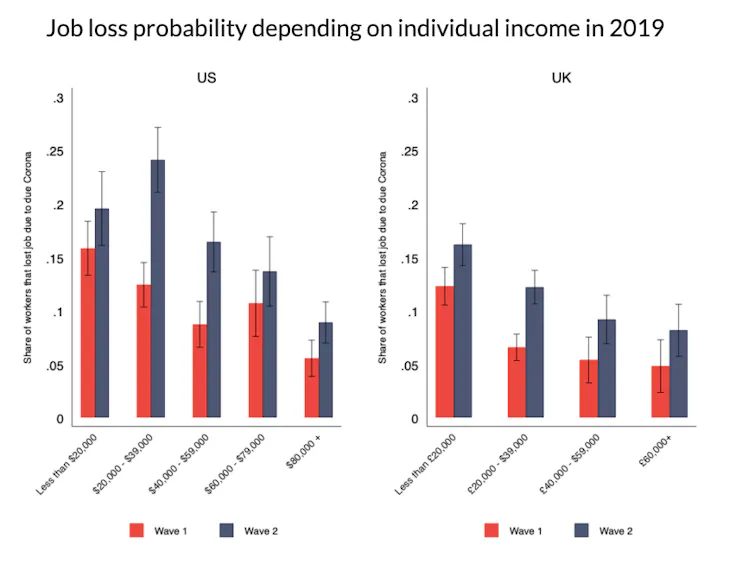
But here we sound a note of caution. This pandemic will not necessarily lead to a more generous welfare state. While its impact has been universal, the economic and health risks have been, and will continue to be, most severe for the poor. It has been low-paid workers in sectors such as tourism, hospitality, retail and transport who have been the most likely to lose their jobs. High-skilled workers may still demand higher social insurance payments either because they are concerned for their own incomes or feel an affinity with the worst affected, but this is not guaranteed. If it is only the low-skilled few who demand a more generous welfare state, then governments will feel little pressure to deliver it.
Unemployment Risk by Earnings in the UK and USA.COVID Inequality Project
COVID-19, by posing a universal risk and forcing us to engage in a common cause, has the potential to forge a new consensus on the welfare state. A majority of voters could now demand that political parties supply social insurance payments that are significantly more generous than before the crisis hit. When this pandemic passes, electorates may not be content to reduce sickness-related social security payments knowing that they could have needed it, or may do, in the future. They may not be satisfied that social security payments to a now-essential grocery store worker are too low to allow them to escape poverty.
Just as with the second world war, “one happy consequence of this otherwise desperately unhappy experience,” may be a more generous welfare state that insures us all against the risks posed by illness and poverty.
Jeevun Sandher, PhD Candidate – Department of Political Economy, King’s College London and Hanna Kleider, Lecturer in public policy, King’s College London
This article is republished from The Conversation under a Creative Commons license. Read the original article.
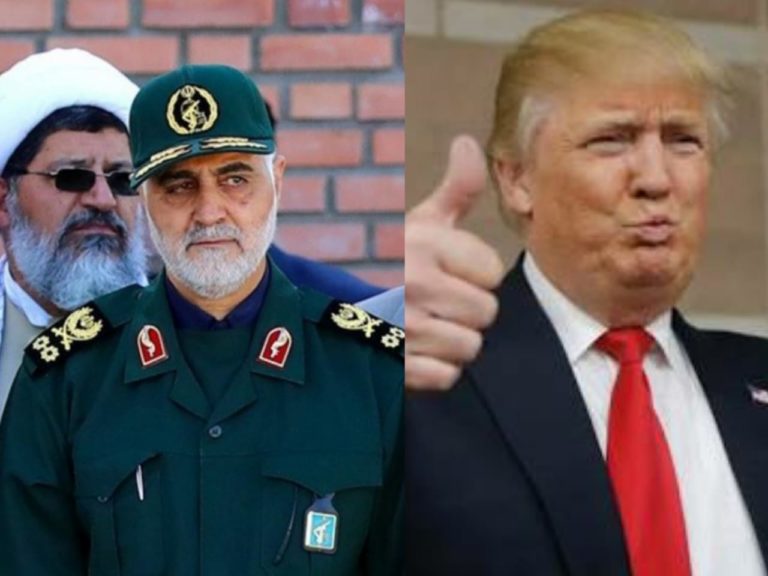
Iran has issued an arrest warrant for President Donald Trump and a dozen others for their involvement in a drone strike that killed top Iranian Gen Soleimani in Baghdad in January 2020.
Iran has also asked help from Interpol in detaining US President Donald Trump.
The US killed Soleimani, who oversaw the Revolutionary Guard’s expeditionary Quds Force, and others in the January strike near Baghdad International Airport.
This new twist in US-Iran relations shows further deterioration in tensions between the two countries.
The relations between US and Iran have been on a decline for years and especially when early this year President Trump Trump unilaterally withdrew America from Tehran’s nuclear deal with world powers.
The prosecutor in Tehran Ali Alqasimehr said Trump and more than 30 others whom Iran accuses of involvement in the January 3 strike that killed Gen. Qassem Soleimani in Baghdad face “murder and terrorism charges,” the semiofficial ISNA news agency reported.
Alqasimehr did not identify anyone else sought other than Trump but stressed that Iran would continue to pursue his prosecution even after his presidency ends.
Alqasimehr also was quoted as saying that Iran requested a “red notice” be put out for Trump and the others, which represents the highest level arrest request issued by Interpol.
Will Interpol Intervene?
According to Associated Press, Interpol, based in Lyon, France, has not commented on the development.
Normally, after receiving a request, Interpol meets by a committee and discusses whether or not to share the information with its member states. Interpol has no requirement for making any of the notices public, though some do get published on its website.
It is unlikely Interpol would grant Iran’s request as its guideline for notices forbids it from “undertaking any intervention or activities of a political” nature.
In the case of a Interpol alerts, the local authorities end up making the arrests on behalf of the country that requests it. The notice to Interpol cannot force countries to arrest or extradite suspects but can put government leaders on the spot and limit suspects’ travel.
The US killed Soleimani, who oversaw the Revolutionary Guard’s expeditionary Quds Force, and others in the January strike near Baghdad International Airport. It came after months of incidents raising tensions between the two countries and ultimately saw Iran retaliate with a ballistic missile strike targeting American troops in Iraq.
The issue of sexual harassment of women at the workplace has overlapping issues of it being a criminal offence, gender discrimination, as civil liability and abuse of workers’ rights, and also a violation of human rights among other things.
The percentage of women in a position of power or in a position of authority is very minimum. It is of course quite possible that even women in position of power in the hierarchy could be sexually harassed by a subordinate, or one of equal cadre colleagues, or persons of another establishment.
In the matter of Vishaka Vs State of Rajasthan the Supreme Court have laid down guidelines as follows:
” Workers Initiative: Employees should be allowed to raise issues of sexual harassment at workers meeting and in other appropriate forums and it should be affirmatively discussed in Employer-Employee meetings”.
Thus, recognising the primary status of the victim to be a worker. The Supreme Court also considered that it is to do with a clean and safe environment for a worker and is to be a valid point for discussion in workers’ meetings.
The Sexual Harassment of Women at Workplace (Prevention, Prohibition and Redressal), the 2013 Act, also has left the door open for women workers to seek redressal under the Industrial Disputes Act, 1947(ID Act).
As directed by the Supreme Court, the Central Government, included sexual harassment at workplace as a “misconduct” and consequent disciplinary proceedings in the Industrial Establishments (Standing Orders) Central Rules and Model Standing orders contained in IE((SO) rules. As directed in Medha Kotwal lele Vs Union of India, Interim order dated 26th January 2004 in W.P. (Cr) No. s 173-177/1999 the inquiry conducted by the Internal Complaints Committee has the validity of a domestic inquiry authority for the purposes of the Central Civil services (Conduct) Rules, 1964.
There could be a choice of also filing a petition under the Industrial Dispute Act, in case the management interferes adversely against a case of complaint of sexual harassment at workplace.
It is deemed as unfair labour practice when there is victimisation or retaliation on complaining of sexual harassment at workplace. Also, if the management defends the perpetrator or does not take any preventive or redressal steps regarding sexual harassment at workplace. If the management does not communicate to the employee and third parties that it clearly prohibits any kind of sexual harassment at workplace.
In respect of Government servants, the Central Civil Services (Conduct) Rules) stipulates that every Government Servant shall at all times:
(i) Maintain absolute integrity;
(ii) Maintain devotion to duty
(iii) Do nothing which is unbecoming of a government servant.
Hence if a Government servant behaves inappropriately or conducts himself in such a way as to cause sexual harassment of a woman at workplace, he can be liable for disciplinary action under the service rules and also under the Act.
The Supreme Court has held that in a domestic inquiry the misconduct need not be proved beyond all reasonable doubt, but if there are preponderance of probabilities, that is enough for holding a person guilty of misconduct.
“Quid pro quo harassment”. The said harassment contains a threat of adverse implication or an indication of preferential treatment. Thus, it is usually perpetrated by a person in power who is believed to have the authority or leverage to exercise such treatment. In such a situation the employer can be held liable for putting or keeping an employee in a vulnerable situation.
Similarly, an employer should also be held liable if there is a potential for creating a hostile work environment.Sexual harassment at workplace creates a hostile work environment. It harms the workers’ health and self-esteem. Hostile work environment engenders the safety and cleanliness of the workplace. It affects the work potential of the worker and may result in abstention, attrition, inefficiency and loss of production.
Hostile work environment exists when one’s behavior within a workplace creates an environment that is difficult or uncomfortable for another person to work in, due to discrimination. The conduct must create a work environment that would be intimidating, hostile, or offensive, to a reasonable person. An employer can be held liable for failing to prevent these adverse workplace conditions. Sexual harassment by an employer is a form of illegal employment discrimination.
In Liberty Group Ltd v M (2017) 38 ILJ 1318 (LAC), an employee resigned from her employment and stated in her resignation letter that her employment had become intolerable due to ongoing and continued sexual harassment by her manager. The employee then instituted an unfair discrimination claim against her employer.
The Labour Court (LC) and later the appellate court found the employer liable for failing to take reasonable steps to protect the employee from sexual harassment.
RSS is the Hindutva gurukul, (university) which specialises in training it’s cadres in the internalising of half-truths and lies, based on the manufacturing of history. A recent proof of this is evidenced in Ram Madhav’s claim that, Indian democracy survives due to “leaders in the government who fought for that very freedom and are committed to liberal democratic values, not just as a matter of compulsion but as an article of faith.”[i] Described as an ‘RSS ideologue by commercial television channels, Madhav was speaking on the 45th anniversary of the Emergency. His falsified claim is that RSS-BJP leaders fought against the Emergency, not out of compulsion but as an article of faith in democracy. Both claims are white lies. This can be seen not just from the claims of critics of the RSS, but from all contemporary RSS documents available.
Let us take first, address the claim that the RSS-BJP rulers are/have been committed to the liberal democratic values, as an article of faith. The most prominent ideologue of the RSS, MS Golwalkar, also known as the ‘Guru of Hate’ [whom PM Modi credits for grooming him into a political leader] while addressing as many as 1350 top-level cadres of the RSS, in 1940, declared, “RSS inspired by one flag, one leader and one ideology is lighting the flame of Hindutva in each and every corner of this great land.”[ii]
With such a philosophical liking for totalitarianism, the RSS has hated the sharing of power. This can be seen from the outfit’s strong opposition to the federal structure of the constitution, a ‘Basic’ feature of the Indian republic. Golwalkar, declared in 1961, “Today’s federal form of government not only gives birth but also nourishes the feelings of separatism, in a way refuses to recognise the fact of one nation, and destroys it. It must be completely uprooted, the constitution purified, and (a) unitary form of government be established.”[iii]
As far as the Emergency is concerned, the RSS claim of fighting against it needs also to be evaluated in the light of contemporary narratives as also from RSS’ own documents. In this connection, two narratives, one by a veteran thinker and journalist of India, Prabhash Joshi and the other, by TV Rajeswar, former Intelligence Bureau [IB] chief, who was the deputy chief of IB during the Emergency, are of immense importance. They recounted the days of Emergency (or state authoritarianism) when the RSS surrendered to the repressive regime of Indira Gandhi, assured both her and her son, Sanjay Gandhi, of their cooperation to enforce faithfully the draconian 20-point programme, announced by the Emergency regime. A large number of RSS cadres came out of jails by submitting maafinaamas (mercy petitions).
This contemporary, historical narrative by Prabhash Joshi, appeared in the English weekly, Tehelka on the 25th anniversary of the Emergency.[iv] According to Joshi, even during the Emergency “there was always a lurking sense of suspicion, a distance, a discreet lack of trust” about the RSS’ joining the anti-Emergency struggle. He went on to write, that “Balasaheb Deoras, the then RSS chief, wrote a letter to Indira Gandhi pledging to help implement the notorious 20-point programme of Sanjay Gandhi. This is the real character of the RSS…You can decipher a line of action, a pattern. Even during the Emergency, many among the RSS and Jana Sangh who came out of the jails, gave maafinamas. They were the first to apologise. Only their leaders remained in jail: Atal Behari Vajpayee [most of the time, in the hospital], LK Advani, even Arun Jaitley. But the RSS did not fight the Emergency. So why is the BJP trying to appropriate that memory?”
Prabhash Joshi’s conclusion was that “they are not a fighting force and they are never keen to fight. They are basically a compromising lot. They are never genuinely against the government”.
TV Rajeswar, who served as Governor of Uttar Pradesh and Sikkim penned a book, ‘India: The Crucial Years” [Harper Collins], in which, he corroborated the fact, that, “Not only they (RSS) were supportive of this [Emergency], they wanted to establish contact apart from Mrs Gandhi, with Sanjay Gandhi also”.[v] Rajeswar in an interview with Karan Thapar disclosed that, Deoras, “quietly established a link with the PM’s house and expressed strong support for several steps taken to enforce order and discipline in the country. Deoras was keen to meet Mrs. Gandhi and Sanjay. But Mrs. Gandhi refused.”[vi]
According to Rajeswar’s book,
“RSS, a right-wing Hindu nationalist organisation, was banned in the wake of the Emergency. But its chief, Balasaheb Deoras, quietly established a link with the PM’s house and expressed strong support to several steps taken to enforce order and discipline in the country. Sanjay Gandhi’s concerted drive to enforce family planning, particularly among Muslims, had earned Deoras’s approbation.”[vii]
Rajeswar also shared the fact, that, even after Emergency, the “organisation, (RSS) had specifically conveyed its support to the Congress in the post-emergency elections.”[viii] It will be interesting to note that even according to Subramanian Swamy during the Emergency period, most of the senior leaders of RSS had betrayed the struggle against the Emergency.[ix]
Contemporary documents in the RSS archives corroborate the narratives proffered by Prabhash Joshi and Rajeswar. The 3rd Supremo of RSS, Madhukar Dattatraya Deoras wrote the first letter to Indira Gandhi within two months of the imposition of Emergency. It was the time when state terror was running amok. In a letter dated, August 22, 1975, he began with the following praise of Indira:
“I heard your address to the nation which you delivered on August 15, 1975, from Red Fort on radio in jail [Yervada jail] with attention. Your address was timely and balanced so I decided to write to you”.[x]
Indira Gandhi did not respond to it. So Deoras wrote another letter to Indira on November 10, 1975. He began his letter with congratulating her on being cleared by the Supreme Court of disqualification (in the elections) which was ordered by the Allahabad High Court, “All the five Justices of the Supreme Court have declared your election constitutional, heartiest greetings for it.” It is to be noted that opposition was firm of the opinion that this judgment was ‘influenced’ by the Congress. In the course of the letter, he declared that “RSS has been named in the context of Jaiprakash Narayan’s movement. The government has also connected RSS with the Gujarat movement and the Bihar movement without any reason…Sangh has no relation with these movements…”[xi]
Since Indira Gandhi did not respond to this letter also, RSS chief got hold of Vinoba Bhave who supported the Emergency religiously and was a favourite of Indira Gandhi. In a letter dated January 12, 1976, he begged that the Acharya should suggest a way to ensure that the ban on the RSS was removed.[xii] Since the Acharya, too, did not respond to Deoras letter, the latter in another letter without date wrote in desperation,
“According to press reports, respected PM [Indira Gandhi] is going to meet you at Pavnar Ashram on January 24. At that time there will be a discussion about the present condition of the country. I beg you to try to remove the wrong assumptions of PM about RSS so that ban on RSS is lifted and RSS members are released from jails. We are looking forward to the time when RSS and its members are able to contribute to the plans of progress that are being run in all the fields under the leadership of PM.”[xiii]
All these letters in Hindi are being reproduced from a publication of the RSS at the end of this article.
Significantly, former President of the Indian Republic, Pranab Mukherjee was invited by the RSS chief, Mohan Bhagwat as the chief guest at the graduation ceremony of its new recruits. These recruits are trained to work over-time (on social and political steps) to convert India into a theocratic (Hindu) state. Pranab Mukherjee has been known, and held responsible too, as one of the top leaders of Congress, responsible, for Emergency excesses. The tragedy of the RSS in power at the Centre is that India, while a constitutional democracy, is governed by a love of power, which compels its spokespersons to indulge in doublespeak.
Despite these facts, it is shameful, that thousands of RSS cadres continue to get a monthly pension for ‘persecution’ during Emergency. BJP ruled states like Gujarat, Madhya Pradesh, Rajasthan and Maharashtra have decided to award a monthly pension of Rs 20,000 to those who were jailed during the Emergency period for less than 2 months and Rs 10,000 to those who were jailed for less than a month. This rule took care of the financial interest of those RSS cadres who submitted mercy letters completing only one or two months’ jail term. For securing such a significant pension, there is no condition that the beneficiary should have been in jail for the whole period of the Emergency.
Interestingly, in the case of anti-British freedom struggle, not a single person from RSS cadres is fit to claim a freedom fighters pension. Neither does India remember hundreds of Communist youth, branded as Naxals, who were killed in brute extra-judicial killings (“fake encounters”) during the Emergency. Interestingly, the Shiv Sena too, a former Hindutva co-traveler of the RSS openly supported the Emergency.
The author can be reached at [email protected]
Women ´s rights activists and social organisations have expressed deep concern over the recent remarks of Karnataka High Court judge Justice Krishna S Dixit’s statements while allowing a bail plea in a rape case.
On 22nd June 2020, The Karnataka High Court bench comprising of Justice Krishna S Dixit had issued an order in the case of Rakesh BV Vs State of Karnataka. In this order, a plea of Rakesh BV for anticipatory bail against accusations of rape was accepted by the High Court. However, instead of looking at the legal merits of the bail application, the order has judged a women’s conduct on patriarchal, misogynistic, and ‘moral’ grounds.
Issues with the Judgement
The judgement is problematic on various grounds. Firstly it assassinates the victim’s character to dismiss the allegations of rape covered up under the cover of non-availability of prima facie evidence of the crime. The order notes that the victim accompanied the accused to the hotel and did not object to “drink with the accused”. This is an attempt of the judiciary to shift the burden of assault away from the accused and making the victim responsible for the sexual assault she had to undergo. The order also makes unacceptable statements related to the conduct of women. The victim’s claim of having slept after the perpetration of the act as she was tired has been noted as “unbecoming of the Indian women”. It has further gone on to state “That is not the way our women react when they are ravished”. The higher judiciary thereby takes upon itself to judge what conducts of women is acceptable and what is not. This is only a testimony of the judiciary’s patronizing undertone. The judiciary also claims women as it’s own thereby denying the right of women to self-identify as individuals with their own identity and reasoning. The complainants’ failure to justify why she went to her office at 11 PM on the day of the alleged crime is cited as one of the reasons to accept the accused’s bail plea.The undertone of such reasons is only mirroring the patriarchal view while questioning the act of women practicing freedom in its truest sense.
Judiciary and Patriarchy
Despite such efforts, the social and political systems including the judiciary have not been free from discriminatory practices of patriarchy. In fact, the Indian Judiciary has on innumerable occasions has failed to uphold the constitutional values of freedom and equality. One example for the same is the instance when Prof Upendra Baxi and Lotika Sarkar amongst others had to write openly to the Chief Justice of India in 1979 to pull-up the conscience of the judiciary and revisit itself when the top court acquitted the accused by questioning the “moral” integrity of a 15-year old whom it claimed had been “habituated to sexual intercourse”.
The Women’s Rights Activists and concerned Indian citizens have rightly expressed their disappointment about the decision rendered by the High Court of Karnataka. They have also called the judiciary to correct by itself this blatant violation of women’s rights and dignity. The violation of women’s rights and dignity is indeed the violation of the ideals of the Constitution. They have called the judiciary to stand by the women of India in their struggle to build an equitable, just, and democratic society with zero tolerance to violence women and all marginalized genders.
Organisations
Stree Jagruthi Samithi
Mahila Munnade
Gamana Mahila Samuha
AIPWA (All India Progressive Women’s Association)
All India Janwadi Mahila Sanghatane
Sadhana Mahila Sangha
PUCL Karnataka
AIPF
AICCTU
Swaraj Abhiyan
Karnataka Janarogya Chaluvali
Naavu Bharateeyaru
Karnataka Janashakthi
Forward Trust
Open Space
Blank Noise
HID Forum
Fraternity Movement
Individuals
Ramachandra Guha, Historian, Author
Arundhathi Nag Managing Trustee and Artistic Advisor, Ranga Shankara
The government of India has agreed to allow the World Bank (WB) to intervene in the Indian school education system through Strengthening the Teaching-Learning and Results for States (STARS) program.
The World Bank Board announced on their website on 24th June 2020 that the Executive Directors of WB have approved a $500 million STARS project to improve the quality and governance of school education in India.
STARS is to be implemented in six states on a pilot basis. These states are Himachal Pradesh, Kerala, Madhya Pradesh, Odisha, Maharashtra, and Rajasthan.
All India Forum for Right To Education (AIFRTE), a federal platform of more than 80 students, youth, teachers and civil society organization from all over India has opposed the Government of India’s move to surrender school education to the World Bank under the STARS program.
In its open letter to PM Modi dated 24th June 2020, they have questioned the hypocritical stances of his government. They have noted that the government calls to create ‘Atmanirbhar Bharat’ on one end and then invites the World Bank to design and monitor school education in India.
The Forum has expressed its angst against the Union Government’s move to allow World Bank intervention yet again after DPEP( District Primary Education Program) and SSA (Sarv shkisha Abhiyan).
The STARS program would focus on influencing teaching-learning content, practices and outcomes of the school education system from ECCE (Early Childhood care and education) onwards. It also envisions training and monitoring of the faculty to implement the same. It would not only formulate and implement governance reforms but also train educational officials and parents to participate in its implementation. It also would create “merit-based” learning assessment systems.
Financing of STARS Program
The overall expenditure for the years 2019-25, under the GOI’s Samagra Shiksha Abhiyan is estimated to be at 36 Billion US Dollars. The STARS will be a component of the Samagra Shiksha Abhiyan. The WB would support this proposed ‘reforms’ in the education system financially to an extent of 14.93% over a period of six years. The government of India and the state governments will bear up to 53.43% and 31.64% of the costs respectively. Hence, the WB’s contribution will only be 1.4% of the total expenditure on school education to be made by GOI and State/UT governments. AIFRTE has questioned why the government cannot mobilize an additional 1.4% when it can mobilize 98.6% of the funds.
Experience of the District Primary Education Program (DPEP):
The WB contributed almost the same proportion of funds to the District Primary Education Program (DPEP) in the 1990s. The DPEP was also designed and pushed forward by the WB. It was implemented in almost half of India’s districts across 18 states between 1993 and 2002. It led to the rapid deterioration of quality in state-funded school education systems. DPEP resulted in the loss of the credibility of the state-funded schools amongst common people, especially the SCs, STs, OBCs, Muslims and Denotified Tribes amongst other impoverished sections.
Rapid Privatization of Education post DPEP
It also resulted in rapid privatization and commercialization than what was witnessed ever before. WB, primarily an institution concerned with the interests of the International Financial Capital. It has never been an organization concerned about educational rights or pedagogical concerns. Providing quality education to the masses of students deprived of educational opportunities is not a concern for the world bank. Inducing privatization to provide for the free-market principles to thrive in the sector of education is its ideological agenda. The negative experience of DPEP was ignored and WB’s intervention in India’s school education has continued from 2002 till now under the Sarva Shiksha Abhiyan.
The STARS Program will be the third round of intervention in India’s School Education system. The letter argues that Modi’s Government has disregarded the experiences of transformative educational philosophy including anti-caste, anti-imperialist and pro-socialist legacies available in India.
Exclusion of Masses from the Education System:
AIFRTE has argued that the program is not initiated due to a lack of financial resources. It has alleged that the present Modi Government is in line with World Bank’s free-market ideology. Hence, it is against the constitutional ideal of building an egalitarian education system based on social justice free from discrimination. This would destroy the public education system and exclude 85% of the population including SCs, STs, OBCs, Muslims, Denotified Tribes. This massive exclusion would be implemented under various pretexts like discrimination,’ low’ performance in pro-market and pro-elite assessments, low attendance of students during the post-Covid-19 period, undermining the social justice programs like reservations, scholarships, and fellowships. It would also push subtly Bahujans to vocational streams thereby denying them access to higher education and professions.
AIFRTE has also informed that it would return with a detailed issue-wise critique of the STARS program. They have asked the government to outrightly reject the WB project. If the government fails to do so, Atmanirbhar Bharat would be understood as yet another ‘Jumla’. They have also called upon the government to undertake new programs to reconstruct India’s education system from KG to PG by taking inspiration from the twin anti-caste and anti-imperialist socialist legacies in consonance with the Constitution.
Indian Institute of Technology (IIT) -Bombay will go completely online next semester in view of the COVID-19 pandemic so as not to compromise on the safety and well being of students, its director said on Thursday.
The decision, the first by any IIT, followed deliberations that went on till late night Wednesday.
This is the first time in the institute’s 62-year history that a new academic year will start with no students on campus. Other IITs are likely to follow suit with similar announcements for the autumn semester that runs from July till December.
“After a long deliberation in the Senate, we have decided that the next semester will be run purely in the online mode so that there is no compromise on the safety and well being of the students. The COVID pandemic has made us rethink the way we impart education to our students,” IIT-Bombay Director Subhasis Chaudhuri said in a statement to the media.
“To ensure that our students begin the academic year without further delay, we are planning on extensive online classes details of which will be informed to all students in due course of time,” he added.
With a large section of students coming from economically weak families, the director also appealed for donations to help bridge the digital divide.
“A large section of our students come from economically less privileged families and would require a helping hand to equip them with the IT hardware to take these online classes. We look forward to your overwhelming support to help these bright young minds to continue their learning without any further hindrances or delays,” he said.
IIT-Bombay’s announcement comes at a time the HRD Ministry is holding discussions on revising the academic calendar in view of the spike in COVID-19 cases.HRD Minister Ramesh Pokhriyal ‘ Nishank’ on Wednesday asked the University Grants Commission (UGC) to revisit the guidelines for intermediate and terminal semester exams and the academic calendar. He said the foundation for revisited guidelines shall be the health and safety of students, teachers and staff.
According to officials, exams for final year university students planned to be held in July are likely to be cancelled and alternative modalities of assessment will be worked out. An opportunity will be given to students to improve their score at a later stage, they said.
The commencement of the academic session, earlier planned for August for existing students and September for freshers, is expected to be deferred to October. However, no final decision has been taken yet and revised guidelines are expected to be announced within a week.
The various IITs have been deliberating on delaying calling students to campus this year.
“Considering the challenge of uncertainty thrown by the pandemic, it is not wise to delay the academic session because we don’t know yet that by when will it be completely safe to call students on campus. It is better we start the academic session and figure out ways to help students who may not have access to computer or internet,” an IIT-Delhi official said.
The highest-ever single-day surge of 16,922 COVID-19 cases pushed India’s total tally to 4,73,105 on Thursday whereas the death toll climbed to 14,894 with 418 new fatalities, according to the Union Health Ministry.
With this, India has registered over 14,000 cases for the sixth day in a row.
Also read: https://gaurilankeshnews.com/online-classes-a-bane-for-kashmiri-teachers-and-students/
The Karnataka Government is conducting Secondary School Leaving Certificate (SSLC/Class 10) examinations between 25th June and 4 July amid the rising cases of COVID-19 in the state. 8 lakh students will be appearing for exams from today.
States of Andhra Pradesh, Telangana, and Tamil Nadu have canceled the exams and carried out mass promotion of the students to the next year.
Such decisions of conducting examinations amidst the Covid-19 pandemic was resisted by both, eminent educationists and activists from across the state.
The COVID cases are soaring at jet speeds all across the state including the state capital, Bengaluru. In this backdrop, it was argued that such decisions would jeopardize the health and lives of students. This would also affect the health and lives of parents and families of the students too.
In addition, the pressure to take up exams amidst the grave situation could also affect the mental health and demoralize the students.
However, the state was hell-bent to not heed to multiple requests to futher postpone or scrap SSLC examinations for the academic year. The state’s Minister of Education was unwilling to consider the scrapping of exams even when the neighbouring state of Tamil Nadu, Andhra Pradesh and Telangana did so.
Though several politicians and parents urged for the postponement or cancellation of the exams, the Govt. has decided to conduct them, so I urge all students to be careful and strictly follow the guidelines to avoid further spreading of the virus. pic.twitter.com/fFC91kSlo0
The neighboring states decided to evaluate and promote students based on their scores in previous exams and attendances. Instead of exploring other possibilities, the state took to conduct the examinations. State Minister of Education S Suresh Kumar was vocal that the state had made all necessary arrangements.
More than 8,48,000 students have taken up the exams this year across 2879 examination centres. It was reported that 43,720 classrooms were allocated for the conduct of examinations. The measures taken up by the state government to prevent the spread of Covid-19 during examinations included sanitization of schools. Other measures to ensuure physical distancing, thermal screening of students, provisioning of masks and free transportation for the students were also taken up.
Students follow social distancing norms as they leave an exam center in #Karnataka after completing their first #SSLCExam. Exams are scheduled to be held till July 4. @IndianExpress@ralpharakal
Students follow social distancing norms as they leave an exam center in #Karnataka after completing their first #SSLCExam. Exams are scheduled to be held till July 4. @IndianExpress@ralpharakal


 In a press release from the Ministry of Electronics and IT, the ministry has raised concerns about the data security and privacy of 130 crore Indians.
The release states-
“It has been noted recently that such concerns also pose a threat to the sovereignty and security of our country. The Ministry of Information Technology has received many complaints from various sources including several reports about the misuse of some mobile apps available on Android and iOS platforms for stealing and surreptitiously transmitting users’ data in an unauthorized manner to servers that have locations outside India. The compilation of these data, its mining and profiling by elements hostile to national security and defence of India, which ultimately impinges upon the sovereignty and integrity of India, is a matter of very deep and immediate concern which requires emergency measures.”
The Indian Cyber Crime Coordinate Centre under the Ministry of Home Affairs sent an exhaustive recommendation for blocking these “malicious apps,” the IT ministry. “This Ministry has also received many representations raising concerns from citizens regarding security of data and risk to privacy relating to operation of certain apps.”
In addition, the CERT-IN also has received representations from citizens regarding security of data. Parliamentarians have also flagged the issue, the release said.

 Siddaramaiah on Monday slammed Prime Minister Narendra Modi over a drastic hike in fuel prices.
Siddaramiah has also written to PM Modi on 17th June raising concerns about the fuel price hike in the country amidst the Covid-19 pandemic. He has alleged that the BJP government is extracting flesh out of the common people when the country is undergoing a crisis.