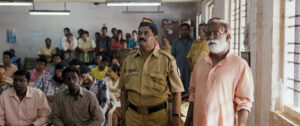
Film review: Court, a commentary on legalised Caste Oppression

The Marathi movie Court (directed by Chaitanya Tamahane) centers around the realistically-absurd trial of a Dalit folk singer, who is charged with Abetment of Suicide. He is accused of abetting the suicide of a Dalit sewage cleaner, Vasudev Pawar, through the messages conveyed in his songs. The film critically analyzes the Indian Judiciary, exposing its biased, archaic and tedious aspects. The main aspect highlighted in the film is the systematized, state-sponsored caste oppression that exists in and around our legal system. The Constitution of India explicitly prohibits discrimination on the basis of caste, which formally banned casteism in India. Various other legislative measures, including the Untouchability Offences Act and the Scheduled Caste and Scheduled Tribes Act, have attempted to curb the practice of untouchability and integrate marginalized groups into society. However, although formally the caste system may be unlawful in India, the aftermath of India’s ridding of untouchability has merely been an extension of the period when untouchability was legal. Although the relationships are altered, subordination subsists long after it has formally ended.

Read More: Shree 420: Why this Masterpiece from Raj Kapoor needs a revisit

It is ingrained in the minds of this very society that the Dalits are inferior. Thus, they can never truly escape the system that brands them as untouchables. Practically, the inescapable nature of the caste system can be observed by the kind of work taken up by these marginalized sections. Common professions include undignified work such as sewage cleaning, manual scavenging, amongst others. This aspect is depicted in the movie through the character of the deceased (Vasudev Pawar) in the case. When his wife is called to be cross-examined in Court, the viewers get a vivid idea of the working conditions Pawar is made to work in. court Another evidence of this is the conversation the defence attorney, Vinay, has with Vasudev’s wife. She asks him if he knows of any work and informs him that she is “willing to work anywhere”. One can presume that despite her willingness, she has struggled to find work for herself. This statement, although delivered with complete nonchalance (in keeping with the rest of the movie), leaves a lasting impression on the mind of the viewer as it is indicative of the extent of her marginalization in society. It is interesting that in the multiple courtroom scenes, there is no use of the term ‘Dalit’ or any such related term. In fact, there is no mention of the lower-caste status of the accused. Although all of his “crimes” have a strong relation to an anti-oppression struggle, it is an angle not explored in the court. During the trial, Kamble is branded a nuisance and is painted as a threat against the State, but is never called what he really is; a Dalit. This diverts from the actual context in which Kamble sings his songs. It is true that the term Dalit, rather than being an oppressive term, is one that is considered liberating by Dalits themselves. Thus, the blatant exclusion appears to be a tactic to dilute the movement against caste-based oppression prevalent in society. In other words, the subject of the law (the individual) in a liberal society is viewed objectively, without any importance given to the individual’s context or history. The ignorance of the caste context in Kamble’s case is one such example. All the above observations point to the conclusion that the law has formally attempted to integrate marginal sections of the society, but, in reality, no such integration has occurred. The law still views the lower castes as the “other”, whom the law will more often subjugate, rather than liberate. Kamble’s prior criminal record is testament to that. He has been booked under general laws with wide ambit, such as the Unlawful Activities (Prevention) Act, 1967, and archaic, colonial laws such as the Dramatic Performances Act, 1876, demonstrating the State’s repeated effort to curtail freedom through any and all legal means. The trial depicted in the movie also reeks of ulterior motives on the part of the State. Rather than examining their own contribution in the death of Vasudev Pawar (no safety gear was provided, and the conditions in the gutter are so poor that he would have to be in an inebriated state to enter), they file a baseless, yet serious allegation of Abetment of suicide against Kamble. The laws under which Kamble has been booked are perfect examples to explain how the hierarchy is maintained. When Kamble’s past run-ins with the law are brought up, the prosecution lawyer states that Kamble has been warned to not perform songs which are “seditious in nature and harmful to the general society”, given his violation of the Dramatic Performances Law; an archaic, colonial Act. Additionally, the Prosecutor claims that Kamble is a threat to “the sovereignty and integrity of India”, under the draconian Unlawful Activities (Prevention) Act. The general wording of such laws lends itself to misuse by the State. The primary use is to curtail any disturbance of the class/ caste hierarchy. It is this aspect of the law that gives the State the power to repeatedly incarcerate Kamble. The general, vague wording of the law serves another useful purpose for the State. It gives the impression of universal applicability; applicable even to those belonging to the upper echelons of class and caste, whilst also de-politicizing the caste struggle. The former gives legitimacy to the law and the latter stifles any collective uprising. This de-politicization may manifest itself in the form of charging the deviating offender with ordinary, ‘non-political’ crimes. Abetment of Suicide is a ‘non-political’ act, yet Kamble’s words which allegedly caused the suicide were purely political in nature. Although a number of laws have been enacted to curb caste oppression and violence, the gap between the law and lower castes (access to justice, that is) is still appalling. In the caste stratification, the upper caste Brahmans constitute the powerful class exercising control over the law. In the film, it is the government that bends the law to suit its needs, oppressing the lower-caste and maintaining its dominance. It exposes the true intent of the State to ensure that the upper-caste members of the society remain in a position to influence law and law-making, while the lower caste struggle to find a place in this exclusionary narrative of the State.

It’s been 75 years since Hiroshima, yet the threat of nuclear war persists

It is important to mark the solemn 75th anniversary of the first and only use of atomic weapons against cities as not only a remembrance of a tragic past event, but as a reminder of an ever-present threat that we have failed to address. According to the Bulletin of the Atomic Scientists, civilization-ending nuclear war — whether started by design, blunder or miscommunication — is at the highest risk of realization since 1945, as the Doomsday Clock is at 100 seconds to midnight. As a professor of disaster and emergency management who has spent time at the site of the first atomic blast and subsequently studied civil defence preparedness for survival during nuclear war, the 75th anniversary of the bombing of Hiroshima and Nagasaki comes at an especially depressing time.
A replica of the atomic bomb being carried on a flatbed trailer.
A replica of the atomic bomb known as Fat Man, which was dropped on Nagasaki, Japan on Aug. 9, 1945. (Jack Rozdilsky), Author provided
At the current moment, we as a civilization are at a low point in our failure to reduce the risk of nuclear weapon attacks. The risks of uninformed decision-making, mishaps or seemingly rational but flawed choices made under pressure can lead nations down a rapid one-way path of nuclear destruction that we can never fully prepare for.

Weapons of mass destruction

The world forever changed on July 16, 1945, when the first atomic bomb was detonated at the Trinity Test site in the New Mexico desert. The early morning blast was the capstone of an experiment that represented the potential of scientific achievement. Twenty-one days after the successful test blast, the decisions made to quickly use this new bomb as an unparalleled weapon represented the capability of humankind to inflict suffering onto others. As with many acts of warfare, the use of the bomb was a purposeful creation of a disaster: a weapon of mass destruction. For 2020, the status of world nuclear forces, provided by the Federation of American Scientists, indicates that nine nations hold 13,410 nuclear warheads, with what is thought to be 1,800 nuclear weapons on high alert for immediate use. These weapons lurk in the background, and sometimes they make headlines. In 2017, threats of nuclear war were in the news again as tensions mounted when North Korea was developing its own nuclear weapons. The situation was further aggravated when U.S. President Donald Trump’s words threatening nuclear war were shockingly juvenile and frightening in tone.
An animation showing the evolution of nuclear weapons.

Civil defence

Protecting the public requires the emergency management and homeland security branches of governments to develop civil defence plans. An example of Cold War-era Canadian civil defence efforts is the late 1960s 11 Steps to Survival guide. Civil defence from nuclear attack is fraught with difficulty, and perhaps among the most complex actions that an emergency manager will ever need to engage in. If a nuclear attack with a prior warning were to take place, providing pertinent information to the populace about the imminent threat, having shelter-in-place or evacuation options available, having plans appropriately tailored to a given community’s needs and being able to convey the risks without creating unnecessary alarm are all needed civil defence actions. In 1986, former Federal Emergency Management Agency (FEMA) planning specialist Wayne Blanchard asked: “Civil defence measures can make a difference of tens of millions of lives saved in a nuclear attack. How, then, does one reconcile this with the fact that as of 1984, the U.S. has only a rudimentary civil defence system?” Today’s civil defence efforts remain rudimentary in comparison to the threat. A more recent FEMA fact sheet, from 2018, entitled “Be Prepared for a Nuclear Explosion” raises more unanswerable questions. In the 1950s, the United States Federal Civil Defense Administration produced a public information campaign with atomic bomb survival advice should a weapon of mass destruction attack occur. One of the products was the 1951 film, Duck and Cover, which was designed to teach safety measures to schoolchildren. Public information strategies have come a lot further since then; a recent campaign from Ventura County, Calif., informs residents to “Get inside. Stay inside. Stay tuned.”
A 1951 film from the U.S. Federal Civil Defense Administration starring Bert the Turtle demonstrating “duck and cover.”

Outpaced preparedness

While any preparedness is better than none, preparedness plans are futile for those in proximity to an atomic blast. We also know from Hiroshima and Nagasaki about the serious long-term health impacts from radiation exposure. Managing the countless long-term social and economic consequences would require years of work by our best and brightest, assuming they were not already killed by the initial explosion or its after-effects. Nuclear weapons development has effectively outpaced preparedness efforts. Civil defence actions, while meaningful in their own right, are ultimately of little utility in reducing the risks realized in nuclear explosions. Any reocurring Hiroshima-like atomic bombings elsewhere would be bleak; mass death would prevail. On this 75th anniversary of the atomic bombing of Hiroshima and Nagasaki, it remains a disappointment that the threat of nuclear weapons remains. Our only way out of this problem is to work towards abolishing them.The Conversation Jack L. Rozdilsky, Associate Professor of Disaster and Emergency Management, York University, Canada This article is republished from The Conversation under a Creative Commons license. Read the original article.

Also Read: 75 years to World’s First Atomic Bombing at Hiroshima

Karnataka: Health Minister Sriramulu tested Covid positive

B Sriramulu, Minister of Health and Family Welfare & Backward Classes Welfare for Government of Karnataka, is tested Corona Positive. In a series of tweets that he has made just some time ago, he noted that he was tested Corona positive when he got himself tested after having caught fever this day. He has also noted that under the leadership of BS Yeddiyurappa, all the government officials are working day and night to contain the spread of Covid-19 cases. He has also noted that these were testing times for him given that he and his officials were trying their best to ensure that people had access and availed treatment in the times of a global pandemic. B Sriramulu is now admitted to the Bowring and Lady Curzon Hospital in Bengaluru and has requested everyone who was in his contact in the last few days to undertake precautionary and testing measures. He has also prayed the almighty to help him recover soon and thereby continue to work for the people with even more rigor in these difficult times.
Sri Ramulu being treated in Bowring & Lady Curzon Hospital in Bengaluru
Sri Ramulu being treated in Bowring & Lady Curzon Hospital in Bengaluru | Picture Courtesy: Twitter Handle of B Sriramulu
Sriramulu was in news recently when he had remarked that ‘only god has to save us from Coronavirus’ while being a people’s representative and Minister of Health and Family Welfare in the state. This remark of his was largely in line with the narrative that BJP Government in the state had failed in the state to control the spread of Covid-19 pandemic. The situation in the state, especially in its capital city Bengaluru, is as bad that patients could not find beds for Covid Care and treatment. In fact, on more than one occasion patients had succumbed to death due to the non-availability of the ambulance to transfer the patients to the hospitals even when they hailed from Bengaluru. The statement he had made while being the Health Minister of the state had irked people.
Read About: Ram Janmabhoomi Trust gets Donation of 41 Crores before Bhoomipoojan
He is not the first people’s representative to be corona positive in the state. A few days ago, Chief Minister BS Yeddiyurappa and Leader of Opposition Siddaramaiah have also tested Corona positive and had been admitted to the same private hospital. Earlier, Tourism Minister of the state CT Ravi and Agricultural Minister BC Patil were also affected by Covid-19.

Indigenous Communities and Independent India’s Colonialism

It has been almost 73 years since our country attained territorial and political independence. However, something that Indian society is yet to attain is ‘the freedom of mind’. After a long haul, though we were able to overthrow our Colonial rulers, yet the ruled could not do away with the colonial mindset. Just like our colonizers had sown the seeds of derision for the Indian culture as a whole, in the post-independence era, mainstream Indian society is held captive to a similar mindset. The way the Colonial rulers painted the picture of the tribes of India is still considered a standard frame of reference in the post-independence era. The colonial rulers had described indigenous communities as “barbaric” and “uncivilized” for their administrative convenience. Yet, even after attaining independence, mainstream society pictures the tribes the way they were portrayed by the alien rulers, and this has caused the attachment of derogatory connotation to terms like “Tribal” or “Adivasi” because it is assumed that the forest-dwellers are a community that is a backward community and lacks agency of their own to think and act in a civilized or progressive manner. This has resulted in the supremacy of one form of knowledge over the other. The knowledge produced by caste society is considered to be superior to alternative forms of knowledge, i.e., of non-caste communities (here: Indigenous communities). In the process of the capitalistic ‘development’ model promoted by the independent Indian state, there is a hierarchy in terms of who is defining such concepts. The mainstream idea of development is considered to be superior and progressive and is thus considered to be universal, leading to suppression of the indigenous idea of development. But is this really true? To be able to understand this better, we need to un-learn and re-learn a few things about indigenous communities.

Unique in Characteristics, United in Spirit

The umbrella term ‘indigenous’ or the communities that are commonly referred to as ‘tribes’ in the Indian context, is in reality a heterogeneous community. This means that each tribe has its own distinct language, diverse culture, and rich history. Though quite distinct from one another, indigenous communities have one thing in common: their struggle to protect their natural resources i.e., water, forest, and land (popularly known as ‘Jal’, ‘Jangal’ and ‘Jameen’ in the Chhotanagpur region). This struggle to protect their land and natural resources has become extremely crucial in contemporary times where our world is facing a grave threat of climate change. To add to it, we have a pandemic to deal with as well. We have all been witnesses to the overburdened medical system; this makes me wonder about all the progress that we have been running after. This situation of global crisis has compelled us to introspect and reflect on our ideas and models of development. At the outbreak of this pandemic in our country, while the whole nation was in chaos chasing after hand sanitizers, it was a pathbreaking development by the women of one of the indigenous communities of Chhattisgarh who were successful in making liquid hand sanitizer out of forest produce, the ‘mahua’ flower, which has been an integral part of the Adivasi lifestyle, a sustainable lifestyle.

The struggle of Jal, Jangal, Jameen

Adivasi/Tribal communities have always fought their battle to preserve their land, their home against imperial and capitalist interests. While the mainstream education teaches us that The First War of Independence was the Sepoy Mutiny (1857) and Mangal Pandey was one of the earliest freedom fighters, in reality, it was Tilka Majhi, a Santhal tribal leader who had waged the war against the Britishers, as early as in the 1700s followed by the ‘Santhal Hul’ (the Santhal Rebellion, 1855) and ‘Ulgulan’, a revolt headed by Bir Birsa Munda. In contemporary times, the situations have changed, but the struggle has not. In one of the recent interviews regarding the auction of coal blocks that fall under the tribal lands, the CM of Jharkhand, Mr. Hemant Soren had rightly pointed out that “The land and forests are their bank account, their ATM, their primary asset. You have to think of development keeping these things in mind…”

Just like the Colonial Rulers had described the ruled as “passive subjects”, conscious steps must be taken so that today, mainstream society does not do the same to Indigenous communities. Ritu is pursuing her MA in Social Work in Dalit and Tribal Studies and Action at TISS, Mumbai.

Women led Workers Union on All India Strike, Satyagraha on 9th August

Scheme workers (Workers employed under various Schemes of the Government) including ASHA (Accredited Social Health Activities) Workers, Mid-Day Meal (MDM), Anganwadi, National Health Mission(NHM), Samagra Shiksha Workers and Para-Teachers had called for All India Strike on August 7th and 8th. They have also called for Satyagraha/Jail Bharo Program on August 9th.  Around Six Lakh workers across the country affiliated with Central Trade Unions (INTUC, AITUC, HMS, CITU, AIUTUC, TUCC, SEWA, AICCTU, LPF, UTUC) are on strike since yesterday demanding the fulfillment of their 15 demands. Many of these Scheme Workers serve as front-line workers (Corona Warriors) in the turbulent times of the Coronavirus outbreak. Despite innumerable pleas and requests to the government, their demands have not been acknowledged let alone addressed. For over four months now, they demanded that they are provided the bare minimum requirement of safety, insurance, and risk allowances to undertake their work with a sense of dignity and security. Even though many workers have succumbed to death owing to the lack of protective equipment and systems in place, the government has not tried addressing their issues. Even at the peaks of the Covid-19 pandemic, they haven’t been paid their salary regularly. Workers from Delhi, Haryana, Chattisgarh, Bihar, Tamil Nadu, Gujarat, karnataka are among the states that have gone on strike.

Major demands of the Scheme Workers- 

1. Withdraw privatization proposals of basic services- health, nutrition (including ICDS and MDMS)
2. Make the Centrally Sponsored Schemes – ICDS, NHM, MDMS permanent
3. Regularization of scheme workers as workers
4. Pay Minimum wages Rs.21000 and pension Rs.10000 per month; 5. Provide ESI and PF to all scheme workers
5.Enact legislation for right to universal healthcare as in case of right to food and right to education
6.No Pro employer change in Labour Laws
  Speaking about the issue KV Bhat, noted that “In Karnataka, around 40000 ASHA Workers had undertaken a 20-day protest. They had also called for Seizing the Chief Minister’s Residence on 29th July. However, on 28th July evening, CM BS Yeddyurappa along with B Sri Ramulu, State Minister for Health, and Family Welfare discussed the issue with the leaders of ASHA Workers and had assured that the State Government would look into the issue and that they would be resolved in the next week. Many Scheme Workers also participated in the strike in Bangalore, Karnataka while adhering to the Physical distancing norms laid down by the World Health Organization. They protested yesterday near the Gandhi Statue at Maurya Circle and have submitted their Charter of Demand to the Governor of the State, Vajubhai Vala. One of their main demand is a minimum wage of Rs 21,000/month, Rs 10,000/month pension & safety gear for frontline workers. Several Trade Unions in Karnataka has called for Save India Campaign on 10th August 2020 in the backdrop of Quit India Day being celebrated on 9th August. It includes the Joint Committee of Trade Union (JCTU – Karnataka),  JCTU with 10 Member Unions of Workers including INTUC, AITUC, HMS, CITU, AIUTUC, AICCTU, TUCC, HMKP, GATWU and NCL have called for the campaign on 10th August 2020 with 10 demands in place. ‘Save India’ Campaign is a continuous struggle of Farmers, Agricultural Labourers, Women, Students, Youth, and other Secular and Democratic Forces of the Country. They have also requested all workers to join in solidarity and spirit for the All India Protest to be organized in September as well.
Read About: Karnataka BJP Govt dismantles another PSU: RTPS fires 1500 employees

Ram Janmabhoomi Trust gets Donation of 41 Crores before Bhoomipoojan

The Sri Ram Janmabhoomi Theerth Kshetra (SRJBTK) Trust has received Rs 41 Crore as donations even before the start of the construction of Ram Mandir. The amount quoted here was till August 4th 2020, a day before the Foundation Stone was laid at Ayodhya to construct the Ram Mandir at the site of where Babri Masjid was demolished in 1992. Babri Masjid was demolished by karsevaks from all over India who came to Ayodhya after a call was given by LK Advani, who took out a Rath yatra to campaign for the temple to be constructed at the Babri masjid site. The donation received by the trust stood at Rs. 30 Crores when the logbook was last seen on Tuesday. Another 11 Crore Rs was donated by Morari Babu which makes it Rs 41 Crore. However, the amount does not include other donations made on Wednesday (August 05th)” said the treasurer of the trust Swami Govind Dev Giri to Times of India.  Swarajya has quoted that the Trust received donations amounting to Rs. 4.60 Crores since Lockdown was first announced by PM Narendra Modi. Besides these, people are also contributing to the construction of the temple through Online Bank Transfers after the Trust started accepting these donations as well. According to Vishwaprasanna Teertha, of the Pejawara Mutt at Udupi who is a close ally of the Sangh Parivar and was an active mobilizer for the infamous Rath Yatra from Karnataka, the estimated cost of construction for Ram temple was Rs 300 Crore and another Rs 1000 Crore would be used for the development of surroundings for temple-related activities. He has also noted that a share of the expenditure would also be raised through Corporate Social Responsibilities (CSR) from Corporate houses. The Government through the Central Board of Direct Taxes (CBDT) had recently allowed tax exemptions to donations made to the trust under Section 80G of the Income Tax Act given that the temple would be a ‘place of historic importance and a place of public worship’. Hence 100% of donations would be exempted from the tax liability subject to a limit of 10% of their gross total income. One might wonder about these donations in crores being made in the name of Ram Temple when India is witnessing the biggest economic depression for more than a year that is worsened by the COVID-19 pandemic. The pandemic has not only caused a health crisis but an economic and humanitarian crisis that has destroyed the lives and livelihoods of millions of Indians.

Read About: Did Savarkar, Shyama Prasad Mukherjee and RSS Betray 1942 Quit India Movement?

Hemant Soren Declares State Holiday on 9th August, World indigenous peoples day

Jharkhand: CM Hemant Soren declared that 9th August will be a State holiday from this year onwards, in observance of the International Day of the World’s Indigenous Peoples. Although this year it falls on a Sunday, it will be a public holiday in Jharkhand from the coming year. He informed the media at Project Bhawan in Ranchi, that since Jharkhand has a large Adivasi population, it is only right that such a day be observed by the state. The JMM MLA Sita Soren along with villagers of the Dumka district had requested the CM to make this decision, pointing out that Rajasthan and Chattisgarh already observe this day as a public holiday.  Out of the total population of 3.19 crore, 27 percent of the people of Jharkhand are Adivasis. The state has seen self-determination movements by the Adivasi population, such as the Pathalgadi movement, which resisted the grabbing of their land and resources by the State. Recently the central government started to auction off 20 coal blocks in Jharkhand as an ‘aatma nirbhar’ initiative, in response to which the Jharkhand Janadhikar Mahasabha called for a protest. The UN General Assembly had passed a resolution in 1994 deciding that 9 August every year will be observed as the International Day of the World’s Indigenous Peoples. This date marked the first meeting of the UN Working Group on Indigenous Populations of the Sub-Commission on the Promotion and Protection of Human Rights in 1982. The UN recognizes that throughout history, the rights of Indigenous people have been violated and today, they form one of the most disadvantaged and vulnerable groups in the world. The theme for this year is “COVID-19 and indigenous peoples’ resilience”. According to the UN, the link between environmental damage and pandemics has been well known to lead research organizations. Indigenous people’s rights to land and resources are closely linked to environmental conservation and anticapitalism. In India, Adivasi movements throughout history have presented some of the strongest resistance to imperialist and capitalist forces and the degradation of land, forest, and water resources in their quest for profit. 

Did Savarkar, Shyama Prasad Mukherjee and RSS Betray 1942 Quit India Movement?

Quit India Movement(QIM) also is known as ‘August Kranti’ (August Revolution) was a nation-wide Civil Disobedience Movement for which a call was given on August 7, 1942, by the Bombay session of the All-India Congress Committee. It was to begin on August 9 as per Gandhi’s call to ‘Do or Die’ in his Quit India speech delivered in Mumbai at the Gowalia Tank Maidan on August 8. Since then August 9 is celebrated as August Kranti Divas.

The Hindutva camp not only opposed QIM but also provided multi-faceted and multi-dimensional support to the British rulers in suppressing this historic mass upsurge. In this connection, shocking documents are available; these should be read to be believed. 

The British swiftly responded with mass detentions on August 8th itself. Over 100,000 arrests were made which included the total top leadership of Congress including Gandhi, mass fines were levied and demonstrators were subjected to public flogging. Hundreds of civilians were killed in the violence, many shot by the police and army. Many national leaders went underground and continued their struggle by broadcasting messages over clandestine radio stations, distributing pamphlets, and establishing parallel governments. Innumerable patriotic Indians were shot dead for the crime that they were holding Tricolour publically. Even before that, a terrible massacre took place in Mysore where the armed forces of Mysore Raja who was very close to Hindu Mahasabha and RSS shot dead 22 Congress activists for saluting Tricolour. It is to be noted that after declaring Congress an anti-national and unlawful organization, the British masters allowed only Hindu Mahasabha and the Muslim League to function. Most of us know that the then Communist Party of India opposed the QIM thus betraying a great phase of a mass upsurge in the history of the freedom struggle. But it is well documented that despite CPI’s call for keeping aloof from QIM large number of Communist activists participated in it. Moreover, CPI later offered an unconditional apology for opposing it. Hindu Mahasabha led by ‘Veer’ Savarkar ran coalition governments with Muslim League in 1942. However, what role the then Hindutva camp—consisting of the Hindu Mahasabha and Rashtriya Swayamsevak Sangh —played in the QIM is under wraps for reasons unknown. The Hindutva camp not only opposed QIM but also provided multi-faceted and multi-dimensional support to the British rulers in suppressing this historic mass upsurge. In this connection, shocking documents are available; these should be read to be believed.

“Veer” Savarkar Led Hindu Mahasabha Joined Hands With the British Rules to Suppress QIM

While addressing the 24th session of the Hindu Mahasabha at Cawnpore (now Kanpur) in 1942, Savarkar outlined the strategy of the Hindu Mahasabha of co-operating with the rulers in the following words:
“The Hindu Mahasabha holds that the leading principle of all practical politics is the policy of Responsive Co-operation [with the British]. And in virtue of it, it believes that all those Hindu Sangathanists who are working as councilors, ministers, legislators and conducting any municipal or any public bodies with a view to utilize those centres of government power to safeguard and even promote the legitimate interests of the Hindus without, of course, encroaching on the legitimate interests of others are rendering a highly patriotic service to our nation. Knowing the limitations under which they work, the Mahasabha only expects them to do whatever good they can under the circumstances and if they do not fail to do that much it would thank them for having acquitted themselves well. The limitations are bound to get themselves limited step by step till they get altogether eliminated. The policy of responsive co-operation which covers the whole gamut of patriotic activities from unconditional co-operation right up to active and even armed resistance will also keep adapting itself to the exigencies of the time, resources at our disposal and dictates of our national interest.” 
This ‘Responsive Cooperation’ with the British masters was not only a theoretical commitment. It soon got concretized in the ganging up of Hindu Mahasabha with the Muslim League. Hindu Mahasabha led by ‘Veer’ Savarkar ran coalition governments with Muslim League in 1942. Savarkar defended this nexus in his presidential speech in the same session of Hindu Mahasabha at Kanpur, in the following words:
“In practical politics also the Mahasabha knows that we must advance through reasonable compromises. Witness the fact that only recently in Sind, the Sind-Hindu-Sabha on invitation had taken the responsibility of joining hands with the League itself in running coalition Government. The case of Bengal is well known. Wild Leaguers whom even the Congress with all its submissive-ness could not placate grew quite reasonably compromising and socialable as soon as they came in contact with the Hindu Mahasabha and the Coalition Government, under the premiership of Mr. Fazlul Huq and the able lead of our esteemed Mahasabha leader Dr Syama Prasad Mookerji, functioned successfully for a year or so to the benefit of both the communities.” 
Hindu Mahasabha and Muslim League beside Bengal and Sind ran coalition government in NWFP also during this period.

Hindutva Icon Dr. Syama Prasad Mukherjee, Deputy CM in the Bengal Muslim League Ministry took up the Responsibility of Crushing QIM in Bengal

Following the Hindu Mahasabha directive to co-operate with the British, the Hindutva icon, Dr. Mookerjee assured the British masters through a letter dated July 26, 1942. Shockingly, it read:
“Let me now refer to the situation that may be created in the province as a result of any widespread movement launched by the Congress. Anybody, who during the war, plans to stir up mass feeling, resulting internal disturbances or insecurity, must be resisted by any Government that may function for the time being” 
The second-in-command of the Hindu Mahasabha, Dr Syama Prasad Mookerjee, also the deputy chief minister in Bengal Muslim league ministry in a letter to Bengal governor on behalf of Hindu Mahasabha and Muslim League made it clear that both these parties looked at the British rulers as saviours of Bengal against Quit India Movement launched by Congress. In this letter, he mentioned item wise the steps to be taken for dealing with the situation. It read:
“The question is how to combat this movement (Quit India) in Bengal? The administration of the province should be carried on in such a manner that in spite of the best efforts of the Congress, this movement will fail to take root in the province. It should be possible for us, especially responsible Ministers, to be able to tell the public that the freedom for which the Congress has started the movement, already belongs to the representatives of the people. In some spheres it might be limited during the emergency. Indian have to trust the British, not for the sake for Britain, not for any advantage that the British might gain, but for the maintenance of the defence and freedom of the province itself.” 

RSS Followed Savarkar in Opposing Quit India Movement

THE other flag-bearer of Hindutva, the RSS, was not different in its attitude towards the QIM. It openly sided with its mentor ‘Veer’ Savarkar against this great revolt. The RSS’ attitude towards the QIM becomes clear from the following utterances of its second chief and most prominent ideologue till date, M.S. Golwalkar. While talking about the outcome of the Non-Cooperation Movement and QIM he said:
“Definitely there are bound to be bad results of struggle. The boys became unruly after the 1920-21 movement. It is not an attempt to throw mud at the leaders. But these are inevitable products after the struggle. The matter is that we could not properly control these results. After 1942, people often started thinking that there was no need to think of the law.” 
Thus, the prophet of Hindutva, Golwalkar, wanted the Indians to respect the draconian and repressive laws of the inhuman British rulers! He admitted that this kind of negative attitude towards the QIM did not go well even with the RSS cadres:
“In 1942 also there was a strong sentiment in the hearts of many. At that time, too the routine work of Sangh continued. Sangh vowed not to do anything directly. However, upheaval (uthal-puthal) in the minds of Sangh volunteers continued. Sangh is an organisation of inactive persons, their talks are useless, not only outsiders but also many of our volunteers did talk like this. They were greatly disgusted too.” 
It would be interesting to note what Golwalkar meant by ‘routine work of Sangh’. It surely meant working overtime to widen the divide between Hindus and Muslims thus serving the strategic goal of the British rulers and Muslim League. In fact, the contemporary reports of the British intelligence agencies on the QIM were straight forward in describing the fact that RSS kept aloof from the QIM. According to one such report, “the Sangh has scrupulously kept itself within the law, and in particular, has refrained from taking part in the disturbances that broke out in August 1942”. These historically documented facts make it clear that the Hindutva gang led by the RSS not only betrayed QIM but also rendered great service to the British masters by aligning with the Muslim League when the foreign rulers were faced with the nation-wide popular revolt by the Indians. They in collusion mounted one of the fiercest repressions of the freedom fighters. Shockingly, this gang is ruling India today describing itself as a symbol of Indian nationalism. We need to convey these facts to the Indians so that these traitors are exposed and charged for crimes committed against India. The RSS/BJP rulers know that betrayal of the QIM by their Hindutva parents cannot be covered up. It is crystal clear that RSS including its top leaders like Golwalkar (head of the RSS), Deendayal Upadhyaya, Balraj Madhok, LK Advani, and KR Malkani who were RSS whole timers during QIM did not participate in this Movement. Thus if the betrayal of the QIM cannot be covered up then rake up polarizing issues with communal motives so that Indians remain at war with each other. Prof. ShamSul Islam is a faculty at Delhi University. His other publications can be found here

Also Read: The ‘VADH’/Annihilation Of The Indian Republic

References:
  1.  Cited in V.D. Savarkar, Samagra Savarkar Wangmaya: Hindu Rashtra Darshan, vol. 6, Maharashtra Prantik Hindu Sabha, Poona, 1963, p. 474.
  2.  Samagra Savarkar Wangmaya, vol. 6, 479-480.
  3.  Mookherjee, Shyama Prasad, Leaves from a Dairy, Oxford University Press. p. 179.
  4.  [Cited in A G. Noorani, The RSS, and the BJP: A Division of Labour. LeftWord Books, p. 56–57.
  5.  M.S. Golwalkar, Shri Guruji Samagra Darshan (Collected Works of Golwalkar in Hindi), vol. IV, Bhartiya Vichar Sadhna, Nagpur, nd, p. 41.
  6.  M.S. Golwalkar, Shri Guruji Samagra Darshan (Collected Works of Golwalkar in Hindi), vol. IV, Bhartiya Vichar Sadhna, Nagpur, nd, p. 40.
  7.  Cited in Andersen, Walter K.& Damle, Shridhar D. The Brotherhood in Saffron: the Rashtriya Swayamsevak Sangh and Hindu Revivalism, Westview Press, 1987, 44.


Poland Opposition protests against Homophobic President with rainbow masks

1
On August 6, members of the Poland opposition formed a rainbow with their outfits and masks at the swearing-in ceremony of Andrzej Duda as Polish President. This act was a symbolic show of solidarity with the LGBT community as Duda’s polarizing election campaign was run along strongly homophobic lines. Duda won the election but it was by a thin margin in the closest election in the country since the end of communist rule in 1989. The MPs, from Poland’s “Left” wing parties, wore rainbow masks and outfits in shades of the rainbow, sitting in rows, as Duda was sworn in on Thursday in the lower house of parliament, the Sejm. They also posed in and outside parliament with rainbow and white and red Polish flags.
 
Duda had brought his Law and Justice party to power five years ago on a strong anti-migrant agenda, calling them ‘parasites’, and capitalizing on the idea of the external threat to gather support. This time, Duda’s presidential campaign presented homosexuality as the greatest threat to the nation, with Duda’s arguing that it is an ‘ideology’ that is ‘more dangerous than communism’.  After 6 Polish towns declared themselves as “LGBT free zones”, the European Union had criticized the move and announced that it withheld funding from these towns. Soon after, in protest of the homophobic culture of the country, activists hung rainbow flags on the major monuments of Poland, including the Mermaid of Warsaw, a symbol of Poland’s capital city; a statue of the famed astronomer Nicholas Copernicus; a memorial to Jozef Pilsudski, the father of Polish independence after the World War I; and a statue of Jesus bearing a cross in front of the Basilica of the Holy Cross. This prompted political leaders such as the Deputy Minister of justice to condemn the act as offending religious beliefs and insulting national monuments. The activists responsible for the act were detained, charged, and released. These events had led to the rainbow flag being specially charged by the atmosphere of polarization and resistance from the events of the last few days. 

Congress killed Handloom in Gandhi’s name, BJP is killing it in Ram’s name: Prasanna

7th August is celebrated as the National Handloom Day each year to acknowledge the contributions made by the weavers, artisans, and other workers involved in the handloom sector who make immense contributions in preserving Indigenous Art and Culture. It was on this day in 1905 that the Swadeshi Movement was launched in Calcutta’s Town Hall against the partition of the Bengal presidency initiated by the British Colonial Government.

“Congress killed the sector in the name of Gandhi, BJP is doing the same thing in the name of Rama”- Prasanna

However, the BJP Government known for paying only lip-service with no real intent of bettering the lives of people has only recently abolished that All India Handloom Board and All India Handicrafts Boards on July 27th and August 3rd respectively and this is the first time that India is celebrating its National Handloom Day without the advisory boards in place. The novel coronavirus disease (COVID-19) pandemic and the ensuing countrywide lockdown have only added to the problems of the sector.

Related Read: Smriti Irani #Vocal4Handmade while abolishing Handloom Handicrafts Board

Prasanna Heggodu
Speaking about the issue, Prasanna Heggodu, Theater person, Social Activist and Founder of  Gram Seva Sangh (GSS) commented, ” India alone today houses as many varieties of handlooms that the rest of the world does. Congress killed the sector in the name of Gandhi, BJP is doing the same thing in the name of Rama. Even Rama after defeating Ravana, went to Nandigram wherein Bharat had worked with handloom and handicraft workers for 14 years.”

Livelihoods at stake

Nearly 2.8 million households in India, mostly rural, were associated with handloom work, according to the Third National Handloom Census of Weavers and Allied Workers 2010. Among them, nearly 1.7 million were in the North East. Many of the Indian states are famous for Handloom especially the Varanasi in Uttar Pradesh, West Bengal, Orissa, and States of North East for their unique brand of handloom. While Speaking to gaurilankeshnews.com, Ravi Kiran of Gram Seva Sabha(GSS) said- ” With at least 31 lakh families involved in the Handloom and Handicrafts sector, it is the second most prominent employer in India only after agriculture”. According to the report, it is also common for multiple members of such households to participate in the work. In fact, the census identified more than three-quarters of the workers to be women. Two-thirds of these households were full-time into the handloom sector. The weaver households (three-fourth of the total) worked for 531 million person-days in the year the census was taken. Weaving and ancillary activities, like many traditional occupations in India, still continue to be under strict caste-based domination. Among them, 40.9 percent were from Other Backward Classes, 22.1 percent form scheduled tribes, and 9.8 percent from scheduled castes; nearly a quarter were from minority communities.

BJP´s Maximum Governance Minimum Government

The Ministry of Textiles headed by Smriti Irani has launched a series of initiatives today including ‘Craft Handloom Village’ aimed to develop Craft Villages in select Handloom and Handicraft pockets on important tourist circuits. eDhaga app, MyHandloom portal, and Handloom Mark Scheme were launched as a platform for handicraft projects online and to popularize ‘authenticate handloom and handicraft products’. Ravi Kiran was skeptical of what the newly launched schemes entailed for the sector as digitalization of the sector is based upon an understanding of the efficiency. However, what is to be pushed is the idea of sufficiency. Sloganeering of “Atmanirbhar Bharat” and #Vocal4Handmade make no real difference if it is not accompanied with the idea and work on the aspect of the sufficiency of the sector. Only 10% of the Indians need to actively purchase Handloom and Handicraft products if they have to be supported which is not happening at the moment and this needs careful consideration” he noted. Abhishek, Convenor of Gram Seva Sangh opined that though the issues faced by Handlooms and Handicrafts have made news due to the dismantling of the Handloom and Handicraft boards, we need to note that they were largely dysfunctional over the last four years. While it is easier to dismantle institutions, it’s very difficult to make them functional and efforts had to be made to ensure that. While many may point out that such boards are defunct anyway and this is a move towards Modi government mantra of maximum governance minimum government such boards do have a role in representing various stakeholders across India. In a report by Down to earth magazine, Ramesh Menon, founder of non-profit Save the Loom had spoken about the importance of these government boards. “These stakeholders who made up two-thirds of the boards used to bring their issues to the table directly, bypassing bottlenecks,” says Ramesh Menon. In the backdrop of Weavers and Artisans committing suicide across the country including Karnataka, especially so in the deeply troubling Covid-19 pandemic outbreak times, what is required is not the social media campaign or the romanticization of their work, but real support – financially, technically and otherwise. Until this is ensured, neither the plight of the people involved with the sector be bettered nor would India be the Vishwaguru or be truly Self-Sufficient (Atmanirbhar).