Delhi HC denies prescreening of ‘Bad Boy Billionaires’ for Mehul Choksi

Delhi High Court has dismissed the plea of fugitive diamond merchant Mehul Choksi to pre-screen the Netflix Documentary “Bad Boy Billionaires”. The film is on the lives of India’s business tycoons accused of committing frauds of massive proportions and were involved in many financial scandals. The docu-series is scheduled for release on September 2.

Mehul Choksi, Nirav Modi and the PNB bank Scandal

Mehul Choksi is the owner of the Gitanjali Group, a jewelry company, and maternal uncle of Nirav Modi. Earlier this week, Mehul Choksi had moved the Delhi High Court against the said show on Netflix.

Modi was the prime accused in a fraud case of around 2 billion dollars by the Punjab National Bank and was also sued in the State of California for 4.2 million dollars for defrauding Los Angeles entrepreneur, Paul Alfonso. Investigations in both cases are ongoing, and Nirav Modi is currently arrested by the London police.

Mehul Choksi, Nirav Modi’s partner in many of the firms involved in the PNB fraud, is also accused in the same case. He is wanted by the Judicial authorities of India but is a fugitive, and has gained Antiguan citizenship.

Earlier this year, he was also listed by the RBI amongst 50 wilful defaulters accused of scamming the country’s banks. In an RTI response to activist Saket Gokhale, the RBI said that the outstanding loans amount to about 68,607 crore rupees.

Bad Boy Billionaires

Bad Boy Billionaires, a documentary series is based on four Indian billionaires- Vijay Mallya, Subrata Roy, Nirav Modi, and Byrraju Ramalinga Raju- all of whom are charged with money laundering. The series aims to take a closer look at how these billionaires built their empire and how their financial crimes led to their downfall. “This investigative docu-series explores the greed, fraud and corruption that build up- and ultimately brought down-India’s most infamous tycoons,” the Netflix description read.
However, the trailer of the series didn’t go down well with Mehul Choksi, who moved the Delhi HC on grounds that the show could influence the ongoing probe in his case. His lawyer said that they are not seeking to stay the release of the show but want to see it before it is released. Netflix informed the court that Choksi is covered for only 2 minutes in the film.

The Supreme Court on Mehul Choksi plea had verbally asked the counsel for the Netflix series to consider showing him the series before the release in order to cut the controversy short.

In the last hearing on 28th August, Friday, Delhi HC denied the plea but Mr. Choksi can, however, file a civil suit if he still wants to pursue the matter, Justice Navin Chawla said after a two-hour hearing today. “In my opinion, a writ petition for enforcement of a private is not maintainable. The appropriate remedy would be civil suit as the alleged infringement is of a private right. The petition is dismissed. The petitioner is at liberty to raise the issue in a private civil suit,” Justice Chawla said. Netflix’s lawyers said Mr Choksi’s plea for a pre-screening was “wholly misconceived” and “mischievous”. Neeraj Kishan Kaul and Dayan Krishnan, representing Netflix, said Mr Choksi is a “declared absconder and fugitive” and allowing pre-screening to him will be “freezing of free speech”. Along with his nephew Nirav Modi, Mr Choksi is accused of cheating Punjab National Bank of up to ₹ 13,500 crore. Both fled India before the case blew up and have never returned. Mr Choksi’s lawyer Vijay Aggarwal said his client has a right to fair trial, which should not be prejudiced with the release of the documentary, and objected to Netflix’s lawyer calling Mr Choksi a fugitive. “I am not a fugitive. There is a stay order operating in my favour by the Bombay High Court. They have called me a fugitive 100 times in this hearing and they have misinformed the court. I urge the court to preview the series and protect me (Mr Choksi),” Mr Aggarwal said on behalf of his client. He threatened that Netflix, an American company, has to respect Indian laws and the Constitution or it could be banned like Chinese apps. Additional Solicitor General Chetan Sharma and the centre’s counsel Ajay Digpaul, representing the Electronics and Information Technology Ministry, said there is no statutory mandate to regulate or review over the top (OTT) content. Giving a brief about the series, Netflix’s lawyers said it includes a story about a diamond tycoon who travelled to London with his uncle, after which the Punjab National Bank scam broke out. The lawyer said only one or two interviews of Mr Choksi to the media are in the series and just two minutes are devoted to him. There is no reference to any trial going on about Mr Choksi or him being related to any case allegedly involving Nirav Modi, the Netflix lawyer said. “If pre-screening is allowed, it will be a form of censorship. Free speech is not only what a journalist writes, it is also the right of a citizen to know what is happening,” he said.    

The Neglect of Kazi Nazrul Islam’s Revolutionary Poetry and Ideas

0

Although on the one hand there is no denying the sheer magnitude of Kazi Nazrul Islam’s contribution to the canon of Bangla poetry, there is also no denying the fact that the poet- neither during his lifetime nor since his death- has received the kind of public attention his work deserved. 44 years since his demise, as a society we find ourselves almost severely impaired and certainly poorer for it.

In their poetics and their politics, the revolutionary Indian poets of the early 20th century envisioned a world rife with cross-cultural interaction and inclusive discourse such that all demographics could feel not only represented but also had enough incentive to participate in its making. This shone most vividly in their language which was at the same time rustic and polished, rural and urban and most importantly, comprised the poetic use of both Sanskrit and Perso-Arabic jargon.

We find ourselves today in a situation where the communal assignments to the root languages (Sanskrit and Arabic- Persian) are being given an increasingly serious position. However, like most other fascist tricks that comprise India’s current political tapestry, this too is part of India’s vast colonial heritage. Even back then, the language was just another easy instrument along the lines of which a potentially resistant polity could be divided so as to weaken its foundational unity.

With the assignment of Sanskrit as the root language to which the Hindu population could pledge some form of nostalgic allegiance, the Perso- Arabic heritage of the modern Indian languages was reduced merely to a very specific inheritance for the Urdu speaking Muslim population of British India. Unfortunately, this very strategically planted ridge worked all too well, such that much of the revolutionary intelligentsia, including some of its tallest names, bought into it.

Kazi Nazrul, however, remained immune to this seduction through the length of his literary career. In fact, he is lauded by his (albeit restricted) readership for the positively affirmative secular politics that defined his writing. His poetry is characterised by a rich, purposeful intermingling of Hindu and Muslim imagery and Sanskrit and Perso-Arabic phrases- which, predictably, was a thorn in the side for many of his right-wing or less confrontational contemporaries- such as the poets that comprised the magazine Shonibarer Chithi.

A special memorial article in The Wire on the 27th of May this year (commemorative of Nazrul’s birth anniversary on the 25th of May) references one of the more banal interactions of the poet with the stalwart Rabindranath Tagore in 1927 that can be seen, perhaps, as an entirely unambiguous representation of Nazrul’s disgust towards divisive politics and his clear identification of the use of language as one of its bases.

Following Chittaranjan Das’s death in 1925 and the failure of the Hindu-Muslim pact of cooperation he engineered in 1923, Kazi Nazrul found around himself the warning tolls of a swiftly collapsing resistance. In May the next year, he wrote one of his most poignant poems, “Kandari Hushiyar” (Boatman Beware).

Yet, much to his disappointment, he was met with unexpected criticism from his mentor Rabindranath, who, in a lecture to the Rabindra Parishad arranged by Presidency College, Kolkata, lamented that “a young Bengali poet” (implying but not directly naming Nazrul) felt the need to use the word “khun”, as though the Bangla word for blood, rakta, did not afford him enough redness. It was not lost on Nazrul that this jibe was directed at him regarding the use of the word khun in the lines:

“Kandari taba sammukhe oi Palashir Prantar, Bangalir khune lal holo jetha Cliver khanjar”

“Boatman, before you lies the desert of Palashi, Where the blood of the Bengali painted Clive’s sword red” [Translation mine.]

Moreover, this was a disagreement the two of them had already had with reference to a different song.

Pained, Kazi Nazrul responded to Tagore in an essay titled “Boror Piriti Baalir Baandh” [The love of the great is a sand bank]. He says, in defence of his literary choice, “This standard complaint coming from Kaviguru is really unwarranted. In a poem addressed to Italy he says “utaaro ghomta”. We are used to hearing “ghomta kholo”…But wherever the word ‘utaaro’ may come from, who can deny the cadence and beauty that emanates from this particular usage? I am tempted to use a foreign word that generates pace, that initiates rhythm, and that is why I end up using Arabic and Persian words. Kaviguru himself has pointed out the triumph of such usage on many occasions in debate and discussion…Yes, I could have [said rakta], but it would have taken away half the vital force of the sentence. Where I used the word “khoon” it was surely in a song, or in a poem, of patriotic zeal, or of apocalyptic fervour.” [Transl. Shameem Daad]

However, his defence exceeds the literary and steps into the socio-political as he laments the strict allocation of Perso-Arabic language to Islam and Muslim literateurs to such an extent, that if a nationalist Muslim poet were to use such language, their secular nationalist status would be redacted in favour of a more fundamentalist “miyan- sahib” status. Yet, throughout his career, Nazrul defied to his best ability, this stereotype, creating in his poetry a language of secular inclusivity- earning, perhaps justifiably, the title of “Rebel Poet” (Bidrohi Kobi).

Notably, his politics were not limited to inclusivity but also encompassed the principle of representation. Perhaps the most important aspect of this is his very verbal inclusion of Muslim readership, so as to invite them to participate in the national struggle, without them feeling underrepresented or even unwanted. He hails the universal muse of poetry with a characteristically Hindu name- Visva-kavyalakshmi- and claims, nevertheless, that she is bedecked in Muslim grandeur. Moreover, he states vehemently that contemporary poets seem to have been forgetting that about half of the recipients of Visva-kavyalakshmi’s presents are Muslim and would like, once in a while, to see themselves represented via poets dressed in “toopi-chapkan” and Islamic imagery and Perso Arabic phrases like “Bageechar bulbul” rather than “phulboner kokil”.

Nazrul was part of a collective of revolutionary nationalist poets called Kallol, who, like many other vernacular poets of the late nineteenth and early twentieth century, believed in and practised the poetics and politics of inclusive growth and literary representation. Yet, their stubborn commitment to their politics earned them much harassment and willful vilification from their contemporaries – and as a result, they never became the popular icons of nation-building that they should have become. In this day and age of rampant Sankritisation and the rapid erasure of minority cultural identities, the socially conscious must ask ourselves, should we not have championed heroes like Kazi Nazrul Islam sooner? Or is there time yet?

Asmita Chowdhury is a student of English Literature at Jadavpur University, Kolkata.

Mob of 200 People from Dominant Castes Attack Dalits in Ainlasari, Odisha

0

A mob of around 200 people belonging to dominant castes attacked Dalits in a village of Odisha on August 26. In the Ainlasari Village in the Puintala block of the Balangir district in Odisha, the mob came to the Dalit Basti in the morning, vandalizing homes, throwing stones, and assaulting people, with many suffering severe injuries. Attackers also damaged people’s belongings and vehicles and used derogatory language against Dalits.

In footage uploaded by Biswa Kumbhar, and shared by anti-caste rapper Sumeet Samos, the mob can be seen walking into the locality holding what seem to be sticks and flags, shouting at people, entering people’s houses and pulling people out of their houses.

The Ambedkar Students Association of Pondicherry University released a statement where a Dalit woman, who is head of the locality, narrated the incident.

ainlasari violence odisha
Courtesy: @asa.pu_ (Instagram)

She wrote that in Ainlasari village, Dalit women had been facing harassment at the hands of the dominant caste men every time they stepped out of their homes. Teenage girls and newlywed women were explicitly being targeted. They lodged numerous complaints to the ward members and the head officials, but no action was taken against the harassers.

When they reached out to the Sarpanch recently, he told them to do whatever they want regarding the harassment and to “stop disturbing him”. The women then, faced by this complete inaction of the authorities, decided to go to each of the harasser’s homes and report their actions to their family members and relatives. However, the family members of the men blamed the women instead and didn’t listen to them.

On their way back to the Dalit locality, which is located outside the Ainlasari village, some of the dominant caste men stopped them and threatened them against informing their family members about the issue. They were around 200, while the Dalit women were just 20 in number. So the women stood in front of them in order to protect their men and requested them to not instigate violence.

After the incident, the women went to the police station to file a complaint. When a notice was sent to them by the police, the dominant caste men along with a few women from their community, came to the Dalit locality and started attacking their homes. They pulled people out of their homes and beat them with bastons and rods. Many of the people are hospitalized now. Victims include Keshava Nanda, Birendra Nanda, and Bikhari Kumbhar who suffered fractures and severe injuries, and Shrabana Kumbhar whose head was injured.

All the violence took place in the presence of the Sarpanch, who did not intervene. It is clear that the violence was a response to the Dalit women raising their voice against the exploitative actions of the dominant caste men, and refusing to let it go in spite of pressures from administrative leaders. The local government officials, rather than protecting the Dalit women and community and holding the perpetrators accountable, ignored their complaints. The mob that perpetrated the violence, along with all those officials who enabled the harasser’s behaviour and ignored the Dalit women’s complaints, should be held accountable.

NEET-JEE: 6 Opposition State Govts File Review Petition in SC

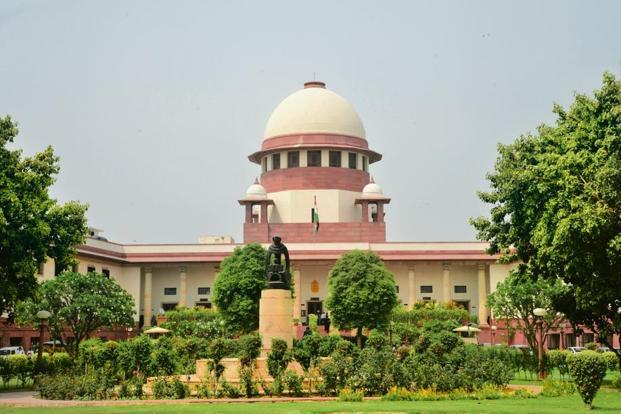
Opposition-ruled states including Punjab, West Bengal, Maharashtra, Rajasthan, Chhattisgarh and Jharkhand today filed a review petition in the Supreme Court challenging the conduct of the NEET and JEE exams.

The JEE-Main which was originally scheduled in April, and the NEET-UG which was originally scheduled in May, have both been postponed multiple times due to the pandemic and are currently scheduled for September.

A petition seeking the postponement of the exams was dismissed by a three-judge bench of the Supreme Court on August 17, saying that “life has to go on”, although the court itself continues to function virtually. The petition, filed by 11 students from 11 different states, stated that conducting the JEE online and the NEET offline in centres across the country was “utterly arbitrary, whimsical and violative of the fundamental right to life of lakhs of affected students.” Students across the country began online and offline protests against this decision.

In support of the students seven Chief Ministers, including West Bengal’s Mamata Banerjee (TMC), Maharashtra’s Uddhav Thackeray, who is heading the Shiv Sena-NCP-Congress government, Punjab’s Amarinder Singh (Congress), Jharkhand’s Hemant Soren (JMM), Rajasthan’s Ashok Gehlot (Congress), Chhattisgarh’s Bhupesh Baghel (Congress) and Puducherry’s V Narayanasamy (Congress) had a meeting in which they decided to jointly move the Supreme Court on the issue.

Students are against the exams due to a number of logistical and safety concerns. Due to the lockdown transport to and from test centres will be extremely inaccessible and expensive even if it is possible, low-cost lodging for students near test centres will not be available either. Online exams in other cases have shown themselves to be inaccessible and mismanaged, especially as access to the necessary technology is not available for the majority of the students of the country, and various parts of the country have recently been hit by extreme floods. Most crucial is the risk of contracting COVID-19 and further spreading it, and the subsequent costs of treatment, quarantining, healthcare for the student’s family, and risk to the life of the students themselves. Regions with test centres will face an increase in infections as well.

The chief ministers have now filed a petition seeking a review of its earlier judgment.

Remembering the Kandhamal massacre, Twelve Years On

0

This week marks twelve years since the organized attack against Christians in the Kandhamal district of Orissa.

The brunt of the attack took place over the course of four days from 25th to 28th August 2008. The violence, however, continued for over several weeks. According to the National People’s Tribunal, over 600 villages were destroyed and looted, 232 churches destroyed and over 39 Christians were killed. Around 5,600 houses were burnt and 54,000 people were displaced and left homeless. Human rights groups report higher numbers, with The Kandhamal Committee for Peace and Justice reporting over 90 deaths. There were numerous incidents of forced conversion into Hinduism and more than 40 women were reportedly sexually assaulted. Many first-person accounts include stories of Christians hiding in the forests for weeks, fearing for their lives. Many displaced after the violence never returned to the area.

Kandhamal is a forested area located in the heart of Orissa. Christians form about 20 percent of its population, mostly from Dalit and Adivasi communities. Tensions between Hindutva groups and the Christians had existed for many years. Hate campaigns against Christian conversions go all the way back to the 1960s. Around Christmas 2007, violent attacks took place over Christmas celebrations, with churches and houses being burnt down and vandalized, and hundreds of people left homeless.

The massacre of 2008 began after the murder of Vishwa Hindu Parishad leader Swami Laxmanananda Saraswati. One cannot begin to tell the story of this violence without talking about what this religious leader represented. In the documentary ‘The Agony of Kandhamal’, Swami Laxmanananda Saraswati is quoted saying “The actual intention of the Europe, US, the Pope, and Sonia Gandhi was to convert the entire region into the independent Christian land. That is why their campaign was to drive away Swamiji and create a Christian land. As long as I am alive I shall not let you do that.” His anti-Christian ideology was the cause of violence and persecution of Christians in the area for a long time before his death. He campaigned vigorously against missionaries and worked to reconvert Dalits and Adivasis who had adopted Christianity. Upon his murder, violent mobs led by the Sangh Parivar were instigated leading to what is considered the worst anti-Christian violence in the history of India.

Anto Akkara, a journalist and author of the book ‘Who Killed Swami Laxmanananda’ concluded that the Hindutva groups and the Odisha police falsely spread the theory of a “Christian conspiracy” against Swami Laxmanananda that led to the violence. The court also bought this narrative and seven men, all Christians, were convicted of his murder and sentenced to life imprisonment in October 2013.

The men maintained their innocence throughout and spent seven years in prison, falsely accused. All seven were released on bail in 2019 by the Supreme Court after two local police officers admitted the men were falsely accused, and a Maoist leader took responsibility for the crime.

In August 2016, The Supreme Court ordered the state government to reinvestigate 315 cases of violence reported during the Kandhamal attack, where the perpetrators were not prosecuted. The court also noted the inadequate compensation provided to the victims. BJP MLA Manoj Kumar Pradhan, one of the few convicted for the violence, remained an MLA from the area until 2014 when he lost to a Congress candidate. Twelve years on, Dalit and Adivasi Christians of Kandhamal still await justice.

The violence in Kandhamal is not an isolated incident. Anti-Christian violence has been growing in India. In 2019, the Evangelical Fellowship of India (EFI) documented 366 instances of violence against Christians in their annual report. These numbers only give a partial picture of religious violence as many cases go unreported. Just this year, in June, 14-year-old Samaru Madkami from the Malkangiri district in Orissa was killed and his body was allegedly chopped into pieces for converting to Christianity. This intersection of religion and caste is essential to understanding anti-Christian violence perpetrated by Hindutva forces. A report by the Institute for Dalit Studies concluded that “discrimination, violence, and atrocities being committed on Dalit Christians are mostly on caste lines and its nature and forms are same as that of the offences and atrocities”. Dalit and Adivasi Christians form the majority of the victims of religious violence, especially in their physical forms.

The 2008 violence is a constant reminder that anti-Christian hatred is still thriving in India The memory of the Kandhamal violence continues to be alive for survivors who experienced it and for Christians across the country.

Lydia Jayakumar, 21, is a recent graduate of Political Science and Economics at St. Stephen’s College, New Delhi.

Reservations for Subcastes Within SC and ST: Supreme Court

0

The Supreme Court on August 27 said that reservations may be given to specific subcastes within the Scheduled Caste and Scheduled Tribes categories by State governments.

The Supreme Court was considering a case between the Punjab and Haryana High Court and the State government.  In a 2010 verdict, the High Court had struck down a state law, which empowered the government to classify subcastes within SC/STs for grant of quotas.

The law in question was Section 4 (5) of the Punjab Scheduled Caste and Backward Classes (Reservation in Services) Act, 2006, which gave first preference to the subcastes of Mazhabi Sikhs and Balmikis for the Scheduled Caste quota in public services. The High Court had termed this law as unconstitutional. The State government had appealed against this verdict to the Supreme Court.

The five-judge bench headed by Justice Arun Mishra, and comprising Justices Indira Banerjee, Vineet Saran, MR Shah and Aniruddha Bose, disagreed with an earlier judgement made by another five-judge Constitution Bench. The earlier judgement, made in 2004, had ruled against giving preferential treatment to certain subcastes within Scheduled Castes.

On Thursday, the bench observed that reservation may be made for the subcastes within Scheduled Castes, and such classification would not lead to interfering with the presidential order under Article 341. The bench called for reconsideration of the 2004 judgement in the EV Chinnaiah case.

Due to the disagreement between the two benches, the case will now be placed before the Chief Justice in order to refer it to a bench of seven judges or more.

Observing that according to anthropological and statistical data, the Scheduled Caste category is not a homogenous one, and the Presidential order listing the SC and STs was not frozen in time. The Court said,

“The Constitution is an effective tool of social transformation; removal of inequalities intends to wipe off tears from every eye. The social realities cannot be ignored and overlooked while the Constitution aims at the comprehensive removal of the disparities. The very purpose of providing reservation is to take care of disparities.”

The Court further said that it is the State’s obligation to undertake the emancipation of the deprived section of the community and eradicate inequalities, and in order to do so, the State may engage in “redistribution and reallocation of resources and opportunities”. Once the state has power to give reservation, the SC said, it could go ahead with sub-classification, to extend the benefits of reservation to those subcastes, which have not availed these benefits.

This is not the first time an attempt has been made to create sub categorizations within the administrative category of Scheduled Castes or Scheduled Tribes, under the argument that certain castes are monopolising the reserved quotas. In a 2011 piece published on Roundtable India, Anand Teltumbde outlined the various points at which such an attempt has been made. He wrote,

“The subcaste manipulation started in earnest from Punjab in 1972, by subdividing the quota between Ravidasias on the one hand and Valmiki and Majhabi Sikhs on the other. The next big upsurge was witnessed in the neo-liberal era, notably in Haryana (categorisation into A and B as per the recommendation of Justice Gurnam Singh Commission), Andhra Pradesh (categorisation into A, B, C and D as per the recommendation of Justice Ramchandra Raju Commission) and Bihar (exclusion of four affluent and advanced classes/castes from Maha Dalit Ayog). The contention between the Malas and Madigas took the form of virtual war in Andhra Pradesh and inspired others to raise the categorisation issue. Now it is the Mangs versus Mahars in Maharashtra, Arundhatiyars versus Parayas and Palars in Tamil Nadu, Chamars versus other minor castes in the northern states, and so on.”

He pointed out that this logic is flawed and promotes further hierarchization and strengthening of individual castes. The multiple categorizations within the Scheduled Caste category, which essentially listed all castes against whom untouchability was practised, runs the risk of fracturing and dismantling the categories of Dalit and Bahujan, both of which go against the notion of individual castes and their position in the graded hierarchy of caste, but rather stress on commonality and unity amongst the oppressed.

In February this year, a judgement by the Supreme Court upheld the discretion of State Governments to decide whether or not to implement quotas and said that the State was not obligated to provide quotas.

This Supreme Court Verdict had the following salient aspects: A) Reservations in promotions are not a fundamental right, B) Courts of law cannot direct the state governments to implement reservation policy for SCs and STs, C) The governments are at liberty to implement the policy of reservations or not to implement. If they decide to implement the policy  they have to first collect details of the representation of different sections of the society in government jobs, D) If the government does not intend to implement the policy in respect of any group it is not necessary to  collect such details, E) Even if such statistics are available, the courts of law can not direct the governments to implement the policy.

According to a statement signed by over 500 activists and intellectuals against the non-implementation of OBC reservations in medical admissions, “OBC students have been denied 27% reservation in AIQ seats for undergraduate and postgraduate medical courses in the academic years 2017-18, 2018-19 and 2019-20. Thus, they are denied 3000 seats every year which are transferred to General Category.”

Thus, in yesterday’s judgement, the Supreme Court failed to address earlier judgements which have promoted the lack of implementation of reservations and gone against the principle of social justice enshrined in the constitution. The effect these earlier judgements will have on ‘disparities’ amongst groups were ignored by the Court, which instead suggested a system that will lead to a struggle between castes to avail of the already minuscule representation provided by the government.

Rise Against Exams in COVID: Countrywide protests Against NEET and JEE Exams

0

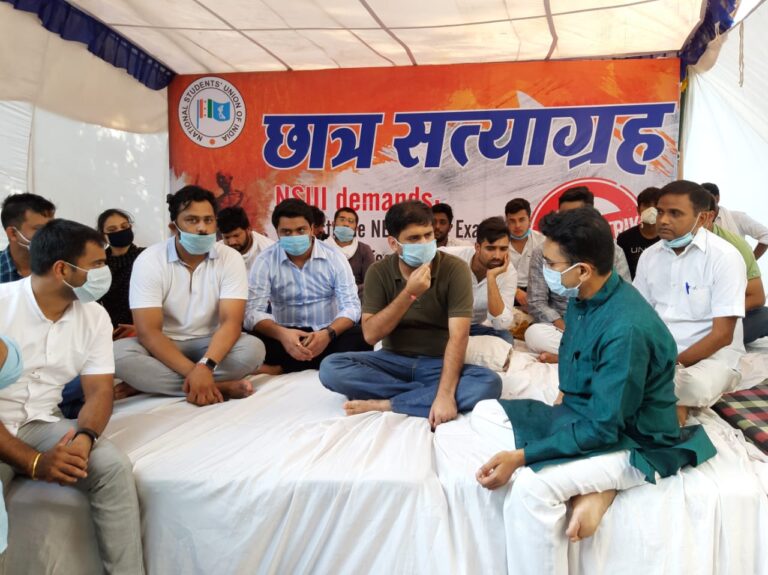
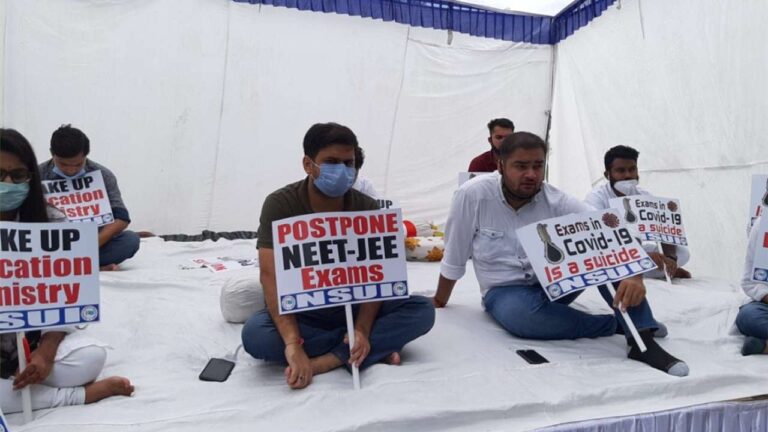
Students across the country have begun online and offline protests against the Centre’s decision to go ahead with conducting the NEET and JEE exams in September. The JEE-Main which was originally scheduled in April, and the NEET-UG which was originally scheduled in May, have both been postponed multiple times due to the pandemic and are currently scheduled for September. 9.53 Lakh candidates have registered for JEE-Mains and 15.97 lakh students have registered for NEET. Today, students expressed their opposition to the NEET and JEE exams under the hashtags #Rise_AgainstExamsInCovid and #AntiStudentNarendraModi.

https://twitter.com/AISA_tweets/status/1298846458012028928

The All India Students Association held an all India satyagraha and hunger strike on August 23, in which over 4,200 students reportedly participated. Other student organisations have also been holding hunger strikes against the exams since then.

A petition seeking the postponement of the exams was dismissed by the Supreme Court, saying that “life has to go on”, although the court itself continues to function virtually. The petition, filed by 11 students from 11 different states, stated that conducting the JEE online and the NEET offline in centres across the country was “utterly arbitrary, whimsical and violative of the fundamental right to life of lakhs of affected students.”

Students are against the exams due to a number of logistical and safety concerns. Due to the lockdown transport to and from test centres will be extremely inaccessible and expensive even if it is possible, low-cost lodging for students near test centres will not be available either.

Online exams in other cases have shown themselves to be inaccessible and mismanaged, especially as access to the necessary technology is not available for the majority of the students of the country, and various parts of the country have recently been hit by extreme floods. Most crucial is the risk of contracting COVID-19 and further spreading it, and the subsequent costs of treatment, quarantining, healthcare for student’s family, and risk to the life of the students themselves.

What is interesting about the protests is that the students protesting against NEET and JEE exams cannot be isolated and targeted as “radical” students, unlike earlier student protests. Many students protesting now have reported themselves to have been supportive of the government earlier and project themselves as ‘nationalists’ as opposed to communist, Ambedkarite, feminist, Muslim, etc kinds of students from universities like Jamia and JNU known to be hubs of students who protest instead of studying. These students have not received a shock at being branded as ‘anti-national’ for speaking about an issue as non-political as this by a government they have largely supported.

Students have also garnered support from various parties and non-BJP state governments. Seven Chief Ministers, including West Bengal’s Mamata Banerjee (TMC), Maharashtra’s Uddhav Thackeray, who is heading the Shiv Sena-NCP-Congress government, Punjab’s Amarinder Singh (Congress), Jharkhand’s Hemant Soren (JMM), Rajasthan’s Ashok Gehlot (Congress), Chhattisgarh’s Bhupesh Baghel (Congress) and Puducherry’s V Narayanasamy (Congress) have decided to jointly move the Supreme Court on the issue.

The Congress party has announced countrywide protests on August 28 to oppose the government’s decision to hold NEET and JEE exams during the pandemic.

Sudha Bharadwaj Develops Heart Ailment Due to Stress in Jail

Sudha Bharadwaj, now in jail for nearly 2 years, has developed a heart ailment. A jail report given to her family on July 23 stated that she is suffering from Ischemic Heart Disease, a heart problem caused by narrowing of arteries that causes reduced blood flow to the heart muscle and can lead to a heart attack.

In a press note released on August 26, Sudha’s daughter Mayesha said that she had never had any heart-related complaints before she was taken in custody in October 2018. Mayesha said that Sudha Bharadwaj’s heart ailment was clearly triggered by the stress she is facing due to her two-year-long incarceration with no trial on sight.

Sudha Bharadwaj already had existing ailments of diabetes, blood pressure, and a past history of pulmonary tuberculosis. Not only is she vulnerable and susceptible to being infected by COVID-19, but her comorbidities could also cause complications and health risks.

Activists from Chhattisgarh have demanded a decisive hearing for her release at the earliest on the grounds of her susceptibility to coronavirus infection within the jail surroundings, along with full access to her medical history in jail and all diagnostic notes. At present, in the medical report provided to Mayesha, no details of the diagnosis of her heart disease have been provided, such as the date or basis for diagnosis.

Sudha Bharadwaj is one of 12 activists and intellectuals who were framed for the Bhima Koregaon violence on January 1, 2018, and accused of having Maoist links. Sudha Bharadwaj has worked for decades as a trade unionist and a lawyer, defending the rights of Adivasis, workers, and peasants against powerful industrial houses. She has been associated with the Chattisgarh Mukti Morcha and founded Janhit, where she provided legal aid to several industrial workers, villages fighting acquisition and mining, Adivasi communities fighting for forest rights, environmental cases, and PIL litigation. She also assisted families of victims of human rights violations looked upon as casualties in the conflict zone of Bastar and supported journalists and activists who dared raise their voices and pen against the State excesses in Bastar.

BJP biggest advertiser of Facebook, 70% ads from Modi´s party

The Indian public is the biggest source of income for Facebook India. Facebook earns from the four pages linked with BJP than any other source. The ruling party BJP is the biggest contributor of ad revenue to the social media company Facebook. BJP, which is a political party spends more on advertisement than any of the corporate companies. In last 18 months, BJP is the biggest contributor of advertising revenue for Facebook for social, electoral and political issues. Since Feb 2019, BJP has spent 4.61 crore Rs on advertisements.
facebook
Facebook CEO Mark Zuckerberg, right, hugs Prime Minister of India Narendra Modi at Facebook in Menlo Park, California (AP Photo)
This information is based on the data tracking of money spent on advertisements on social media. Congress is at number two on this list. Among the top 10 advertisers, four pages and websites assocaited with BJP were the ones that spent the most on ads. Among these three pages promote BJP’s opinion and idealogy. Among these four, two are community pages called – Mera pehla vote modi ko( my first vote is for Modi) and Bharat ke man ki baat (India’s man ki baat). Mera pehla vote modi ko has spent up to 1.39 crore on advertisements while the second page Bharat ke man ki baat has spent close to 2.24 crore on advertising. Along with this there is one page called “Nation with Namo” that is classified as news and media website. It has given 1.28 crore in advertising.

Also Read: Facebook & BJP Ties: Censorship of dissent and promotion of hate speech

There is also a page of BJP leader and ex MP and businessman RK. Sinha, that has given 65 lakhs in advertising to Faebook. All the combined expenditure comes up to 10.17 crore. This is almost 70% of the total advertising money spent i.e 15.81 crore by the top 10 advertisements in this category. This time of BJP’s spending on Facebook also coincides with Lok Sabha Elections last year in April-May and BJP came to power with thumping victory with more votes than in 2014.

100 Educationalists Write to Modi Supporting NEET-JEE Exams

0

In the midst of widespread opposition to the decision to conduct NEET-JEE exams during the pandemic, more than 100 educationalists wrote to the Prime Minister in support of the exams.

Many educationalists including professors from Delhi University, JNU, Kerala Central University, and the University of California have written to the PM saying that the government should conduct the exams this year so that students are not set back by a year.

They wrote that the exams should be conducted as there should be no compromise with the future of the students, and chalked up the opposition to the exams as some people using student’s futures to further their own political agendas and oppose the central government. They wrote that they believe that the central government will successfully conduct the exams and that after the exams, the academic calendar for 2020-21 should also be ascertained.

The Supreme Court has also dismissed a petition to postpone the exams, saying that any delay in conducting the exams will lead to the loss of a year’s time. The letter also wrote that while the students are the future of the country, the uncertainty brought by the COVID-19 pandemic hangs over their future careers. They also said that apprehensions about admissions and classes should be addressed soon.

The educationalists who signed the letter include Professor C.B. Sharma of IGNOU, Professor Prakash Singh of DU, Vice Chancellor of Mahatma Gandhi Central University in Bihar, Professor Sanjiv Sharma, Professor Jayprasad of Kerala Central University, and Professor Ainul Hasan of JNU.

The JEE-Main which was originally scheduled in April, and the NEET-UG which was originally scheduled in May, have both been postponed multiple times due to the pandemic and are currently scheduled for September. 9.53 Lakh candidates have registered for JEE-Mains and 15.97 lakh students have registered for NEET.

There has been widespread opposition against the exams due to concerns about safety, transport, and lodging, all of which are under question during the pandemic and the lockdown. Chief ministers of seven non-BJP State governments under TMC, Congress, Shiv Sena-NCP-Congress, and JMM, have decided to jointly move the Supreme Court on the issue and the Congress party has announced nation-wide protests in support of the students.